


Govt to unveil full-tenure tax roadmap

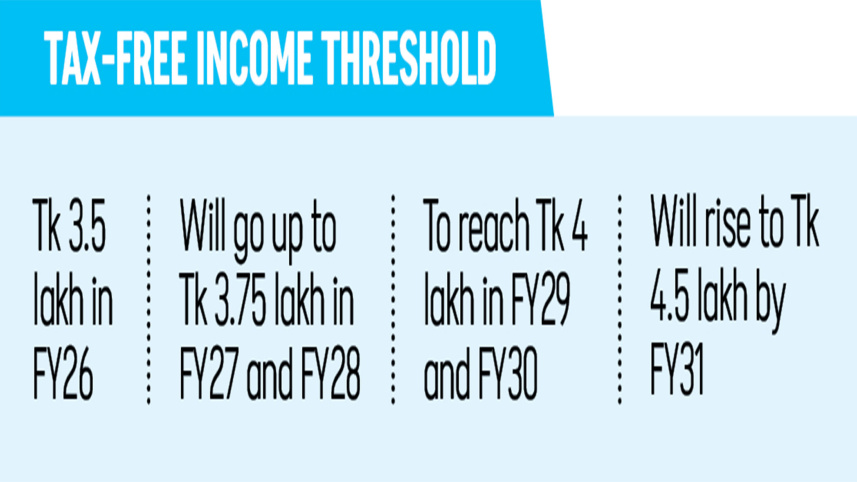
The government is likely to unveil its full-term tax plan on June 11, outlining income tax-free limits and tax rates for individual taxpayers up to the fiscal year 2030-31 (FY31), the final year of its tenure.
Under the plan, the tax-free income threshold is expected to gradually rise to Tk 4.5 lakh by FY31 in an effort to ease pressure on taxpayers amid persistently high inflation.
 For all latest news, follow The Daily Star's Google News channel.
 At present, individuals can earn up to Tk 3.5 lakh a year without paying income tax. This limit is set to increase to Tk 3.75 lakh in FY28 under the interim government’s earlier two-year tax framework.
Finance Minister Amir Khosru Mahmud Chowdhury is expected to go further in his first national budget on June 11 by introducing a broader three-year predictable tax system running through FY31.
Under the proposed roadmap, the tax-free income threshold will rise to Tk 4 lakh from FY29 and remain unchanged through FY30.
Prime Minister Tarique Rahman approved the proposal in principle on May 14 during a high-level meeting at the Secretariat, according to finance ministry officials who attended the meeting.
“The government wants to introduce a predictable tax plan so that taxpayers can set their financial plans accordingly,” a senior finance ministry official said, adding that the higher threshold would offer modest relief to lower-income earners.
However, economists and tax analysts have questioned whether the planned increases are sufficient given persistently high inflation.
“One positive aspect is that the government is providing predictability in tax policy. At the same time, it is making some adjustments for inflation, although we need to assess whether the increase fully matches inflation in percentage terms,” said Towfiqul Islam Khan of the Centre for Policy Dialogue.
Others argue that deeper structural issues remain.
“While policymakers understand the political economy needs to raise the tax-free threshold, they are also constrained by institutional pressure to boost revenue collection. Ultimately, that consideration appears to be driving their decisions,” Khan said.
“This is precisely why we have argued for separating tax policy from tax administration and revenue collection,” he added.
Inflation has remained around 9 percent since March 2023, significantly eroding real incomes. In April, inflation stood at 9.04 percent, according to the Bangladesh Bureau of Statistics.
Amid rising living costs, economists and business groups have repeatedly called for a higher tax-free income threshold, with many proposing an increase to Tk 5 lakh.
“Globally, setting tax rates in advance helps with planning, but international best practice usually limits this to a two- or three-year window, along with an automatic inflation adjustment mechanism,” said tax policy analyst Snehasish Barua.
He warned that extending fixed tax brackets until FY31 could create structural distortions in the tax system.
“Locking in fixed tax brackets until 2031 means that as prices rise, people will be pushed into higher tax brackets without any real increase in their purchasing power or wealth,” said Barua, managing director of SMAC Advisory Services.
He also expressed concerns about fairness, saying that partial adjustments could disproportionately affect middle-income earners. “Global tax standards also emphasise vertical equity. If only the initial tax-free threshold is raised while higher slabs remain unchanged, it creates an unfair ‘middle-class squeeze’,” he said.
Barua added that predictability should be balanced with flexibility, arguing that “long-term fiscal certainty must be paired with proportional, inflation-linked adjustments across all income slabs, rather than rigidly fixed rates stretching to 2030–31,” to align with global norms.
Comments