


BTRC plans to relaunch NEIR on Jan 1
The Bangladesh Telecommunication Regulatory Commission (BTRC) has decided to relaunch the National Equipment Identity Register (NEIR) on January 1, 2027, with a feature to block illegal handsets brought into the country after the launch.
This is the telecom regulator’s third attempt to make the handset-tracking system fully operational since its trial began in 2021.

NEIR is a centralised government database used by telecom networks to verify mobile devices’ international mobile equipment identity (IMEI) numbers and block illegal or stolen phones.
The BTRC made the decision at its latest commission meeting last week, following a recommendation from the home ministry, according to the meeting minutes.
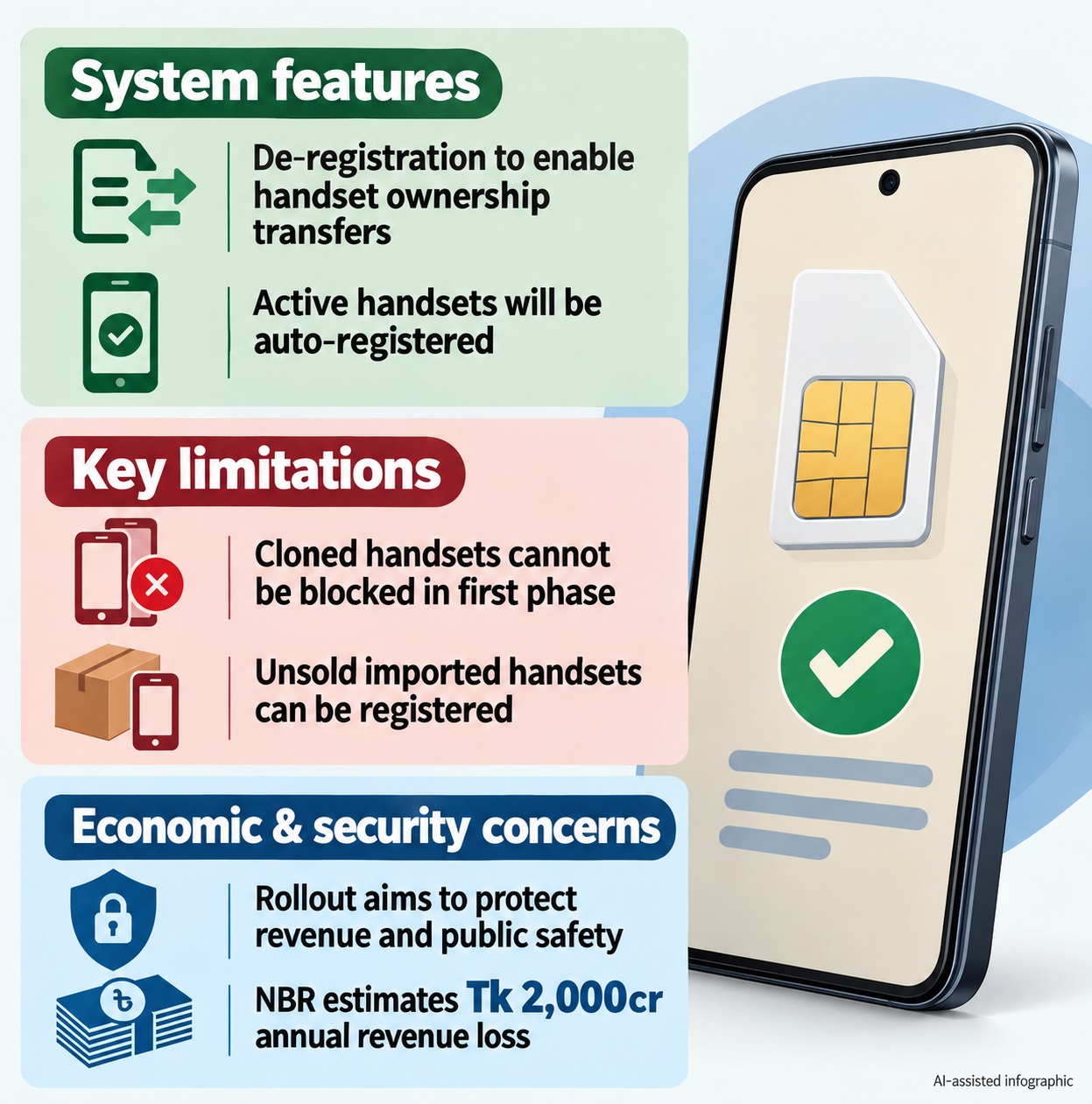
NEIR will be rolled out in two phases. The first, beginning on January 1, will include all the system’s originally designed features except de-registration.
The BTRC will seek prior government approval through the Posts and Telecommunications Division to introduce de-registration in the second phase, for which no date has been set. The feature will be introduced once approval is obtained.
The first phase will enable authorities to identify illegally produced and imported handsets and prevent the sale and use of phones brought into the country by evading duties.
De-registration would allow handset ownership to be transferred between users in the system, linking each device to its genuine or latest owner. The feature is planned for the second phase.
However, the BTRC meeting minutes acknowledge that the first phase will not be able to block cloned handsets, which are often used in criminal activities.
All handsets currently active on mobile operators’ networks will automatically be registered with NEIR. Importers will also be able to enter the IMEI numbers and other details of handsets they have already imported but have yet to sell or still hold in stock, according to the documents.
The Posts and Telecommunications Division and National Security Intelligence (NSI) have also called for a full rollout of NEIR, citing economic and public-safety concerns.
A home ministry meeting also identified weaknesses in mobile phone IMEI and SIM registration, alongside the misuse of mobile financial services, as concerns and proposed launching NEIR, according to the documents.
The latest decision follows two earlier attempts to make the system fully operational.
NEIR began a trial on July 1, 2021, but continued to operate without features to automatically shut down illegally imported handsets or block cloned devices. The BTRC said this undermined the system’s main objectives.
On October 29, 2024, the NBR wrote to the BTRC seeking a full relaunch, citing annual revenue losses of Tk 2,000 crore. The Posts and Telecommunications Division approved the BTRC’s proposal on June 28, 2025, and a meeting at the division on December 1 that year decided on a full launch.
The BTRC subsequently prepared to launch NEIR with all its features on January 1, 2026.
However, the plan triggered strong protests from unofficial mobile phone sellers, who began staging demonstrations in December 2025.
The BTRC later launched NEIR without the key feature of blocking illegal handsets, citing the upcoming national parliamentary election.
The NSI renewed its call for a full NEIR rollout in a letter dated June 9, 2026, citing economic and public-security concerns. A home ministry meeting chaired by its senior secretary on July 2 also proposed launching the system.
On September 22, a meeting chaired by the home minister recommended launching NEIR by January 1, 2027. The BTRC subsequently approved the two-phase rollout at its latest meeting.
 For all latest news, follow The Daily Star's Google News channel.
 The BTRC said at least two months of publicity would be needed to inform consumers about NEIR, leaving the authorities around three months between the September 28 decision and the January 1 target.
Emdad-Ul-Bari, chairman of the BTRC, said all handsets brought into Bangladesh after the system’s launch would be blocked under the current mechanism.
He said the status of handsets already in use could be corrected in phases without affecting consumers’ existing devices.
Comments