


Handset industry squeezed on multiple fronts
Bangladesh’s local mobile handset industry is under fresh pressure from rising prices of memory components, adding to longstanding problems such as grey-market competition, weak factory utilisation and uncertainty over regulatory enforcement.
Prices of key smartphone components, particularly RAM and ROM, have risen sharply this year, raising production costs for local manufacturers and threatening to make budget smartphones more expensive.

At the same time, local handset production is declining as manufacturers struggle to compete with unofficial imports and operate their factories at full capacity.
Industry players say effective enforcement of the National Equipment Identity Register (NEIR), along with stable tax and regulatory policies, is crucial to restoring competitiveness.
“The biggest challenge today is the global surge in component costs,” said Ziauddin Chowdhury, country general manager of Xiaomi Technologies Bangladesh. He said rising memory-chip prices, driven partly by the rapid expansion of artificial intelligence technologies, were putting “significant pressure on the affordability of entry-level and budget segments”.
Gartner estimates that combined DRAM and solid-state drive prices could rise 130 percent by the end of 2026 from 2025 levels, potentially increasing smartphone prices by 13 percent.
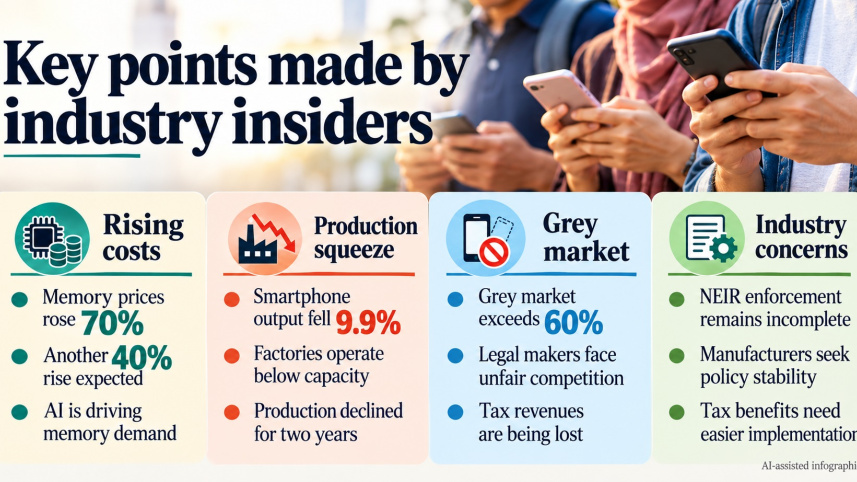
Rezwanul Hoque, CEO of Ismartu Technology BD Ltd, said memory prices had risen 70 percent since January and could climb another 40 percent over the next three months.
Jakaria Shahid, president at the Mobile Phone Industry Owners’ Association of Bangladesh (MIOB), said global memory supplies were very tight, pushing up prices in the unofficial market as well.
The higher component costs come as local production is already losing momentum.
BTRC data show smartphone production fell 9.9 percent year-on-year to 53.76 lakh units in January-August 2026 from 59.66 lakh a year earlier. Feature-phone production dropped 9.6 percent to 85.66 lakh units from 94.73 lakh.
Local manufacturers produced about 2.44 crore handsets in 2025, down from roughly 2.73 crore in 2024.
The Daily Star spoke to half a dozen manufacturers’ officials, who said their factories were operating at less than half capacity. One manufacturer with more than 10 production lines has half of them idle, while monthly output has fallen to around 100,000 units from a capacity of 300,000.
GREY MARKET UNDERMINES LOCAL INDUSTRY
Industry estimates suggest the grey market accounts for more than 60 percent of handset sales, putting local manufacturers at a disadvantage and reducing government tax revenue.
Mohammad Saifuddin Khan, director of operations at Excel Telecom, which manufactures Samsung handsets in Bangladesh, said legal manufacturers were being forced to compete with products that did not bear the same tax and regulatory costs.
The National Equipment Identity Register (NEIR), which uses handsets’ IMEI numbers to identify unauthorised, cloned and illegally imported devices, began enforcement on January 1 this year.
Manufacturers say effective NEIR enforcement could redirect demand towards official channels and help local factories operate at higher capacity.
However, the feature of NEIR that could block such illegal phones has not yet become fully operational. Meanwhile, the rollout has also faced resistance from mobile-phone traders.
Rehan Asif Asad, adviser to the prime minister on posts, telecommunications and ICT, has said the government wants to strengthen the electronics manufacturing ecosystem while ensuring that consumers, retailers and manufacturers are not adversely affected.
SCALE REMAINS A CHALLENGE
 For all latest news, follow The Daily Star's Google News channel.
 Bangladesh’s handset manufacturers remain heavily dependent on imported components, including memory, processors and displays, leaving them with limited control over production costs.
“The major 60 to 70 percent portion of the component cost is controlled by a handful of three or four companies,” said Saifuddin.
More than half of Bangladesh’s smartphone market is concentrated in the Tk 15,000-Tk 20,000 range, according to industry estimates, making higher component prices particularly significant for consumers.
Manufacturers say higher production volumes could reduce per-unit costs by spreading fixed expenses across more units. But weak demand and grey-market competition have made it difficult to achieve the scale needed to improve efficiency and factory utilisation.
Fair Electronics, whic used to manufacture mobile phones, plans to resume handset production in the second half of this year.
Mohammed Mesbah Uddin, CMO of Fair Group, said the company would initially produce selected models. They did not expect to immediately return to its previous scale of around 15 lakh handsets a year -- which they used to make back in 203, when its mobile operation employed 2,000-2,500 people.
POLICY STABILITY SOUGHT
Manufacturers are also seeking greater certainty over taxes, duties and incentives.
The handset manufacturing sector expanded after tax incentives were introduced in fiscal 2017-18, with around 17 factories established since then. However, industry players say changes in taxes and duties have increased uncertainty over investment.
The government has recently taken steps to reduce production costs. In the FY2026-27 budget, it reduced advance income tax on imports of 22 raw materials used in local mobile-phone manufacturing to 1 percent. Existing duty exemptions on raw materials and components, along with conditional VAT exemptions, were extended until June 2030.
Ziauddin welcomed the extension but stressed the importance of policy continuity.
“Incentives attract investment, but it is policy stability that retains it,” he said, arguing that major policies supporting the industry should ideally have a minimum five-year horizon.
Manufacturers say effective implementation is equally important, as bureaucratic complexities sometimes prevent them from fully benefiting from government measures.
Comments