


When numbers don't add up: Understanding dyscalculia
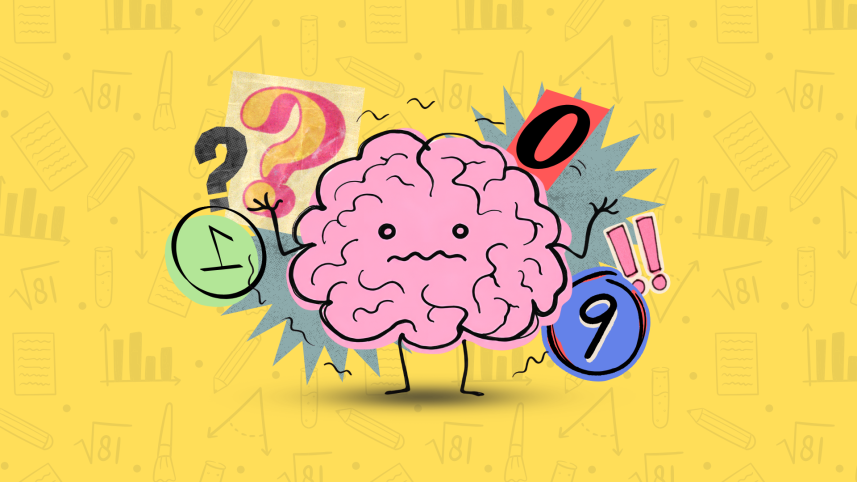
Imagine sitting in maths class, staring at a problem everyone else seems to breeze through. You've read it five times. You understand the words. But the numbers just won't cooperate. You count on your fingers under the desk, get the wrong answer anyway, and feel heat rise to your face as your classmate finishes in thirty seconds. Does that sound familiar? For some students, this isn't just a bad day—it's every day. And there's a name for it: dyscalculia.
Dyscalculia is a specific learning disability that affects a person's ability to understand numbers and perform arithmetic. It isn't about being bad at maths or not trying hard enough. Like dyslexia affects reading, dyscalculia affects how the brain processes numerical information and it has nothing to do with general intelligence.

The condition is more common than most people realise. Research shows that the prevalence of developmental dyscalculia in the school population ranges from three to six percent, a frequency similar to that of dyslexia and ADHD. That means in a class of 30 students, one or two are likely living with it right now.
Dyscalculia isn't a choice or a habit: It's rooted in neuroscience. Mathematical learning deficits are defined as a neurodevelopmental disorder in the International Classification of Diseases. Brain imaging research has traced the condition to the intraparietal sulcus, a region of the brain involved in processing quantities and numbers. Current neuroscience theories suggest dyscalculia may originate from impaired magnitude representation in this region, or from impaired connections between number symbols and that representation.
Importantly, research also points to broader cognitive effects. Studies have found that the dominant features of developmental dyscalculia include visuo-spatial working memory, visuo-spatial short-term memory, and inhibitory function impairment. In other words, dyscalculia can make it harder to hold numbers in mind, visualise spatial relationships, and block out irrelevant information while solving a problem.
Dyscalculia can look different from person to person. Common signs include: Difficulty remembering basic number facts like multiplication tables even with repeated practice, struggling to tell the time, handling money or estimating distances, losing track of steps in multi-stage calculations, trouble understanding the size of numbers (why 1,000 feels no different from 10,000), and taking much longer than peers to complete maths tasks among others.
Dyscalculia doesn't clock out when school ends, either. Adults with the condition report difficulties with everyday tasks, such as estimating how long something will take, managing a budget, calculating a tip on a restaurant bill, or understanding medical dosage instructions. Research has linked persistent dyscalculia to impacts on career choices, income, and even confidence in making healthcare decisions. In short: It's a real-life challenge, not just an academic one.
Perhaps the hardest part of dyscalculia isn't the maths itself—it's being misunderstood. Many people with dyscalculia spend years being told they're lazy, careless, or "just not a numbers person", before anyone realises there's a neurological reason for their struggle. This can take a serious toll on self-esteem. Studies note that people with dyscalculia are often acutely aware of their difficulties, and this awareness frequently leads to anxiety, avoidance, and withdrawal from academic and social situations.
Though dyscalculia is a lifelong condition, it is very manageable with the right support. There is ongoing debate about the exact nature and frequency of developmental dyscalculia, but research continues to examine atypical brain structure and function, leading to better interventions over time. Recent clinical trials have explored combining cognitive training with neurological techniques to improve outcomes. One 2025 randomised controlled trial found that targeting higher-order cognitive processes could partially remediate developmental dyscalculia in adolescents, with improvements in numerical facts, mental calculation speed, and accuracy.
Practical support strategies – such as using visual aids, calculators, extra time on tests, and breaking problems into smaller steps – can make a significant difference. The key is early identification.
Dyscalculia is significantly underdiagnosed compared to dyslexia, despite being equally prevalent, because of how normalised maths struggles are. Many spend years believing they are simply "not maths people", but recognising it as a legitimate learning difference shifts the conversation from shame to support.
Understanding dyscalculia reminds us that learning is not one-size-fits-all. Some minds grasp stories easily, others see patterns in numbers, and some need different pathways to reach the same understanding. It doesn't make you less capable—it might just mean your brain needs a different key to open the same door.
References:
- Eur Child Adolesc Psychiatry. (2000). Developmental dyscalculia: prevalence and prognosis.
- Children. (2024). Developmental dyscalculia in relation to individual differences in mathematical abilities.
- Cortex. Developmental dyscalculia is related to visuo-spatial memory and inhibition impairment.
- Kuhl, U., Sobotta, S., Legascreen Consortium, Skeide, M. A. (2021). Mathematical learning deficits originate in early childhood from atypical development of a frontoparietal brain network.
- Vigna, G., Ghidoni, E., Burgio, F., Danesin, L., Angelini, D., Benavides-Varela, S., Semenza, C. (2022). Dyscalculia in early adulthood: Implications for numerical activities of daily living.
- Zotti, L., Quadrana, L., Conte, G., Sbardella, E., Dawe, J., Di Garbo, A., Pezzuti, L., & Oliveri, M. (2026). Boosting executive functions and math abilities in adolescents with dyscalculia: the combined effect of prismatic adaptation and cognitive training.
Nuzhat is a compulsive doodler and connoisseur of bad early aughts television. Send her recommendations at nuzhat.tahiya@gmail.com
 For all latest news, follow The Daily Star's Google News channel.
Comments