


I have one mantra in life, take it easy: James on his birthday


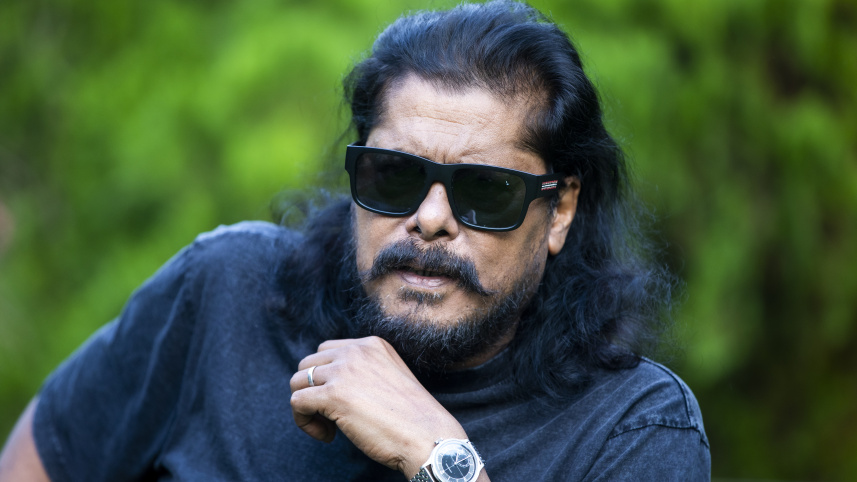
He never personally celebrates his birthday on a grandiose scale. It is mostly his fans and well-wishers who usually commemorate the ‘guru’ of Bangla rock – Mahfuz Anam James.
On Thursday afternoon, the last working day of the week, the fabled “Nagar Baul” spent the afternoon before his birthday in a quiet place away from the traffic jams and bustle of this city.

Upon arriving at a club at Purbachal, we stumbled upon James wearing his signature black Burberry sunglasses, a Longines Heritage watch on his wrist, ash-coloured shoes, a light black T-shirt, and olive-coloured trousers. He looked quite cheerful and shook hands with everyone present.

“I don’t see any difference between myself and 80s James,” the rockstar jested. “Only that there is a bit less hair on my head than before—nothing else besides that.”
When he stepped out of the small conference room to take photos in the light of the setting sun, standing in the garden, he asked how he looked.
Almost instinctually, he asked us to stop taking photos. Everyone was a bit startled -- did “Guru” get offended? No, he had a smile on his face; he was seen twirling his moustache with his hand. He said, “Give me a moment, let me twirl my moustache.”
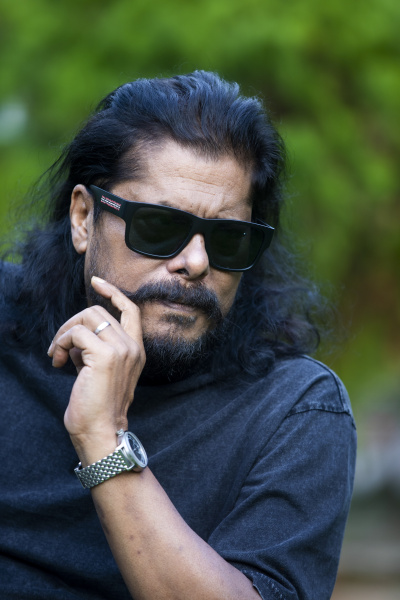
We asked, “You are the creator of countless popular songs. What was your mantra?” When asked this, James said, “It didn’t happen after much deliberation or planning. I always stay in the moment and go where the music takes me. Nothing creative comes out of forcing it.”
He never thought about song arrangements in a complex way either. In his own words, “I first create a basic frame for a song. Then, as it gradually undergoes changes, it becomes complete.”
“I try to keep the frame ‘loose’ rather than keeping a song as something solid or rigid, so that it can be changed if necessary while keeping the core concept intact,” he said.
He answered many questions from journalists, but only became emotional when asked about the late Ayub Bachchu. “I miss the time spent with AB very much. Starting a conversation with him was like opening a book – you would never know how time would pass. He was a very chatty and fun person.”
“I miss this man all the time. Sometimes I get very angry with Bachchu Bhai for leaving like this suddenly without any reason,” reminisced James. Mentioning a final telephone conversation with Ayub Bachchu, James still kept it to himself, as if he wanted to keep that conversation private in his own heart.
The guru also wholeheartedly reminisced about the late legendary poet Shamsur Rahman. His magnum opus, “Taray Taray Rotiye Debo”, escalated James’ rise to a household name when it was converted into a song. James shared that poet Shamsur Rahman had written several more songs for him, but ultimately it was not possible to tune or record them.
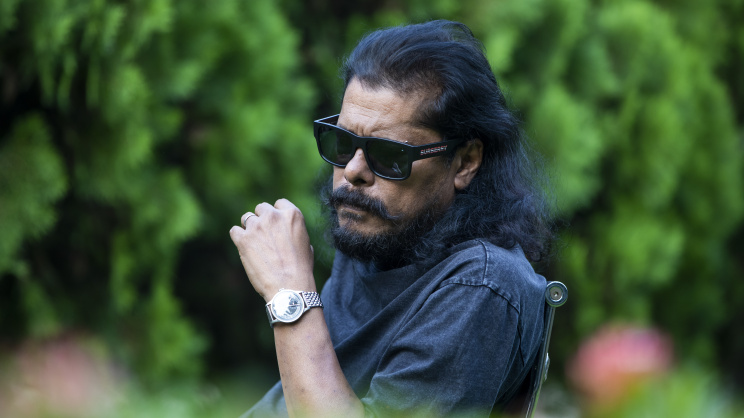
Niloy Das and Lucky Akhand were also gracefully remembered at the small, tight-knit meeting. “Back then, we used to meet musicians regularly in the studio. In a relaxed studio environment, chatting with musicians and exchanging thoughts about various aspects of music had a special importance,” said James, recalling the 80s.
“There was a good culture there -- we used to go to the studio during each other’s recordings. Bachchu Bhai used to come during my recording, and I used to go during Bachchu Bhai’s recording. But nowadays that studio culture has vanished. Everyone has created home studios with laptops and closed themselves off.”
When asked where the new era’s music industry is heading or how the new musicians are doing, he seemed precarious about the industry’s future – but not because of the lack of talent.
“With all the songs that have been conceived so far, even if no new ones are created, people can easily listen to them for the next 20 years. And now, since music has moved to streaming platforms, it has become very easily accessible.”
However, the artiste views this matter as a double-edged sword. “People lose attraction towards what is available for free. People don’t even have the patience to listen to an entire track anymore.”
“Change has to be accepted -- AI is now writing code by itself, so the need for separate coders is decreasing. But even if an art form is on the verge of disappearing, it often survives due to love and passion.”
He continued speaking about passion. “Whatever is done must be done purely out of passion and love. Music cannot be made with thoughts of profit. If something comes naturally, that’s good, but if you start a craft expecting profit, you will be disappointed,” James said.
He feels that the current generation of musicians is talented and passionate. James said, “Now is the age of AI. If young musicians can utilise AI or new technology to create beautiful work, they should definitely do it. There is nothing wrong with accepting any good new technology.”
 For all latest news, follow The Daily Star's Google News channel.
 “Songs are created for people to hear and sing. People will sing wherever they want -- in markets, at river ghats. No one should obstruct this. Culture is like a river -- it should be allowed to flow at its own pace,” James said.
After answering a multitude of questions for about 20 minutes to satisfy everyone’s curiosity, he brought up the topic of refreshments – arrangements were made in the adjacent room. He entered there with everyone and sat down to have snacks. He looked around to check if everyone who was with him managed to get a seat.
On this day, it was as if “Guru” was sitting there with a basket full of thoughts from his heart, ready to share everything.
So how does Bangladesh’s most decorated rockstar view life? James’s simple answer: “Take it easy.”

Regarding the duties and responsibilities of an artiste, his opinion is that if someone wants to talk about social inconsistencies, they can -- that will come from individual awareness. “I am an entertainer; I didn’t come to change society, I came to bring joy to people,” was the Guru’s straightforward reply.
He further added, “Instead of aiming for such big thoughts as doing good for everyone, if each person tries to do good for themselves and the people around them, then automatically, society will benefit.”
His life is entirely a joy. In James’s words, he has no regrets or calculations about what he got or didn’t get in life. “I have never thought about unfulfilled desires.”
Around 5:30pm, he wanted to leave; everyone bid farewell to the beloved Nagar Baul one by one with birthday wishes. While getting into the car, he looked at everyone, smiled, and said, Bhalo thakish. (Stay well.)
Comments