


The Worker at the End of the Supply Chain
Globalization has a habit of making people disappear.
We see the container ship, but not the hands that packed the box. We see the global brand, but rarely the worker who stitched the shirt. We celebrate exports, foreign investment and integration into world markets, while the human being at the far end of the supply chain is often reduced to a statistic.

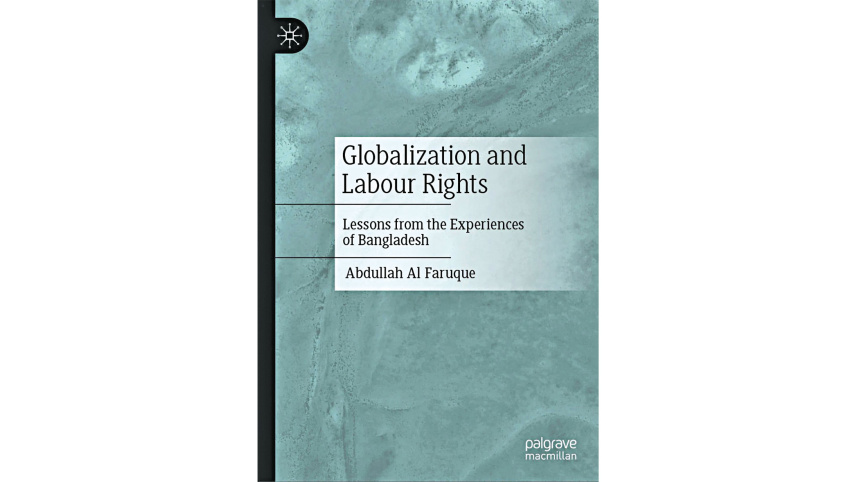
Abdullah Al Faruque’s Globalization and Labour Rights: Lessons from the Experiences of Bangladesh attempts to reverse this disappearance. The book begins with a deceptively simple premise: globalization is not merely an economic phenomenon. It is also a story about power, law and work. As capital, technology and production cross borders, the boundaries of the workplace and the nation-state become increasingly porous. For workers, this can mean opportunity and insecurity at the same time-new jobs alongside precarious employment, and greater participation in the global economy alongside diminished bargaining power.
Bangladesh’s ready-made garment industry provides the clearest window into this dilemma. The sector has become one of the country’s defining links with the global economy, creating employment on a vast scale and transforming the lives of millions, particularly women. But its success has also exposed the fault lines of global production: low wages, long hours, unsafe workplaces and restrictions on labour rights.
For Bangladesh, few questions are more consequential. Over several decades, Bangladesh has moved deeply into the global economy through trade liberalisation, foreign investment and export-oriented production. This transformation has generated employment and increased women’s participation in paid work. Yet it has also brought informalisation, insecure employment and new forms of vulnerability. Dr. Faruque wisely avoids presenting globalization as either salvation or catastrophe. Its consequences, he argues, depend substantially on the institutions that govern it.
That refusal to offer an easy verdict is one of the book’s principal virtues. Across 12 chapters, the author examines industrial relations, labour-law institutions, export processing zones, trade unions, collective bargaining, minimum wages, dispute settlement, international labour standards, social dialogue, post-Rana Plaza initiatives and migrant workers. The subjects are diverse, but they converge on one question: how can workers exercise meaningful rights when the economic forces shaping their working lives increasingly operate beyond national borders?
Bangladesh’s ready-made garment industry provides the clearest window into this dilemma. The sector has become one of the country’s defining links with the global economy, creating employment on a vast scale and transforming the lives of millions, particularly women. But its success has also exposed the fault lines of global production: low wages, long hours, unsafe workplaces and restrictions on labour rights. The garments sold in affluent markets may travel thousands of miles from factories where workers have little influence over the price, timetable or conditions of production.
Dr. Faruque’s discussion of global supply chains is especially revealing because it exposes the geography of value. Bangladesh largely occupies the lower-value stages of production-cutting, making, trimming and shipping-while design, branding, logistics and retail intelligence tend to sit elsewhere. The supply chain is therefore global not only in distance but also in power.
This is where the book moves beyond conventional labour-law analysis. The traditional model-state, employer, worker and union operating within a national framework-has been unsettled by multinational corporations, international buyers, private compliance schemes, transnational unions and multi-stakeholder organisations. Labour governance is no longer confined neatly within national borders.
The Rana Plaza disaster remains the darkest symbol of this transformation. In 2013, the collapse of Rana Plaza killed more than 1,000 workers and forced the world to confront the human foundations of an industry whose products were sold far beyond Bangladesh. In its aftermath came initiatives including the Accord and the Alliance, alongside wider efforts to improve factory safety and supply-chain governance. Dr. Faruque examines these developments as experiments in transnational and private regulation, raising a larger question: who should bear responsibility for labour conditions when a supply chain stretches across continents?
Yet the book does not confine the labour question to the garment factory. One of its important insights is that the most vulnerable worker may be the one who never enters the formal workplace. Informal employment dominates Bangladesh’s labour market, according to the figures cited in the book, leaving a huge proportion of workers outside the effective reach of formal employment protections. Such workers may lack secure wages, fixed hours, paid leave, occupational safety and meaningful representation.
The emerging gig economy adds another layer of uncertainty. Digital platforms, freelancing, ride-sharing and delivery services may offer flexibility, but they raise familiar questions in new forms: Who is the employer? Who bears responsibility for social security? What constitutes a fair wage when the worker is technically independent? The technology may be new; the struggle over power and protection is not.
Trade unions consequently occupy an uneasy place in this landscape. Globalisation can weaken unions by fragmenting production and employment, encouraging subcontracting and eroding the standard employment relationship. Yet it can also create possibilities for transnational worker solidarity. If capital can organise across borders, labour may increasingly need to learn to do the same.
The discussion of international labour standards adds another layer. Bangladesh has ratified most of the ILO’s core conventions, and many international principles have found recognition in domestic law. Yet the distance between legal recognition and everyday enforcement remains substantial. Informality, weak enforcement, inadequate resources and precarious employment complicate the translation of rights from paper into practice.
Dr. Faruque’s treatment of human rights due diligence gives the book a particularly contemporary edge. Developments in the UK, France, Australia and Germany, as well as the European Union, increasingly require companies to identify, prevent and address human-rights risks in their supply chains. For Bangladeshi exporters, compliance is therefore becoming more than a voluntary exercise in corporate responsibility; it is increasingly part of a wider regulatory expectation.
The book’s breadth is both its strength and, occasionally, its limitation. Its wide-ranging treatment means that some subjects receive more conceptual than empirical attention. Yet that breadth is also what makes the work valuable. Labour law does not exist in a vacuum. Workers’ rights are shaped by trade policy, corporate structures, migration regimes, technology, union strength and the ability of public institutions to enforce the law.
Ultimately, Globalization and Labour Rights is less a verdict on globalization than an invitation to see it differently. The book reminds us that markets do not write labour law; institutions do. Globalization may create jobs and opportunities, but without effective institutions it can also distribute its risks disproportionately to those least able to bear them.
The irony is that the more interconnected the world becomes, the easier it can be to forget the individual worker within the machinery of connection. Dr. Faruque’s achievement is to put that worker back into the picture.
In the end, the book asks a question that reaches far beyond Bangladesh: when the world’s economy becomes global, can justice remain local? Its answer is not simple. But its warning is clear: unless rights travel as far as capital does, the promise of globalization will remain incomplete.
 For all latest news, follow The Daily Star's Google News channel.
Comments