


Why we fear stray dogs when human behaviour poses greater risk

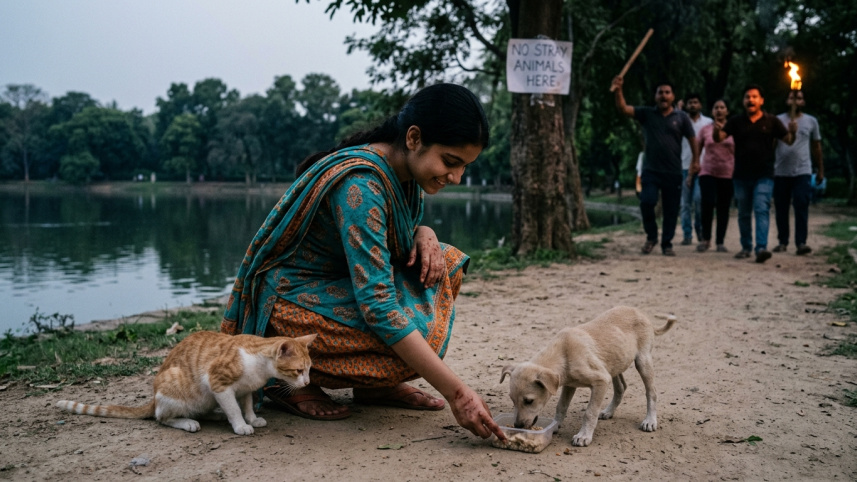
Feeding stray animals in Dhaka is increasingly met with hostility, threats, and physical violence. The recent Banasree attack highlights a troubling shift where human anger poses a far greater threat than street dogs.
According to Sumaiya Rahman, who regularly feeds stray dogs in the area, she went to a lane in Banasree's F Block at around 10PM on Tuesday, as she did on other days. While she was feeding several dogs in front of a clothing shop, she was reportedly asked to move after the animals climbed onto the shop's stairs. Sumaiya alleged that after an exchange of words, a young man punched her in the face. She further alleged that the man gathered between 50 and 60 people, who subsequently assaulted and verbally abused her for around half an hour.

Sumaiya was accompanied by Asif Imtiaz, a small entrepreneur who also feeds dogs in the area. He said that he attempted to seek help from an acquaintance nearby, but eventually returned to take Sumaiya away from the scene. He also expressed concern that he could be assaulted.
The allegations, if established, point to something far more troubling than a disagreement over stray dogs. They raise questions about how quickly a dispute can turn into intimidation and collective aggression.
There are legitimate concerns surrounding stray dogs in a densely populated city like Dhaka. Residents may worry about bites, noise, waste or dogs gathering around shops and homes.
Animal feeders, too, have a responsibility to be mindful of their surroundings and avoid creating unnecessary difficulties for others. But none of these concerns can justify physical assault. A disagreement over where dogs sit, or where someone feeds them, should not become an excuse to threaten someone's safety or treat them with cruelty.
This is where the conversation about coexistence becomes important. Dhaka is a city where people, animals, businesses, and residential communities share the same limited spaces. Disagreements are bound to happen. What matters is how we choose to handle them.
A shopkeeper who does not want dogs gathering at the entrance can ask someone to move to another spot. Someone feeding the dogs can listen and move away. Communities can discuss designated feeding areas and better ways to manage waste. There are practical solutions when people are willing to look for them.
What is harder to understand is how quickly a small disagreement can turn into humiliation, threats, or violence.
We often fear animals because we cannot always predict how they will behave. But humans have something animals do not: the ability to understand the consequences of our actions and choose a different response.
Stray dogs are already part of Dhaka's reality. Their presence comes with real challenges, and those challenges need proper solutions through vaccination, sterilisation, waste management, responsible feeding and public awareness.
But making people afraid to help animals will not solve those problems. Neither will responding to disagreements with aggression.
Perhaps the conversation about stray dogs should also make us look at our own behaviour. A city becomes safer not only when we manage its animals better, but when the people living in it learn to treat one another with a little more restraint.
Because sometimes, the greater danger on the street may not be the stray we are warned about. It may be what happens when humans forget how to behave.
 For all latest news, follow The Daily Star's Google News channel.
Comments