


A visitor’s guide to exploring Old Dhaka’s Armenian heritage

Discovering one of Old Dhaka’s best-kept secrets require knowing exactly where to look behind the bustling market stalls of Armanitola. Use this guide to experience the striking architecture, sacred courtyards, and centuries-old stories of the Armenian Church.
Old Dhaka rarely offers a moment of silence. Its narrow streets are almost permanently in motion, but step inside the Armenian Church compound in Armanitola and the city suddenly feels different. The noise recedes as birds replace horns. White walls edged in gold rise above a quiet courtyard of trees, flowers, and gravestones. At the centre stands the Armenian Apostolic Church of the Holy Resurrection, its dome and cross visible against the Dhaka sky.

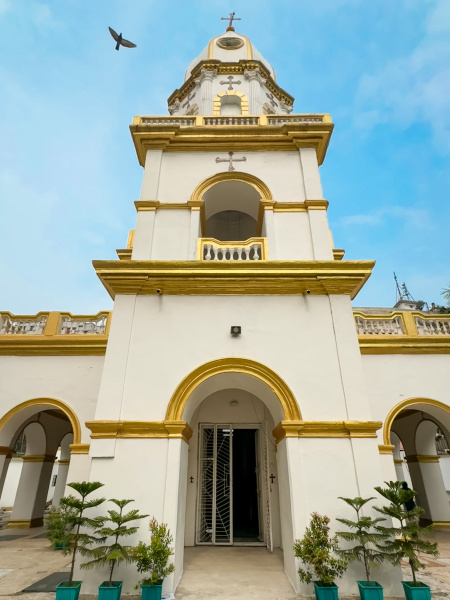
The calm is striking. However, the most interesting thing about this place is not its tranquillity or even its architecture. It is what the church reveals about Dhaka itself!
Long before Armanitola became simply another familiar name on the city's map, an Armenian community lived, traded, worshipped and buried its dead here. Most of that community is gone. Remarkably, much of its physical story is not.
Armenians of Dhaka
Armenian merchants had established themselves in Bengal by the 1600s and became particularly influential in Dhaka's commercial life during the eighteenth and nineteenth centuries. Their trading networks connected Bengal's goods, particularly textiles, with markets beyond the subcontinent.
Their community was never particularly large, but its presence mattered. They became involved in trade, property and civic life. Nicholas Pogose, one of nineteenth-century Dhaka's prominent Armenian figures, founded Pogose School in 1848. The name Armanitola itself carries that history.
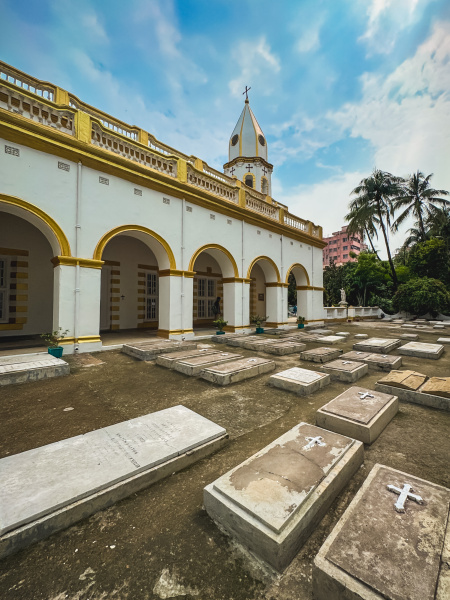
The Church of the Holy Resurrection was built in 1781 on land associated with an Armenian burial ground. More than 350 burials have historically been linked to the site. And today, those graves are impossible to ignore.
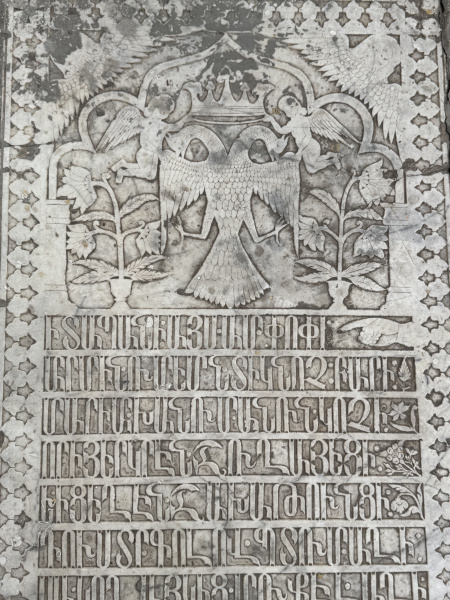
They sit across the churchyard and beneath its covered corridors. Some gravestones are incorporated into the ground itself, so visitors quite literally move through the names and inscriptions of people who lived here generations ago. It makes the compound feel less like a conventional historical attraction and more like a surviving piece of the community itself.
A church that does not overwhelm
Historic churches are often associated with scale and elaborate decoration. This one is different. It is compact, bright and unusually intimate.
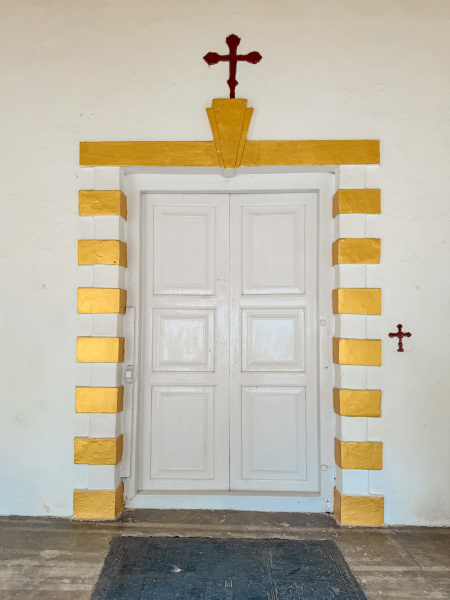
White dominates the building, with gold used around arches, columns and architectural details. The decoration is noticeable without becoming overwhelming. Sunlight against the white surfaces makes the interior feel almost luminous.
Then there are the smaller details.
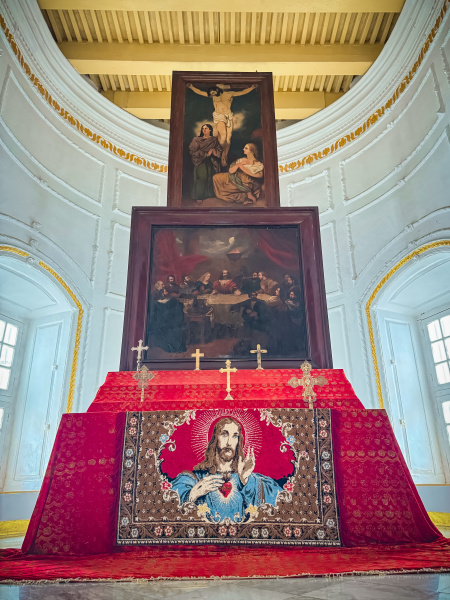
Old wooden furniture sits inside the church. Gold floral patterns run along parts of the interior. Religious paintings and objects occupy the altar. A carved eagle forms part of the Gospel stand, traditionally associated with St John the Evangelist.
Individually, these might seem like minor details. Together, they make the church feel lived-in rather than monumental. There is also something interesting about seeing this architecture in Dhaka. The church belongs unmistakably to an Armenian Christian tradition, but it has existed in Bengal for more than two centuries. Its surroundings, climate and long relationship with the city make it difficult to think of it simply as a foreign object transplanted onto Bangladeshi soil. It has become part of Old Dhaka's landscape.
A piece of Armenia
That connection becomes particularly visible outside the church.
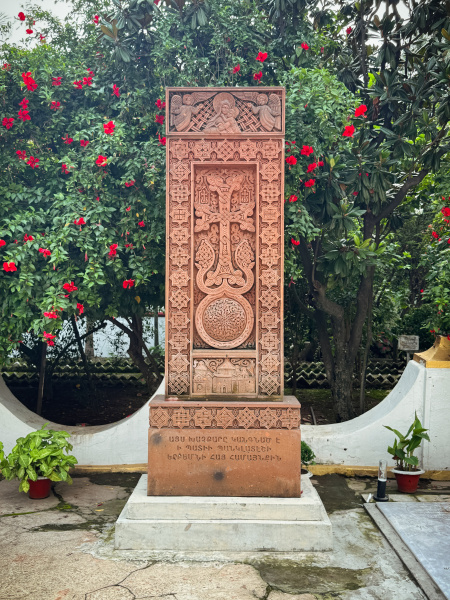
Among the greenery stands a khachkar, or Armenian cross-stone. They are part of a centuries-old Armenian tradition, typically featuring a carved cross surrounded by intricate geometric and botanical patterns. The craftsmanship and symbolism associated with them are recognised by UNESCO as Armenian intangible cultural heritage.
 For all latest news, follow The Daily Star's Google News channel.
 Seeing one surrounded by tropical plants in the middle of Old Dhaka is an unusual sight. But perhaps it shouldn't feel strange.
Cities have always been shaped by people who moved into them. Communities brought languages, religions, food, businesses, craftsmanship and architecture with them. Over time, those influences became part of the cities themselves.
Dhaka is no exception.
The Armenian Church therefore raises an interesting question: when does the heritage of one community become the heritage of an entire city? In this case, the answer seems fairly clear. The church may be Armenian in origin, but its history is also Dhaka's history.
More than preserving an old building
Dhaka changes quickly. Old buildings disappear, neighbourhoods transform and traces of earlier versions of the city become harder to find. Against that reality, the condition of the Armenian Church is remarkable. The compound is clean, maintained and clearly cared for.
But preserving a heritage site involves more than protecting its walls. If people stop knowing why the church exists, who built it or why the surrounding neighbourhood is called Armanitola, something important is still lost.
The building survives, but its meaning begins to disappear. That is why places like the Armenian Church matter. Not because every old building must be romanticised, and not simply because the church is beautiful; it matters because it complicates the story we tell about Dhaka.
The city's history was never created by a single community. Armenians were one of many groups whose lives became intertwined with it, and Armanitola is one of the places where that layered history remains visible.
Outside the compound, Old Dhaka continues at full volume. Inside, the white-and-gold church, gravestones and Armenian cross-stone quietly tell another version of the city. You only have to know what you are looking at.
Comments