


Your parents are getting old and you're running out of time

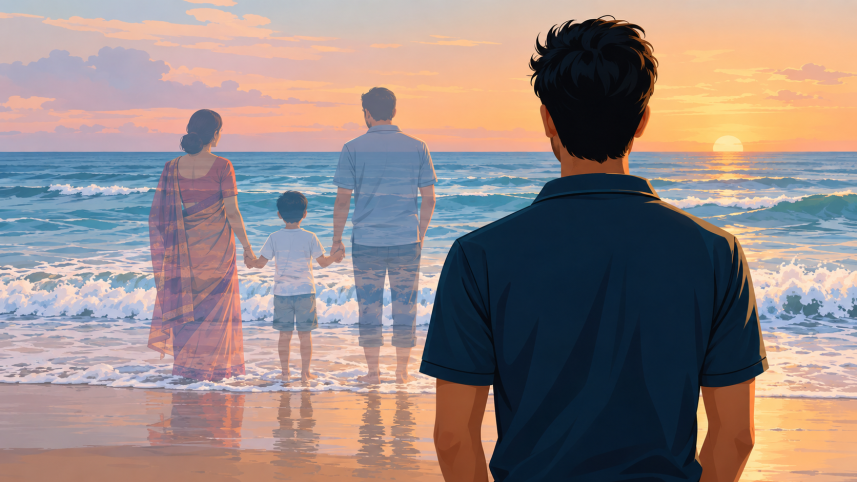
We spend our childhoods believing our parents can walk on water, seeing them as entirely unstoppable. But eventually, the roles quietly reverse, and you realise how short life truly is.
Do you remember being six years old? Back then, the world seemed very different. The words “unstoppable” and “invincible” meant something different in real life — as your mother marches through a rainstorm, your hand in hers, so you don't miss a school day, you realise what unstoppable looks like. When your engineer father takes you to a site he is in charge of, outside Dhaka, and he effortlessly walks up a slope like a skilled mountaineer, while you relegate yourself to all fours just so you don't fall on your back, you see what a dictionary would describe as invincible.


As the years go by, that image of unstoppable and invincible stays rent-free in your mind. The concept of them being anything other than immortal is something you refuse to see. Eventually, that image will break, and you will realise how mortal they are and how short life really is.
Everyone arrives at this realisation one way or another. Mine? When the times I needed the doctor were outnumbered by theirs. Others notice it when they walk with their parents, and realise they have left their once spry parents behind as they struggle to catch up.

Taking over the wheel
Noticing is not the end. This is when the slow, relentless reversal begins. That moment when you stop being the child who needs protecting and become the adult who must protect. And that will feel strange because it’s been your parents who occupied that position for decades. You never imagined it would be your turn.
Gradually, it happens. You translate medical jargon from consultants speaking quickly. You manage medications that multiply each year. You schedule appointments because your parents struggle with phones.
The guilt is relentless. You feel guilty for not talking enough, for Fridays you were too busy, for wanting your own life. But this guilt is based on an impossible standard. The gap between what they need and what you can provide is infinite.

Watching it all unfold
Perhaps the cruellest part is that you are grieving people who are not dead. They are still here, still calling you, still having opinions about your life. Yet, you are mourning them anyway.
For now, you are not grieving death. You are grief-stricken by change. The slow disappearance of the invincible versions of your parents. The ones who had all the answers. The ones who made way for you in the world with certainty. You watch them become slower, smaller, more fragile.
This is anticipatory loss; a combination of worry, sadness, and gratitude twisted into something that is difficult to process or communicate. It's a peculiar form of grief that does not get acknowledged because technically, they are still here.
Something essential is, however, withering anyway. The relationship you always thought you would have. The years you imagined you still had.
The cold hard truth
Somewhere between our 30s and 40s, something shifts in our understanding. We have moved into the place where our parents' generation once stood. And suddenly you understand, viscerally, what it means to be mortal.
We millennials had expectations for certain milestones. Our parents would be there through it all. There would be time for them to watch grandchildren grow. There would be time for conversations we keep putting off. But with every passing day, the reality becomes sharper. Our parents are slower. They tire easily. They talk about wills and property, about how they want to be buried, about a world without them.
You are not prepared for this. No one ever is.

 For all latest news, follow The Daily Star's Google News channel.
 The end of your world
For some, the anticipatory grief is where the story thankfully ends. For others, it moves into darker territory. There is a particular cruelty to losing a parent very few understand.
Your entire world ‘reorganises’ around an absence. One side of your parent’s bed stays empty. Your mother's voice — the one that said "You have to be hungry. I prepped your food for you on the table"— is gone. And you realise that all those moments you rushed through, all those afternoons you were too busy for, those conversations deferred because there would be time later, but there will not be.
Grief becomes complicated by regret. Not the kind that softens with time. The permanent kind.
But parental loss doesn't hit uniformly. It reshapes itself depending on gender and the role that parent held in your life.

For a son, losing a father is losing his teacher and protector. The man who showed him how to navigate the world, how to be strong when everything falls apart. The father is the measure, the standard against which a son judges himself. Losing a mother breaks something deeper. She is the softness in a hard world, the one who loved him unconditionally, the person who would always be on his side.

For a daughter, losing her father means losing the blueprint; her hero in life, and the standard she measured all men against, the first person to show her what she deserved. Losing her mother is losing her one true confidant. A woman who understood her completely, who she could be entirely herself with. Suddenly, there is no one who knew her as a child, who remembers all the versions of her she has been.
But what if life is particularly cruel, and you lose both? Is there anything lonelier than losing the two people responsible for you being you? You become an orphan in a way that feels impossible at 35 or 40. No one above you in the family hierarchy. No one to call when everything falls apart. The people who created you are gone.
You become the elder whether you wanted to or not. You become the keeper of your parents' memory, the one who holds the family together when there's a gaping hole where two people used to be. You are responsible in ways you never were before.
The grief of losing both parents is not twice the grief of losing one. It is the grief of becoming an orphan. It is knowing that you will never again have anyone who loves you simply because you exist.
And beneath that grief is something much harder: the confrontation with your own mortality. Your parents are gone. You have seen how quickly a life can end; how fragile everything is. And you have to figure out how to live with that knowledge.

Living with the reality
The fairytale years are over. Not just for your parents, but for you too. The image that stayed rent-free in your mind for so many years — that unstoppable mother, that invincible father — shatters completely. And in its place is a harder understanding: time is finite. Life is fragile. The people you love will not always be here.
You are the adult now. And you have to figure out how to live with that in a way that doesn't break you.
Comments