


Democratic transition means establishing citizens’ rights, not just holding polls: Ali Riaz
Democratic transition is not merely about holding elections but about establishing citizens’ rights, eminent academic and political scientist Ali Riaz said today, warning that democracy is in retreat worldwide amid a crisis in the post-World War II global order.
“The world order formed after the Second World War has collapsed, with no alternative system emerging,” he said.

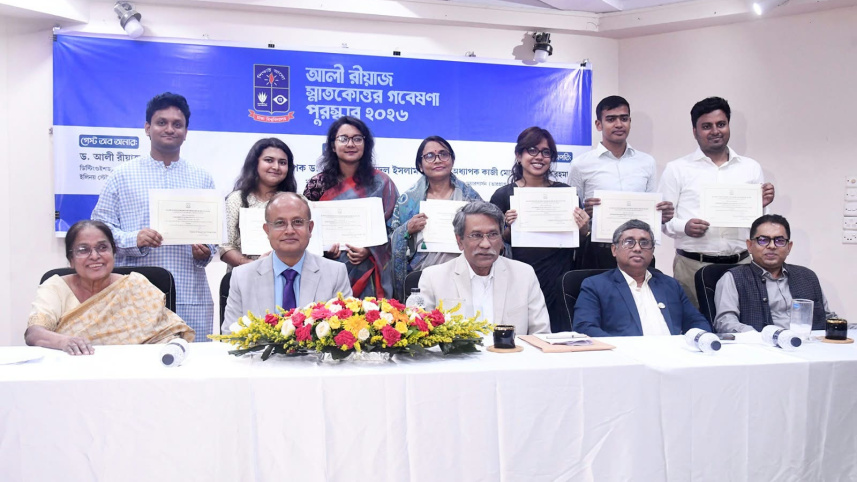
“Democracy has been walking backwards worldwide, with a few exceptions,” he said at the prize-giving ceremony of the Ali Riaz Postgraduate Research Award 2026 at the University of Dhaka’s Muzaffar Ali Chowdhury Auditorium.
The award, instituted through his trust, was given for the second time to students of the Department of Mass Communication and Journalism. Seven students received scholarships and certificates for excellence in research.
He said the global order had shifted from bipolar to unipolar and was now fragmenting in multiple directions, creating an unprecedentedly volatile period.
“We are at a time when more than 60 percent of the world’s population lives under some form of authoritarian rule,” he said, adding that Bangladesh’s youth had made an exception by defeating an authoritarian regime.
However, he cautioned that defeating an authoritarian regime was only the beginning of a longer democratic transition.
“In countries where these democratic movements succeeded, we have seen that they subsequently began to slide backward,” he said, citing the experiences of Tunisia, Madagascar, Sri Lanka and Nepal.
Professor Kazi Mohammad Mahbobor Rahman, dean of the Faculty of Social Sciences, said social mobilisation was necessary before legislative reforms.
He said Bangladesh had introduced legal and structural changes in the past, including a parliamentary system, an independent election commission and a human rights commission, but institutions had ultimately become subservient.
“Excessive preoccupation with politics, government and law will not save society if society itself is not put right,” he said.
University of Dhaka Vice-Chancellor Professor ABM Obaidul Islam called for greater alumni support for the university’s academic development, saying financial constraints had affected several trust funds and scholarships.
The seven award recipients are Aurthy Noboneeta, Farah Jahan Suchi, Usama Rafid, Azra Humayra, Kouritra Poddar Tirtho, Mohammad Al Mukit and Md Muzzammil Haque.
The recipients received scholarships totalling Tk 84,000 along with certificates.
 For all latest news, follow The Daily Star's Google News channel.
Comments