


The predicaments women commuters face on public transportation
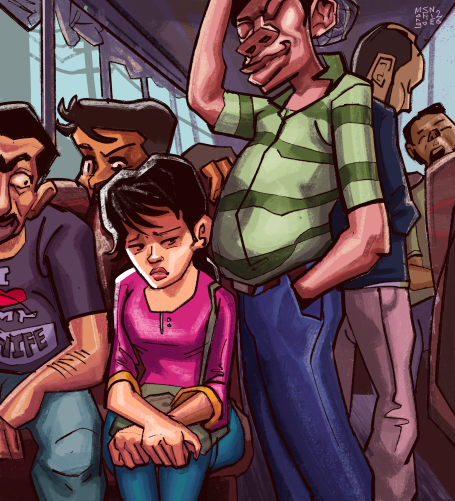
Every morning, women step out of their homes and step onto buses, despite knowing that they are going to be thoroughly tested on how much space they will surrender, how much intrusion they will tolerate, and how long they can remain silent to arrive at their desired destination without protesting.

Research findings paint a grim picture of what women encounter in public transportation systems. A 2024 study carried out by the BRAC James P Grant School of Public Health, BRAC University, as part of a four-year research initiative, found that nearly 79 percent of female commuters have experienced sexual harassment on public transport. Among them, 60 percent feel traumatised, and about one in every six female commuters faces sexual harassment daily.
Despite having to endure such heinous acts, women continue using public transport due to financial constraints as well as reliability concerns regarding other modes of travel.
“For me, the reason is strictly financial. Not everyone can afford CNGs, Uber, private cars, or similar options. I’m just not going to spend that much money on daily commuting,” shares Nusaiba Binte Asad, a young professional from Dhaka.
Jarine Tasnim Ava, an undergraduate student, says that her apprehension about travelling in private rides is the main reason she opts to take local buses: “You hear about these things happening in the news all the time. What if the driver intentionally takes the vehicle to an isolated place? I wouldn’t be able to get out quickly on my own; the door is controlled by the driver. Because of that lingering worry, ‘What if something happens to me one day?’, I put up with the hassle of taking a local bus every day.”
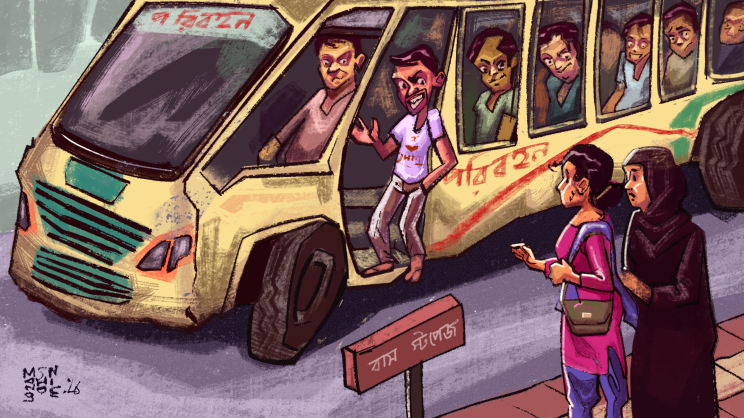
It can start before women even board the bus. As they try to get on, conductors often approach under the guise of assistance, which usually involves a lot of untoward behaviour.
“The conductors make a show of helping you up just to have an excuse to grab you,” Jarine adds.
If women manage to find seats, they often end up folding themselves into as small a space as possible — knees drawn, shoulders hunched, elbows tucked in, as the men beside them spread themselves across seats. Then come the repeated jabs to the side every few seconds, as the men continually shift and readjust themselves.
“Whenever I sit next to a man, he spreads his arms and legs out completely, forcing me to sit awkwardly, squeezed into a tiny corner. Men sit like this all the time,” Nusaiba comments. “And it’s not even because they are large-bodied; they deliberately occupy extra space. Even when I politely ask them to move, they ignore me and pretend not to hear.”
Nusaiba adds that when a woman speaks up, most passengers on the bus fail to support her. “They keep saying, ‘Apa, please be quiet. Leave it. Let it go.’ They are never interested in hearing what actually happened or addressing the problem.”
To rub salt in the wound, if a woman is sitting in an aisle-side seat, as men walk past, they sometimes brush against her or bump into her on purpose. The conductors often do the same, colliding with and leaning against female passengers as they collect fares, and also taking the money with lingering hands.
Hoping for a brief reprieve, women often move to the reserved seating section if a spot becomes available. But these seats are usually on or near the gearbox, forcing women to endure jabs every time the driver shifts gears.
If a woman fails to secure a seat and is left standing, she often has to tolerate men leaning too close to her. Subah Sadika, a master’s student from Dhaka, recalls her experience with male passengers: “They would intentionally touch me or try to brush against me while passing by or standing nearby.”
Her experience is not an isolated incident. Nowshin Anjum, another master’s student, shares, “Honestly, I can’t even count how many times I’ve had to get off the bus after getting into heated arguments. Guys are constantly reaching out, touching you from one side or another. Once, I even had to confront a man and eventually hand him over to the police.”
Bystander apathy only increases Nowshin’s frustration. “Other passengers couldn’t care less. They just say, ‘If you have so many problems as a woman, why do you even board the bus?’ The fact that a man is doing something completely inappropriate doesn’t bother them in the slightest.”
The ordeal does not end until a woman finally steps off the bus. Even getting off the vehicle comes with its own set of risks.
“The narrow aisle meant for passing through is usually packed with standing passengers. If you happen to sit in an inner seat, you have to push past each person to get out, and in that process, there’s a high risk of being harassed,” Nusaiba elaborates. “In that chaos, you don’t even have the chance to protest or confront anyone because you’re in a hurry to get off before the bus moves again.”
When perpetrators perceive that direct contact might have possible consequences, they often resort to staring. It’s easy to dismiss, as there is no visible bruise. But it can cause women to become self-conscious and uncomfortable within their own skin. They may start monitoring and second-guessing themselves — adjusting their posture, clothes, expression, and behaviour. They may also start choosing outfits based on commute safety over their personal preference or professional requirements.
 For all latest news, follow The Daily Star's Google News channel.
 “Even when I wear a hijab and modest clothing, I notice men staring at me, which makes me very uncomfortable. That discomfort of being gawked at is always present,” Nusaiba expresses.
Jarine shares Nusaiba’s sentiments. The constant staring makes her feel so suffocated that the moment she steps onto her university campus, she feels like she can finally breathe again.
Men often occupy these designated seats despite them being reserved for women, children, and people with disabilities.
“Men often sit there and refuse to give them up, making various excuses. We have to argue and fight just to get the nine seats that are clearly marked inside almost every bus,” Nusaiba says. “It’s not due to illiteracy or a lack of awareness — they deliberately choose to ignore it.”
Sometimes, the very people responsible for enforcing the rule cause the situation to escalate.
“To make matters worse, conductors and drivers usually ignore the situation or side with those men. Sometimes, they even claim there are fewer women’s seats, despite the ‘nine seats reserved’ sign being clearly visible,” Nusaiba adds. “When you point it out, they refuse to listen or acknowledge it, making dismissive remarks like, ‘Well, you women sit in men’s seats too,’ and so on.”
Some also claim that the designated seats are the only seats women are allowed to use. “Men seem to believe that those nine seats are the only seats women are allowed to use and the rest are men’s seats and, therefore, belong to them,” Nusaiba continues.
Even when women do manage to get a seat in the designated section, the arrangement itself presents another problem.
“There is no legroom. It isn’t even a proper seating area — it’s often situated literally right over the bus engine. Accommodating nine people there is almost impossible because of the lack of space. Passengers are crammed together, forced to sit shoulder-to-shoulder with one another. We end up trapped in a rigid position without room to move,” Jarine notes.
Both getting in and out of the section can be extremely difficult. “Getting out of that section is an absolute nightmare. Buses only stop for about 10 to 15 seconds, so you don’t have the luxury of asking everyone to move out of your way politely,” Nusaiba shares. “You have to jump off within seconds, and if you’re stuck in there, getting out means forcefully pushing, shoving, and squeezing past people just to step off. One time, my foot got stuck between passengers, and as I forced my way out, my shoe came right off.”
Most of the time, the engine’s right underneath this section, so while sitting, women also have to endure the heat.
“The engine cover gets extremely hot. I honestly preferred standing over sitting on that, but even when I wanted to stand, they wouldn’t let me,” Subah recalls. “They’d make me sit on top of it, and there were times when it actually burnt the skin on my leg.”
Moreover, women are exposed to the largest amount of secondhand cigarette smoke when the driver, helper, or both light up cigarettes.
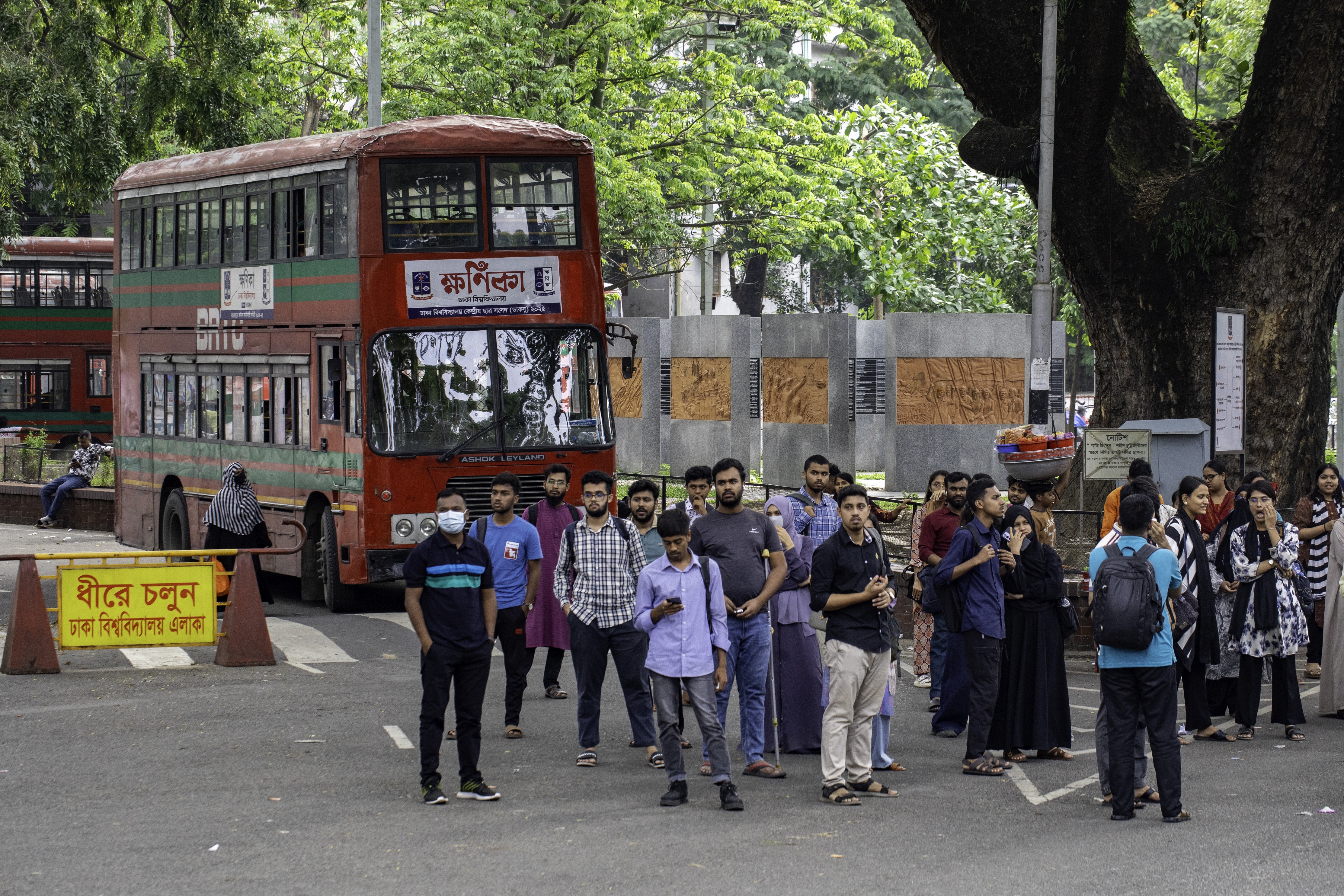
During office hours, as the bus pulls up, men get on immediately. However, women are frequently denied entry outright. Very rarely, they may manage to get on through bargaining and pleading.
“They block the bus entrance with their hands and stand in the way so that we can’t get in,” Jarine states.
Conductors often refuse to let women board once the designated seats are occupied, even when the women are willing to stand.
Nowshin shares, “Their excuse is, ‘No seats left, so we’re not picking up women.’ Did I ask you for a seat? Did I ever tell you I have an issue standing? Why won’t you let me get on the bus? I used to have to force my way onto the bus.”

“What makes it worse is that conductors sometimes let male passengers sit in the reserved seats and then deny entry to female commuters, claiming the women’s section is full,” Nusaiba mentions.
Men’s time is treated as urgent, but women’s as flexible, as though they have nowhere important to be and can afford to stand on the road for another twenty minutes, only to be turned away by yet another bus.
“There is a prevailing mindset that women are riding the bus just for casual outings and don’t have any serious commitments, as if only men have important places to be, while women’s time and work hold no value,” Nusaiba adds.
“I literally heard someone say, ‘Why did you leave your home during office hours? You should commute during off-peak hours when it’s less crowded.’ They said it like it was a completely reasonable thing to say,” Jarine recalls.
While getting on, standing, or getting off, women often find that the handholds are difficult to reach. So, when the driver swerves the bus recklessly, their only option may be to grab the edge of a seat and hold on tightly.
“Getting off the bus is very difficult because there usually isn’t anything to hold onto at my height, and I’ve almost fallen over multiple times,” Jarine continues.
Add it all up, and a single ride becomes exhausting: fighting to board, fighting for a seat, fighting off unwanted hands, and fighting to be heard.
“You have to fight just to board the bus because they won’t let you on. You have to fight for a seat because they won’t let you sit. Once seated, you have to confront men when they nudge or push you. Then you have to argue with the conductor over being overcharged,” Nusaiba reflects. “If you have to fight over every single thing, it becomes overwhelmingly draining. Where are you supposed to find that energy every single day?”
And yet, tomorrow, she must step onto another bus and fight all over again.
References:
- The Daily Star (March 11, 2024). 79% female commuters in Dhaka experience sexual harassment on public transport: research says.
Comments