


Bangladesh’s gas crisis is also a logistics crisis

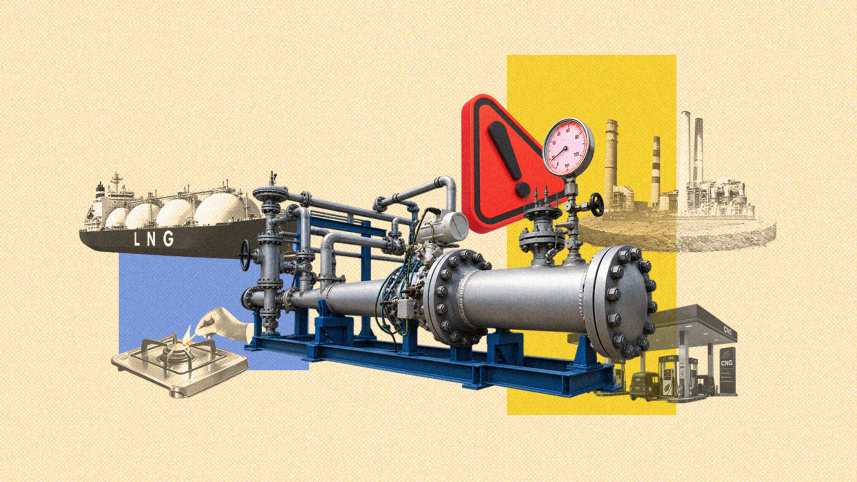
For the past several weeks, the effects of the country’s gas crisis have been felt everywhere: factories struggling with inadequate pressure in supply lines, filling stations facing long queues, households receiving little or no pipeline gas, and power plants unable to generate at their full capacity. In mid-August, the total gas availability was about 2,420 million cubic feet per day (MMcfd) against the national demand of around 3,800 MMcfd.
The usual explanation is that Bangladesh simply does not have enough gas. That is accurate, but it does not tell the whole story. The current disruption reveals something that deserves much greater policy attention: the country does not merely have an energy supply problem but also an energy logistics one.

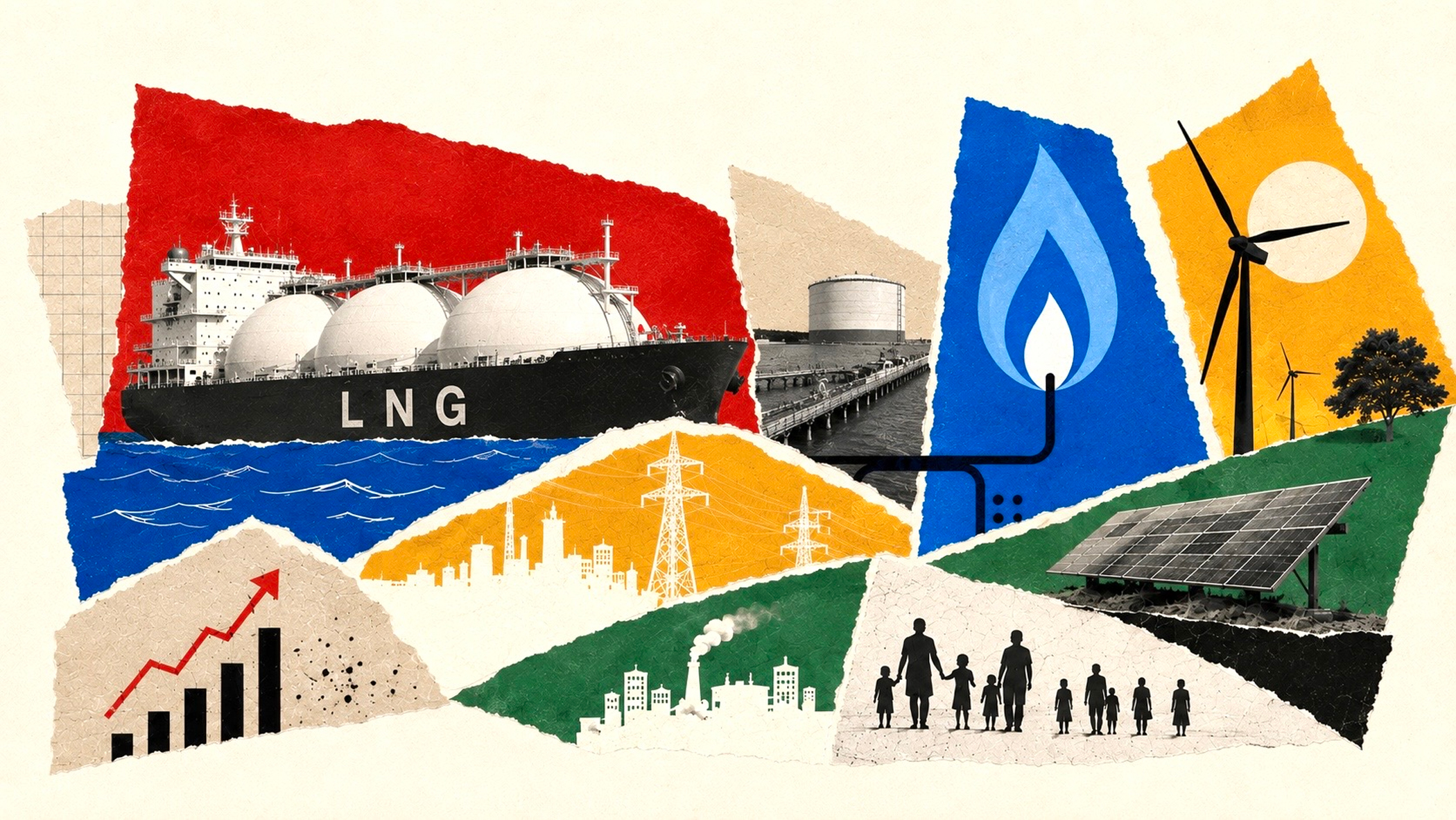
Gas imported as liquefied natural gas (LNG) does not appear in our pipelines when a purchase agreement is signed. It must pass through a long physical chain: procurement, cargo nomination, LNG shipping, vessel scheduling, navigation through the international sea routes, arrival at Moheshkhali, transfer to a floating storage and regasification unit (FSRU), storage, regasification, transmission through high-pressure pipelines, and finally distribution to power plants, industries, refuelling stations and households. When one important link fails, the consequences can travel through the entire economy.
Recent events have demonstrated precisely that. On July 21, Excelerate Energy’s FSRU went offline following a fire and technical problems. Days later, bad weather prevented an LNG carrier from unloading at Summit’s terminal; the FSRU subsequently ran out of LNG and stopped supplying gas. Excelerate’s terminal later also exhausted its LNG inventory while waiting for its next cargo. These were separate incidents, but together they exposed the same weakness: the country’s LNG supply chain does not have enough redundancy.

Bangladesh began importing LNG through its first FSRU in 2018, followed by the second in 2019. Both were established at Moheshkhali, originally with the regasification capacity of about 500 MMcfd each. Floating terminals offered a relatively rapid way of introducing imported gas and helped the country respond to a declining domestic production. But an entry solution has gradually become a critical part of the country’s permanent energy architecture.
That matters because dependence on imported LNG has increased considerably. Petrobangla data analysed recently by The Daily Star show domestic gas production declining from 27.2 billion cubic metres in FY2018-19 to 19.6 billion cubic metres in FY2024-25—a fall of about 28 percent—while LNG imports rose from 3.28 billion cubic metres to 7.98 billion cubic metres, an increase of about 143 percent. The two floating terminals now account for roughly 30 to 37 percent of national gas supply.
From a logistics perspective, this is a concentration risk. A port operator would hesitate to route a critical share of national trade through only two pieces of infrastructure located at essentially the same gateway. Energy deserves the same resilience thinking. Technical failure, cyclone, rough sea, marine accident, delayed cargo, or unloading problem at Moheshkhali can quickly lead to a national industrial and electricity crisis.
The vulnerability starts even before an LNG carrier reaches Bangladesh. The country has traditionally depended heavily on Qatar under long-term LNG contracts. In 2025, the two Qatari contracts accounted for about 4.15 million tonnes out of Bangladesh’s nearly seven million tonnes of LNG imports. Disruption of shipping through the Strait of Hormuz in 2026 forced QatarEnergy to halve scheduled deliveries to Bangladesh and pushed Petrobangla towards additional spot purchases. The episode demonstrates that energy security begins thousands of kilometres away, with supplier diversification, contract design, maritime routes and cargo scheduling.
India provides a useful comparison because of its diversified infrastructure. India’s Petroleum and Natural Gas Regulatory Board reports eight operational LNG terminals with a combined regasification capacity of about 52.7 million tonnes per annum, distributed across its western, southern and eastern coastal regions. India’s policy has also permitted LNG imports under Open General Licensing and allowed LNG terminals as infrastructure projects eligible for private investment. The important lesson here is not the number of physical infrastructure but the principle of multiple gateways, operators and supply options.
Pakistan offers a different warning. It moved quickly into floating LNG infrastructure at Port Qasim; the Engro terminal, for example, was originally designed to regasify up to 600 MMcfd. But Pakistan’s experience reminds us that installing regasification capacity alone cannot guarantee energy security. The terminal is only one part of a chain involving procurement, shipping, transmission, affordability and downstream demand.

Bangladesh, therefore, should not respond to every gas shortage by asking “Where can we buy another LNG cargo?” The more important question is: how do we build a resilient LNG logistics system?
There are encouraging signs. In June, the Rupantarita Prakritik Gas Company Limited formally sought international transaction advisers and consultants for feasibility work, front-end engineering design, and procurement management for a land-based LNG receiving, storage and regasification terminal in Matarbari under a public-private partnership model. That project should be pursued seriously. A properly designed onshore terminal with storage facilities can provide greater operational flexibility and reduce excessive dependency on floating facilities.
But Matarbari should not become simply another isolated terminal project. Bangladesh needs an integrated LNG and gas logistics resilience plan.
Petrobangla should establish a rolling operational picture covering LNG inventories, vessels already loaded or underway, estimated arrival times, weather windows, terminal availability, unloading schedules, pipeline capacity, and projected demand. Vessel compatibility and terminal acceptance requirements should be confirmed before a cargo sails, while minimum LNG inventory thresholds should trigger replacement arrangements before a terminal approaches exhaustion.
Procurement also needs to become a portfolio rather than a dependency. Long-term contracts remain valuable for supply and price stability, but suppliers, geographical sources, and contractual structures should be diversified, while spot procurement provides flexibility rather than serving as emergency firefighting. The recent Qatar disruption illustrates why geographical concentration matters.
The Matarbari terminal must also be planned together with transmission infrastructure. Bangladesh has already identified major future gas pipeline projects, including additional transmission corridors associated with moving greater volumes of regasified LNG inland. However, increasing import or regasification capacity without ensuring sufficient pipeline evacuation capacity would merely move the bottleneck from sea to land.
 For all latest news, follow The Daily Star's Google News channel.
 Finally, LNG cannot permanently substitute for domestic exploration. Bangladesh needs both stronger domestic gas exploration and a more resilient imported energy logistics system. Domestic production has been on a decline for years, and simply replacing every lost unit with imported LNG exposes the economy to international prices, foreign exchange requirements, and maritime disruption. The recent crisis should serve as a reminder that energy security is also supply chain security.
Buying LNG is procurement. Getting it from a distant producer, across vulnerable sea routes, into a terminal, through a pipeline, and ultimately to a factory exactly when it is needed—that is logistics. Unless Bangladesh begins managing that entire chain as one interconnected system, the next disruption could once again turn into a crisis.
Ahamedul Karim Chowdhury a maritime, logistics and supply chain policy analyst, is former head of Kamalapur Inland Container Depot and Pangaon Inland Container Terminal.
Views expressed in this article are the author's own.
Follow The Daily Star Opinion on Facebook for the latest opinions, commentaries, and analyses by experts and professionals. To contribute your article or letter to The Daily Star Opinion, see our guidelines for submission.
Comments