


Paperless by December? Ctg port must get the transition right

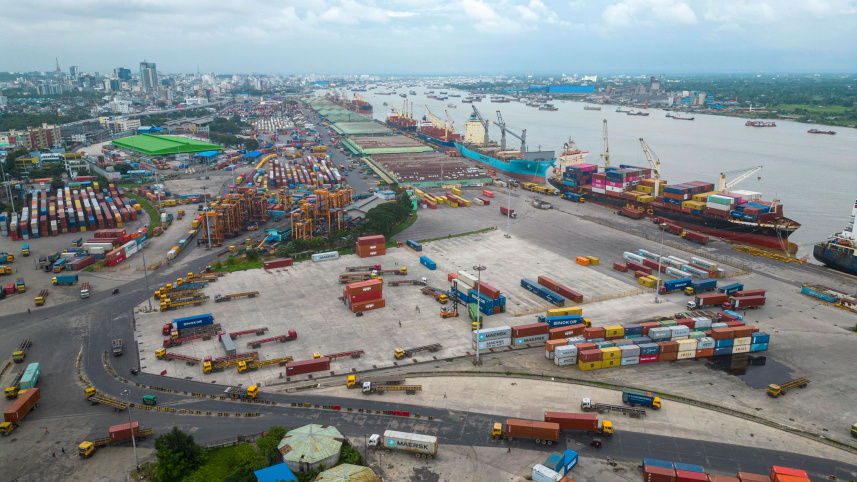
Chattogram port recently set an ambitious target to become “fully paperless” by December 2026. This is a direction we must welcome. For the country’s principal maritime gateway, digitalisation is essential to reducing transaction times, improving transparency, and supporting a trading economy that can no longer afford unnecessary administrative friction.
On September 23, the Chittagong Port Authority (CPA) announced a package of initiatives to accelerate this transition. Container and consignee bills will be generated and collected entirely through the Terminal Operating System (TOS); online payments will be available round the clock; e-gate passes, and gate-in and gate-out operations will be fully online; and time-slot management, online cart tickets, e-gate challans, and vessel e-NOCs will be incorporated into the TOS. Special Delivery Assignments will be approved online through the TOS, while auction deliveries will be facilitated through the National Board of Revenue (NBR)/Customs API integration. As part of the package, the One-Stop Service Centre will also facilitate integration with inland container depots (ICDs).

Technologically, all this represents considerable progress. But an incident only a day earlier offered an equally important lesson about what digitalisation requires.
On September 22, a new payment arrangement requiring port users to make payments through Eastern Bank triggered protests from importers, exporters, and customs clearing and forwarding agents. Many businesses did not maintain accounts with the designated bank, and cargo clearance activities were reportedly disrupted for several hours before the port authority withdrew the arrangement. Port users also raised concerns about difficulties with parts of the TOS.
I mention this episode not as an argument against digitalisation. Rather, it shows why digital systems must be designed around the transactions users actually need to complete. A system may work technically and still create operational difficulties if the underlying business process has not been properly designed. Technology can otherwise replace one source of friction with another.
Chattogram port has already travelled some distance in terms of digitalisation. In February, it launched the platform “CPA Sky,” intended to bring port, customs, and related export-import services onto an integrated platform. In July, CPA announced that import cargo-delivery documentation—from Delivery Order application to final gate-out—had been brought under the upgraded TOS, including integration with NBR’s ASYCUDA World customs system.
So, the foundations for digitalisation and automation are increasingly in place. The more difficult phase now begins—adoption.
Installing software is different from changing the behaviour of the many people, platforms, and organisations using a port every day. Clearing and forwarding agents, shipping agents, importers, exporters, freight forwarders, truck operators, banks, customs officials, and port employees have developed working practices over decades. So when a digital procedure becomes mandatory, users need to know what happens if, for instance, a payment fails, or an approval does not appear, or one system does not recognise information entered into another. Such failures can hold up a container and trigger storage charges, detention, demurrage, missed production schedules, or missed export shipments.
The upcoming December target should, therefore, be viewed not just as a deadline for switching systems on, but as a transition-management deadline for the entire port community.
CPA already provides online manuals, user guidance, and helpdesk arrangements. What is now needed is a more visible and structured change-management programme. Before an important digital procedure becomes compulsory, representative users should test it under real operating conditions. Clearing and forwarding agents should run simulated transactions; shipping agents should test documentation flows; banks should test payment interfaces during peak periods; and truck operators, ICDs, and off-docks should test their respective interfaces before mandatory integration.
Training and awareness are part of the digital infrastructure itself. CPA could conduct hands-on sessions for different user groups, establish temporary digital transition desks, issue short Bangla and English video demonstrations, and strengthen help-desk support during the migration. Where feasible, the digital channel should become visibly quicker and easier than the manual one.
System reliability is equally important. Once paper disappears, the digital platform becomes critical infrastructure. Major services should have measurable standards for availability, response times, payment confirmation, and help desk resolution, together with a clear contingency protocol so that traders are not penalised when the system—not the trader—causes a delay.
There is another prerequisite: regulatory readiness. A paperless operation cannot be achieved simply by switching on digital modules if rules, manuals, forms, or standing instructions still assume physical documents, signatures, stamps, or registers. Bangladesh already provides broad legal recognition for electronic records, and the Customs Act allows customs functions to be carried out electronically under prescribed procedures. But CPA should review its regulations, manuals, standing orders, and forms together with the relevant customs requirements, transaction by transaction.
Such a review should distinguish three things—requirements that need formal legal or regulatory amendment, procedures that can be changed administratively, and paper practices that survive simply through institutional habit. Unless all three are addressed, digital systems may coexist with paper rather than replace it.
Success must also be measured from the user’s side. Counting how many services are “online” does not show whether a port has truly become paperless. Better questions are: how many physical visits are still required? How many documents must still be printed? How often is information re-entered? How long does a digital transaction take? How frequently is manual intervention needed?
This leads to a broader distinction: a paperless port is not necessarily the same as paperless trade. CPA can digitise almost every procedure within the port boundary, while an importer may still move between customs, a bank, a shipping line, regulatory agencies, and other service providers. True paperless trade emerges only when authorised information can move electronically and securely among them.
Bangladesh’s broader performance illustrates this challenge. The 2025 UN Global Survey on Digital and Sustainable Trade Facilitation records Bangladesh’s paperless-trade implementation at 70.37 percent, but cross-border paperless trade at only 33.33 percent; the electronic single-window system was assessed as partially implemented.
The next frontier is, therefore, interoperability. CPA’s TOS and CPA Sky should progressively be integrated with NBR’s ASYCUDA World and the Bangladesh Single Window, as well as with banks, shipping lines, ICDs, off-docks, and other relevant regulatory systems. Information already supplied electronically to one authorised agency should, where the law and data governance arrangements permit, not have to be printed and submitted again elsewhere.
Chattogram port is closer to this objective than before, and the December deadline to go paperless can become an important milestone. But declaring a system digital and making a port genuinely paperless are different. A truly paperless port is one where there are no unnecessary procedures, information is entered once and reused securely, users rarely need to visit an office, and digital transactions are easier than the paper processes they replace. Technology can make that possible but legal and regulatory alignment, interoperability, user readiness, and well-designed processes will determine whether paper actually disappears from CPA.
Ahamedul Karim Chowdhury is former head of Kamalapur Inland Container Depot and Pangaon Inland Container Terminal, and an adjunct faculty member at Bangladesh Maritime University.
 For all latest news, follow The Daily Star's Google News channel.
 Views expressed in this article are the author's own.
Follow The Daily Star Opinion on Facebook for the latest opinions, commentaries, and analyses by experts and professionals. To contribute your article or letter to The Daily Star Opinion, see our guidelines for submission.
Comments