


What do we need to achieve 10,000 MW from solar by 2030?
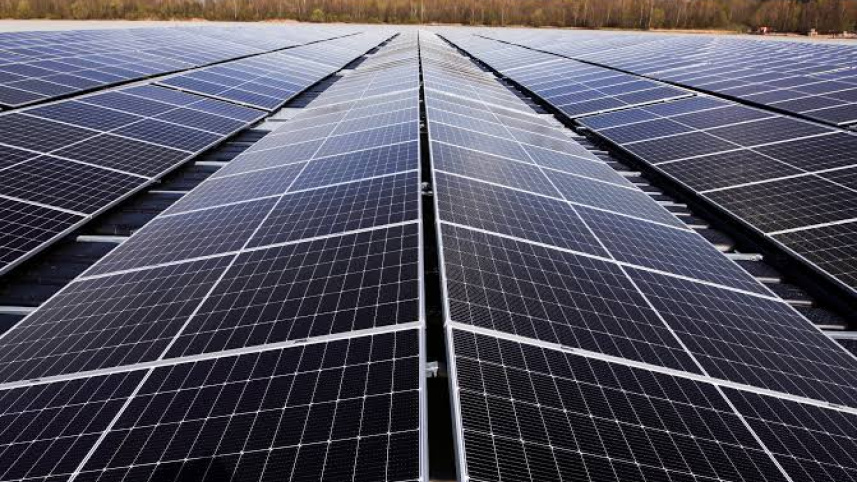
In April 2026, the cabinet approved a target of generating 10,000 megawatts (MW) of electricity from solar by 2030, under a Renewable Energy Policy 2025 that aims to draw at least 20 percent of the country's power from renewables by the end of the decade. The intent is a welcome one. Setting a target on paper, though, is the easy part; building solar power plants and training the people behind them is the hard one. This also raises a tougher question: who will design, install, inspect, maintain and finance 10,000MW of solar in barely four years? Solar currently supplies only about 1.45 gigawatts of the country's capacity, and the plan asks Bangladesh to expand its solar fleet almost sevenfold. Financing and equipment will carry part of the load. The rest depends on people, the component of the plan least discussed.
A 2022 SEIP labour-market study led by economist Dr Selim Raihan projected that solar jobs could climb from about 1.1 lakh today to roughly 2.42 lakh by 2035. Around 1.55 lakh of those workers would need short, certified training while another 75,000 would have to have a backgrounds in STEM. The roles are for installers, electricians, and grid engineers, but also for project managers, quality inspectors, and financiers who can build bankable deals.

Where those jobs land depends on the kind of solar Bangladesh builds. A megawatt of rooftop solar can support more than 25 jobs, against barely two for a utility-scale park. So, a distributed rollout would spread far more work into towns and neighbourhoods. The SEIP projection assumed a build-out far smaller than the 10,000 MW now targeted, so the real training need runs higher still.
The gap between target and delivery is already visible. Last year, the Bangladesh Power Development Board floated a tender for more than 5,000 MW of solar across 55 sites. But it drew a response so weak that the board scaled down to a 495-MW round in April 2026. Investors hesitated on price and risk, but insufficient execution capacity had to be taken into account as well. The Institute for Energy Economics and Financial Analysis (IEEFA) estimates Bangladesh holds only about 1,700 MW of renewable capacity at present and must add some 760 MW a year till 2030 to stay on course.
Bangladesh's technical institutes and universities produce engineers, diploma holders, and electricians, yet their courses rarely cover hands-on solar design, installation standards, grid integration, or digital monitoring. Specialised training is situated mostly within scattered donor projects and NGO programmes, and largely outside the national qualifications framework. One recent assessment states that the country will need thousands of technicians, electricians and engineers, and its training must catch up with the market.
The Renewable Energy Policy 2025 already anticipates some of this. It tasks SREDA, the renewable-energy authority, with forming guidelines, industry-academia links, and a national register of installers and maintenance firms. But a recent BUILD review noted that SREDA must shoulder this growing list of roadmaps and guidelines with a staff of barely 40 members. The gap now is not one of ambition but of administrative muscle.
Other countries show what is possible when training races ahead of demand. India set up a dedicated Skill Council for Green Jobs (SCGJ), whose Suryamitra programme trained more than 56,000 solar technicians since 2015. Yet, barely half found work, because training centres multiplied faster than projects. The Asian Development Bank draws the same lesson for the Asia-Pacific region, certification pays off only when recruitment drives it, not training targets. Bangladesh's planned installer register should therefore track genuine demand from the start, not just one of the gaps in the middle.
Of course, the picture is not all negative. A recent World Bank study found that about one in four jobs in South Asia already qualifies as green, and Bangladesh's green jobs sector clusters at the medium-skill level, closer to solar work than many assume. The study concluded that modest retraining could move a large share of workers into these jobs. But without training, certification, and a clear way in, employment in the solar sector will not happen on its own.
The right approach would make the solar drive a jobs strategy as much as an energy one. It would open technical careers to young Bangladeshis and to women the trades still mostly exclude, while keeping skilled labour at home instead of being exported as usual. A steady pipeline of decent, certified work would turn a power-sector target into a development story.
Building capacity at home also protects the balance of payments. Otherwise importing both the panels and the people who fit them trades one dependence for another. A domestic workforce keeps the value and wages inside the economy, and lets local firms compete as neighbours scale up. Here, speed and skills are not competing goals, and over four years they will rise or fall together.
First, the government should publish a national solar skills roadmap that ties the 2030 target to firm estimates of how many technicians, engineers, inspectors, and trainers it needs and where. Industry groups have already pressed the new government for exactly such a clear, inclusive roadmap, with workforce planning at the centre.
Second, institutes and universities should add solar modules to existing programmes now, rather than build new ones from scratch. Third, Bangladesh needs certification standards for installers and auditors that set clear safety and performance benchmarks. The national register the renewables policy already promises could anchor them, so the rush to build does not compromise quality.
Fourth, none of this can rest on the state alone. Development partners should support the labour force, pairing local training centres with established institutes abroad. Industry should help design courses and run real apprenticeships instead of one-off workshops, while regulators align licensing and inspection requirements with the skills the sector now requires.
The 10,000 MW goal is the right ambition, and Bangladesh is right to call solar a necessity rather than a luxury. But targets do not install themselves. By treating the workforce as an afterthought, the country will either miss its deadline or meet it with imported labour that fails early. A nation that spent decades sending its workers abroad has every reason to build the workforce at home for its own energy future.
Mohammad Iftekharul Islam is lecturer in the Department of Economics at Dhaka International University (DIU). He can be reached at iftekharul.eco@diu.ac.
Views expressed in this article are the author's own.
Follow The Daily Star Opinion on Facebook for the latest opinions, commentaries, and analyses by experts and professionals. To contribute your article or letter to The Daily Star Opinion, see our guidelines for submission.
 For all latest news, follow The Daily Star's Google News channel.
Comments