


What India’s ‘cockroach’ protest tells us about South Asia’s generation of discontent

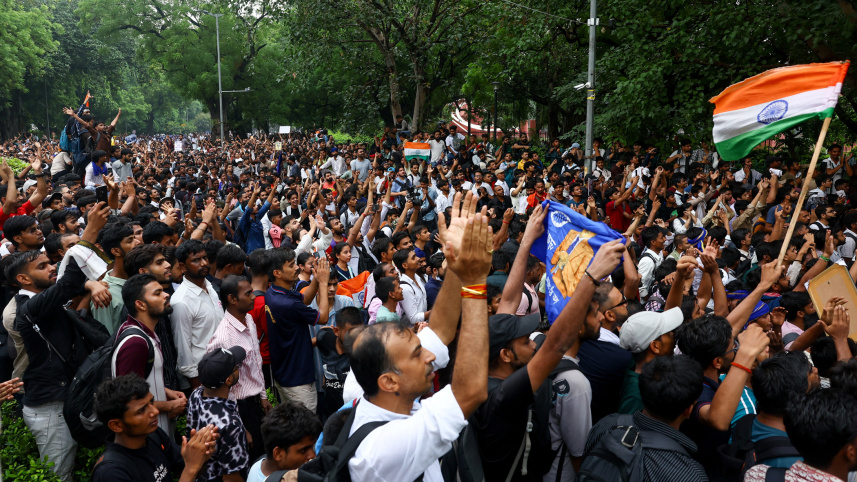
When more than 10,000 young Indians marched from Jantar Mantar to the parliament in New Delhi on Monday—responding to a call by the youth-led Cockroach Janta Party (CJP) movement—police launched a crackdown on them with tear gas and batons, allegedly injuring about 150 protesters and detaining many others. It was the largest demonstration to challenge the Narendra Modi government in years, a spark that may refuse to fizzle soon. The next day, despite heavy rains overnight, hundreds of protesters returned to Jantar Mantar to settle into what appears to be an indefinite sit-in, signalling their intention to prepare for a much longer political fight.
The movement itself is barely ten weeks old. It emerged from an offhand remark by India’s Chief Justice Surya Kant during a hearing on forged educational credentials, when he compared fraudulent degree holders to “cockroaches” and “parasites.” Although he later clarified that he had referred only to fake degree holders, the damage had been done. The CJP founder Abhijeet Dipke embraced the insult, registering a website that mocked the ruling Bharatiya Janata Party’s initials while reclaiming the metaphor. Volunteers soon began arriving at protests dressed as cockroaches. What began as a judicial gaffe evolved into a shared identity for many young Indians who felt that the country’s institutions had long treated them with contempt.

The immediate grievance concerns the National Eligibility-cum-Entrance Test (NEET), the examination that determines admission to India’s medical colleges. Following allegations of questions being leaked, the test was cancelled and conducted again, throwing millions of candidates into weeks of uncertainty. Around a dozen students reportedly died by suicide during the turmoil. The CJP demands Rs 1 crore in compensation for each affected family and the resignation of Union Education Minister Dharmendra Pradhan. Its demands broadened after Sonam Wangchuk, the well-known Ladakhi engineer who had been on an indefinite hunger strike since June 28 in support of the movement, was forcibly removed from his protest stage early this week. Later, Health Minister JP Nadda indicated the government’s willingness to “consider” the demands. The government now seems ready to hold a discussion on the NEET paper leak issue in parliament.
However, treating the ongoing agitation simply as a protest over an exam would be misleading. The NEET controversy has become a vessel for grievances that extend far beyond one test. According to the State of Working India 2026 report released by Azim Premji University, roughly four in ten young graduates remain unemployed, while only a small fraction secure permanent salaried work within a year of finishing university. Anthropologist Craig Jeffrey has spent years documenting how educated Indian youth drift through long periods of preparation for government jobs that statistically most will never obtain. So, the NEET leak did not create this frustration; it only gave it a focal point.
Perhaps this is what distinguishes the CJP from other big protest movements Modi has faced since taking office. The demonstrations against the Citizenship Amendment Act (CAA) centred on constitutional rights and religious identity. The farmers’ movement revolved around agricultural policy and a highly organised rural constituency. This movement draws strength from something “closer to home”: the issues that most consistently galvanise young people regardless of their ideology or geography—unemployment, state repression, and the loss of dignity. It challenges not merely a policy but the belief that education, hard work, and merit still offer a meaningful route to social mobility. In that sense, it may represent a deeper and potentially more enduring challenge than the CAA or farm-law protests because it strikes at the expectations of an entire generation rather than the interests of a particular community.
The comparison with similar movements in Bangladesh, Sri Lanka, and Nepal also reveals something important. In each case, the immediate trigger looked small next to underlying economic misery. Bangladesh’s 2024 protests were initially about a quota system reserving 56 percent of government jobs for descendants of freedom fighters. But the discontent ran far deeper, influenced by years of authoritarian rule, entrenched corruption, political repression, and democratic backsliding. The crisis ultimately escalated into the indiscriminate killing of as many as 1,400 people between July 1 and August 15, 2024, transforming a dispute over quotas into a nationwide uprising against the government. Sri Lanka’s 2022 uprising began with fuel shortages but soon became a revolt against political privilege and economic collapse. Nepal’s demonstrations over restrictions on social media reflected wider frustration among young people confronting limited opportunities at home while watching political elites and “nepo kids” remain insulated from hardship.
Across South Asia, youth-led movements have thus found their momentum not in a single policy dispute but in the convergence of repression, unemployment, and the erosion of dignity. India’s protests are showing the same characteristics.
The symbolism surrounding NEET reinforces this broader reading. In a society where family connections, political patronage, and caste networks continue to shape access to opportunities, competitive examinations have long been presented as the one institution where merit could prevail. The allegation that even this gateway could be manipulated transformed the scandal into something much larger than administrative failure. For many students, it represented the collapse of the last institution that still seemed capable of rewarding effort fairly.
Opposition parties have been naturally eager to associate themselves with the CJP movement, though their reactions have underscored their own political calculations. Arvind Kejriwal proposed making Wangchuk the education minister. Trinamool Congress leaders like Mamata Banerjee and Abhishek Banerjee expressed early support. The Samajwadi Party dispatched delegations. Rahul Gandhi remained largely silent until Wangchuk’s detention made silence politically untenable. Since then, he has emerged as one of the movement’s most prominent political backers, even being briefly detained by Delhi Police during a march towards Modi’s residence. Rather than leading the protests, opposition parties have found themselves trying to borrow legitimacy from a movement that has deliberately kept them at arm’s length. So, as Reuters has put it, the protest has given India’s opposition parties “a rare opening against Modi”.
The government’s response has likewise revealed a calculated balancing act. Authorities blocked the CJP’s website and social media platforms under national security provisions soon after its emergence. Protesters allege constant surveillance around the demonstration site. Yet even as police forcibly removed Wangchuk from his stage, BJP leaders held discussions with movement representatives. Alternating between coercion and engagement appears designed less to resolve the dispute than to prolong it until fatigue overtakes mobilisation.
Even so, the movement faces formidable obstacles. Narendra Modi continues to command significant support, and his government has demonstrated remarkable resilience during previous crises. The CAA protests ultimately failed to alter the government’s broader policy trajectory. The farmers’ agitation secured the repeal of contentious legislation but left the BJP’s electoral dominance largely intact. Those precedents suggest that while the current protests may expose one of the government’s greatest vulnerabilities, Modi’s personal popularity and the BJP’s organisational strength are likely to limit their immediate political impact.
Whether the CJP ultimately succeeds, therefore, matters less than what it has already revealed. A generation of young Indians has discovered that institutions once regarded as untouchable can be openly challenged. The shift to an indefinite sit-in away from potentially confrontational marches suggests the movement is preparing for a war of endurance rather than spectacle. Governments can disperse marches, but they cannot easily extinguish the frustrations that brought thousands of young Indians onto the streets. Bangladesh’s own experience offers a reminder: the anti-VAT protests of 2015, or the quota reform movement and road safety movement of 2018, did not achieve all they sought, but they nurtured the networks, grievances, and political consciousness that eventually culminated in the July 2024 uprising. Thus, even when youth movements appear to fade, the anger that animates them often survives.
Jannatul Naym Pieal is a writer, researcher, and journalist. He can be reached at jn.pieal@gmail.com.
Views expressed in this article are the author's own.
Follow The Daily Star Opinion on Facebook for the latest opinions, commentaries, and analyses by experts and professionals. To contribute your article or letter to The Daily Star Opinion, see our guidelines for submission.
 For all latest news, follow The Daily Star's Google News channel.
Comments