


Political acumen is fine, but economic expertise is crucial

In Bangladesh, we love democracy, cherish it and fight for it, but we have repeatedly failed to make it durable. The July uprising, whose second anniversary we have just observed, was unique in many ways. It was far more all-encompassing, grassroots-based and youth-centric than our previous democratic movements. Students and young people in our country have had a long and glorious tradition of rising against oppressive regimes. It was the youth in the 1950s who secured Bangla the status of one of the two state languages in Pakistan; they were a crucial force that brought down the Ayub Khan regime and formed the Mukti Bahini that helped defeat the Pakistan Army in our Liberation War. After the birth of Bangladesh, they brought down Gen HM Ershad’s regime and, more recently, Sheikh Hasina’s government. The energy, vision and patriotism exhibited in all these movements show the never-ending zeal of the younger generation in dismantling oppressive regimes.
But two years after the July uprising, our political leaders have again resorted to such infighting and mutual demonising that people are becoming increasingly concerned about what kind of future we can expect when politics slides so quickly back into the old ways. The question is, why are our political leaders creating this disenchantment among us? What was supposed to be a celebration of the July uprising has instead turned into an exchange of dangerous rhetoric from both sides of the political aisle, creating a sense of unease among people. At this moment, we should have been congratulating ourselves for moving towards building a democratic order. Instead, we are saying or suggesting things that are creating unnecessary and self-defeating doubt.

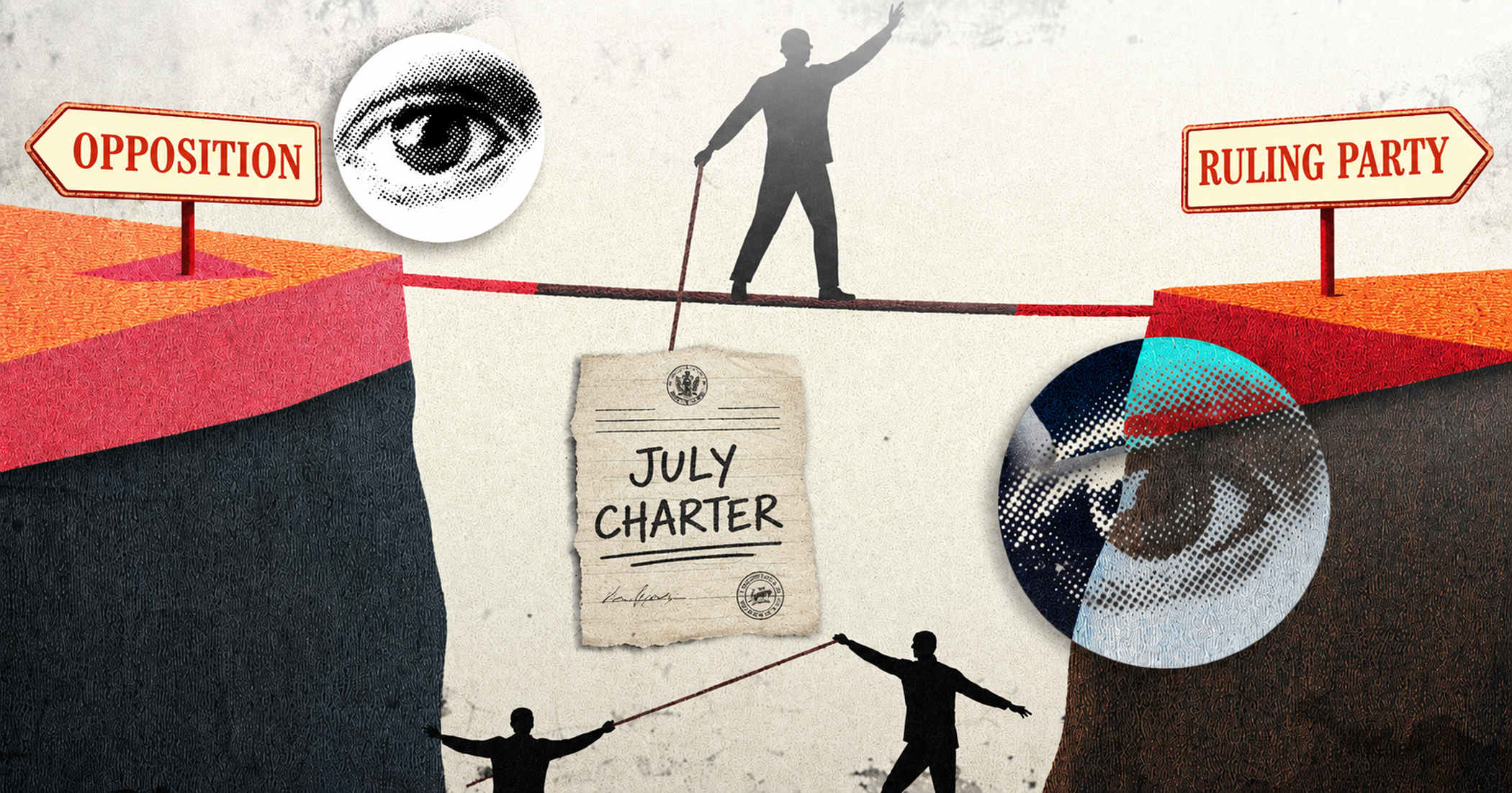
On August 5, 2026, after inaugurating the July Mass Uprising Memorial Museum, the prime minister said, “Some are trying to create unnecessary issues and destabilise the country. We need to consider whether, knowingly or unknowingly, such actions are facilitating the return of the defeated, deposed and fugitive authoritarian forces.” Are we moving towards destabilisation? Is there any chance of the defeated authoritarian forces returning? In our view, we are more than ready to resist such an eventuality, which is far from likely to occur in the near future. But for the PM to speculate along these lines only weakens his position.
On the other hand, the opposition leader, Bangladesh Jamaat-e-Islami chief, referring to the delay in implementing the July National Charter and the reforms pledged in it, said, “We will not sit idly by while the country falls apart.” He added: “Everything suggests that another inevitable revolution is approaching. I call upon all of you to prepare for that revolution.”
What are we to think when the elected leader of the opposition says the country is falling apart? This is most unacceptable. Why would anybody invest in a country that is falling apart? How can we expect to earn the confidence of our own and of foreign investors? Don’t such utterances make our enemies smile and strengthen their position that we are on the wrong track?
If the opposition leader’s prediction is anywhere near the truth, would South Korea have signed a Comprehensive Economic Partnership Agreement (CEPA) with us on Tuesday? Would Japan have signed a similar agreement earlier?
These are sad but real examples of how we hurt our own prospects for advancement simply to gain some populist mileage.
In my last column, published on July 24, I expressed my concern about the growing distance between the ruling party and the opposition. Regrettably, that trend has now become more violent. The student wings of BNP and Jamaat are becoming directly involved in violence. On Tuesday, more than 90 people were injured in clashes between Jatiotabadi Chatradal and Islami Chhatrashibir on four campuses in various districts.
What’s concerning is that the issues at hand were avoidable and could definitely have been resolved through dialogue. This tendency to resort to clashes without giving discussion or peaceful means a chance reveals a predisposition towards violence that will inevitably lead to less mutual respect and tolerance, and more towards what we have seen in the past: patronisation of muscle power by the major political parties. As a result, student politics will not move towards the constructive and nation-building role that we once witnessed and now desperately need.
The general students who don’t belong to any student party already feel intimidated or unsafe attending classes or being on campus. This should not be the scene in our educational institutions in the post-July era. But it is increasingly becoming so. What we are seeing is a continuation of the same dynamics witnessed between ruling party and opposition student wings in the past.
According to the Human Rights Support Society (HRSS), political violence increased significantly from January to June this year. There were 830 incidents that caused the deaths of 56 individuals and left 5,246 injured. Of them, 273 clashes were linked to BNP’s internal conflicts, 290 between BNP and Jamaat, and 33 between BNP and NCP. This is most undesirable.
The point we want to make here is that, instead of violence, there must be more mature and fact-based discussions between the ruling and opposition parties. The need of the time is that our politicians should address the economic issues far more seriously than they do at present. Yes, members of the ruling party who hold ministerial positions do point out economic challenges from time to time, but we don’t see any serious effort on their part to engage their political counterparts, either through parliamentary committees or informal gatherings, to deeply examine the serious economic challenges facing the country.
A serious sense of responsibility is also expected from our opposition politicians. How could the leader of the opposition, Dr Shafiqur Rahman, say that “the government is creating artificial gas shortages to justify price hikes”? The 11-party alliance yesterday announced nationwide protests over gas and electricity crises. This is nothing but “populist politics.”
In the present world, our politicians must have some knowledge of how the economy grows, how an industry is run, and what challenges our exporters face. Agriculture, which remains neglected in our planning priorities, is one of the most scientifically advanced areas of progress in today’s world. Biotechnology and chemical engineering are essential parts of agricultural growth. Meanwhile, banking is one of the most advanced and complex sectors of a modern economy. Therefore, it is imperative that our politicians take into account how project financing works and how accountability has to be ensured.
We appoint ministers without regard to their expertise. If, for political reasons, such appointments have to be made sometimes, then immediate steps should be taken to properly train the appointee in the portfolio they are entrusted with. Please remember that running a government today is a science. It is knowledge-based and driven by practical experience, not rhetoric. Our long experience of failures in implementing good policies should teach us that.
Bangladesh is currently facing one of the most severe economic challenges in its existence. Some of the basic preconditions of a healthy economy were destroyed by the Hasina regime, especially the banking sector. The 18 months of the interim regime brought indiscipline and mob rule at the grassroots level, which significantly reduced our industrial productivity. Then came the US-Israel attack on Iran, which caused chaos in the global energy market, disrupted international supply chains, and damaged the global economy, severely hurting smaller economies. Bangladesh, for example, shouldered nearly $3 billion in additional foreign exchange spending on surging energy and fertiliser imports between March and June, due to the Iran war.
Today, we face severe uncertainties in the supply of raw materials, prices of industrial inputs, and stability of our export markets. But, above all, it’s the supply of energy that is threatening our GDP growth, which the IMF forecasts at 3.5 percent for the current fiscal year, with a similar prediction from the ADB.
The gas crisis, weak private sector investment, and slowing exports are hurting the economy. Industrial production has contracted for the first time since Covid-19. Hundreds of factories have shut down, leading to significant job losses. According to the Bangladesh Employers Federation (BEF), more than 700 factories have closed or fallen into financial distress since August 2024, leaving thousands of people jobless.
The crisis in the banking sector has worsened, with the current non-performing loan ratio rising to 32.26 percent, amounting to Tk 588,704 crore at the end of March this year.
 For all latest news, follow The Daily Star's Google News channel.
 Inflation remains a major challenge, eroding the purchasing power of low- and middle-income consumers. The country has been experiencing an average inflation rate of 8.5 percent for four consecutive fiscal years since 2022-23.
So, our political leaders must recognise the serious economic challenges that Bangladesh is facing, temper their rhetoric, and take positions that are more realistic. We advocate for giving opposition parties more power and freedom to play their role more effectively. However, the more freedom they receive, the more responsible they need to become. Their stance needs to be more practical, scientific, and reality-based.
Every country’s economy, especially those of smaller countries like ours, is inextricably linked with global trade and geopolitical realities. This calls for far more mature political dialogue between our ruling and opposition parties concerning the country’s economic future. The current populist rhetoric, therefore, must be checked.
Mahfuz Anam is the editor and publisher of The Daily Star.
Views expressed in this article are the author's own.
Follow The Daily Star Opinion on Facebook for the latest opinions, commentaries, and analyses by experts and professionals. To contribute your article or letter to The Daily Star Opinion, see our guidelines for submission.
Comments