Bangladesh in a world of impossible choices
The nineteenth-century Danish philosopher Søren Kierkegaard observed that the man who marries regrets it, and the man who does not marry regrets that too. The point is not that choice is meaningless, but that certain situations are structured so that no available option escapes consequence; the regret is not a punishment for choosing wrongly, but a feature of the situation itself, present before the deliberation even begins. This is, perhaps too precisely, the position of low- and middle-income countries (LMICs) today. The US-China trade rivalry, which is rewiring global supply chains, and the US-Iran confrontation, whose consequences are now drawing long queues at filling stations in Dhaka, were not decisions made in Bangladesh’s capital. But the structure of available choices has been arranged, by forces largely external to these countries, such that every path forward precludes something irreversible. Like death and taxes, the regret that follows was never up for negotiation.
The window that closed
For a brief historical window, the economic ladder was attainable. The East Asian miracle, namely that of South Korea, Taiwan, and later China itself, demonstrated that late industrialisation was possible within the postwar liberal order. The conditions were specific: a period of relative great-power stability, open markets for manufactured exports, permissive technology transfer, and a multilateral institutional framework that, despite its asymmetries, provided a stable enough floor for long-run planning. The bet seemingly paid off, producing one of the most dramatic reductions in absolute poverty in recorded history.
The US-China trade rivalry, which is rewiring global supply chains, and the US-Iran confrontation, whose consequences are now drawing long queues at filling stations in Dhaka, were not decisions made in Bangladesh’s capital. But the structure of available choices has been arranged, by forces largely external to these countries, such that every path forward precludes something irreversible.
That window has since closed. What has replaced it is not a new development paradigm but a contest, conducted through tariffs, semiconductor controls, friend-shoring mandates, and the silent rewiring of development finance, between two powers whose rivalry is increasingly total. Bangladesh is the clearest illustration. Its garment sector, the backbone of an export-led development model that lifted millions out of poverty over three decades, was built on the assumption that access to Western consumer markets was stable and expandable. That assumption now sits within a geopolitical variable nobody in Dhaka controls: US-China decoupling reshapes supply-chain geography, friend-shoring redirects investment flows, and trade-as-leverage makes market access a political instrument rather than an economic constant.
The understated trilemma
The trilemma this produces for LMICs is rarely stated plainly, but each of its three parts carries lasting implications that warrant further elaboration.
Align with the Western bloc and inherit its terms: access to capital markets, development finance, and the green transition agenda, each bundled with conditions whose content evolves but whose structural asymmetries persist. The US-Bangladesh Agreement on Reciprocal Trade, signed in February 2026, illustrates this precisely: a reduction in tariffs in exchange for binding commitments across defence procurement, digital governance, energy purchasing, and restrictions on trade relationships with countries Washington designates as non-market economies. Critics have described it as highly unequal and potentially damaging to Bangladesh’s strategic independence, a framework whose obligations run deep while its benefits remain conditional.
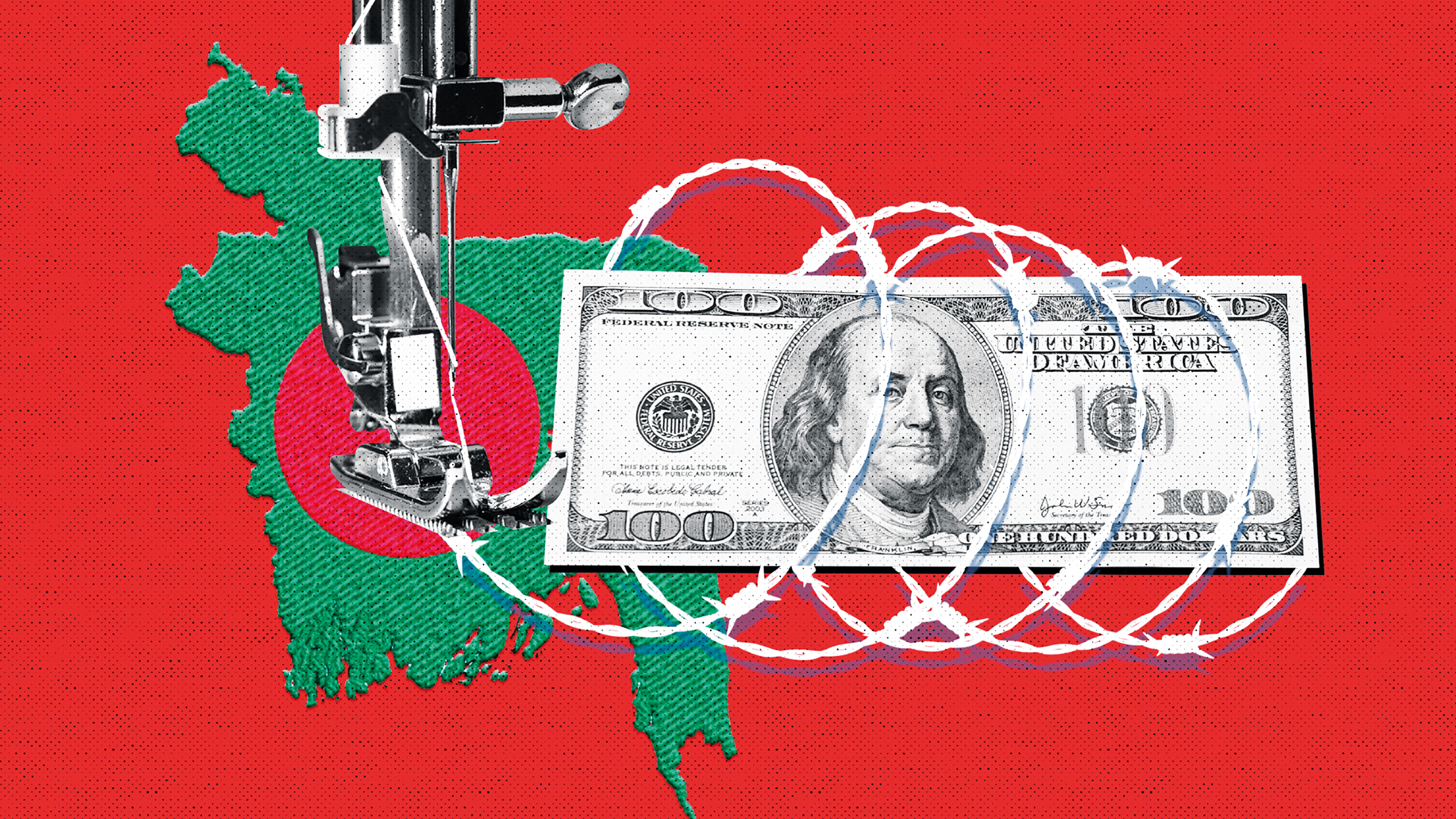
On the climate front, late-developing economies are being asked to forgo an energy pathway that earlier industrialisers relied upon to build the very technological capacity now being brought to bear in designing that transition, a sequencing difficulty that persists regardless of how the demand is framed.
Align with the Eastern alternative and inherit a different set of terms. Chinese development finance has delivered tangible infrastructure investment in countries underserved by multilateral institutions: roads, ports, and power plants that addressed longstanding gaps. The terms, however, have raised documented concerns about debt sustainability, governance standards, and the extent to which financing arrangements serve broader strategic purposes beyond the projects themselves. The Belt and Road Initiative has delivered material benefits while simultaneously deepening recipient countries’ entanglement with a creditor whose substantial and expanding geopolitical ambitions are evident.
Attempt nonalignment and discover that the space no longer exists. The Non-Aligned Movement was a political achievement of the mid-twentieth century, made possible by a Cold War in which both superpowers needed the allegiance of newly independent states and neither had the economic reach to make neutrality prohibitively costly. US-China rivalry is now conducted through the capillaries of the global economy: supply chains, payment systems, technology standards, and development finance institutions. The costs of fragmentation fall asymmetrically, with friend-shoring offering no guaranteed boon to countries outside the principal blocs. The space for genuine neutrality has effectively closed.
In light of the present structure of the global order, Kierkegaard’s insight becomes a diagnosis rather than a provocation. Each path closes something that cannot be reopened. The bill arrives regardless.
US-China rivalry is now conducted through the capillaries of the global economy: supply chains, payment systems, technology standards, and development finance institutions. The costs of fragmentation fall asymmetrically, with friend-shoring offering no guaranteed boon to countries outside the principal blocs. The space for genuine neutrality has effectively closed.
If the trilemma above reads as abstract, consider what is happening right now. Following US and Israeli military strikes on Iran in late February 2026 and the subsequent closure of the Strait of Hormuz, Bangladesh, which sources roughly 72 per cent of its LNG from Qatar and the UAE, finds itself in an energy emergency it had no hand in creating. The IEA confirmed that Bangladesh, India, and Pakistan together imported almost two-thirds of their total LNG through the Strait, making the closure an immediate supply shock with no short-term alternative.
Fuel rationing was introduced, and state-run fertiliser factories halted operations as available gas was redirected to power plants. The government began purchasing LNG on the spot market at sharply elevated prices that its foreign exchange reserves could not easily absorb.
UNCTAD has noted that developing economies already facing constrained fiscal space are particularly exposed to exactly this kind of cascading supply shock, a vulnerability not of their making and not within their power to insure against. The Hormuz crisis did not create Bangladesh’s exposure; rather, it made it visible.
Not all regrets are equal
What makes this more than a familiar lament about great-power politics is the asymmetry of who bears the regret. The fragmentation of the global order is costly for everyone; decoupling is inflationary, and bloc formation is economically inefficient. But the regret of an LMIC is not that of someone who chose poorly; it is that of someone who arrived to find the terms already set.
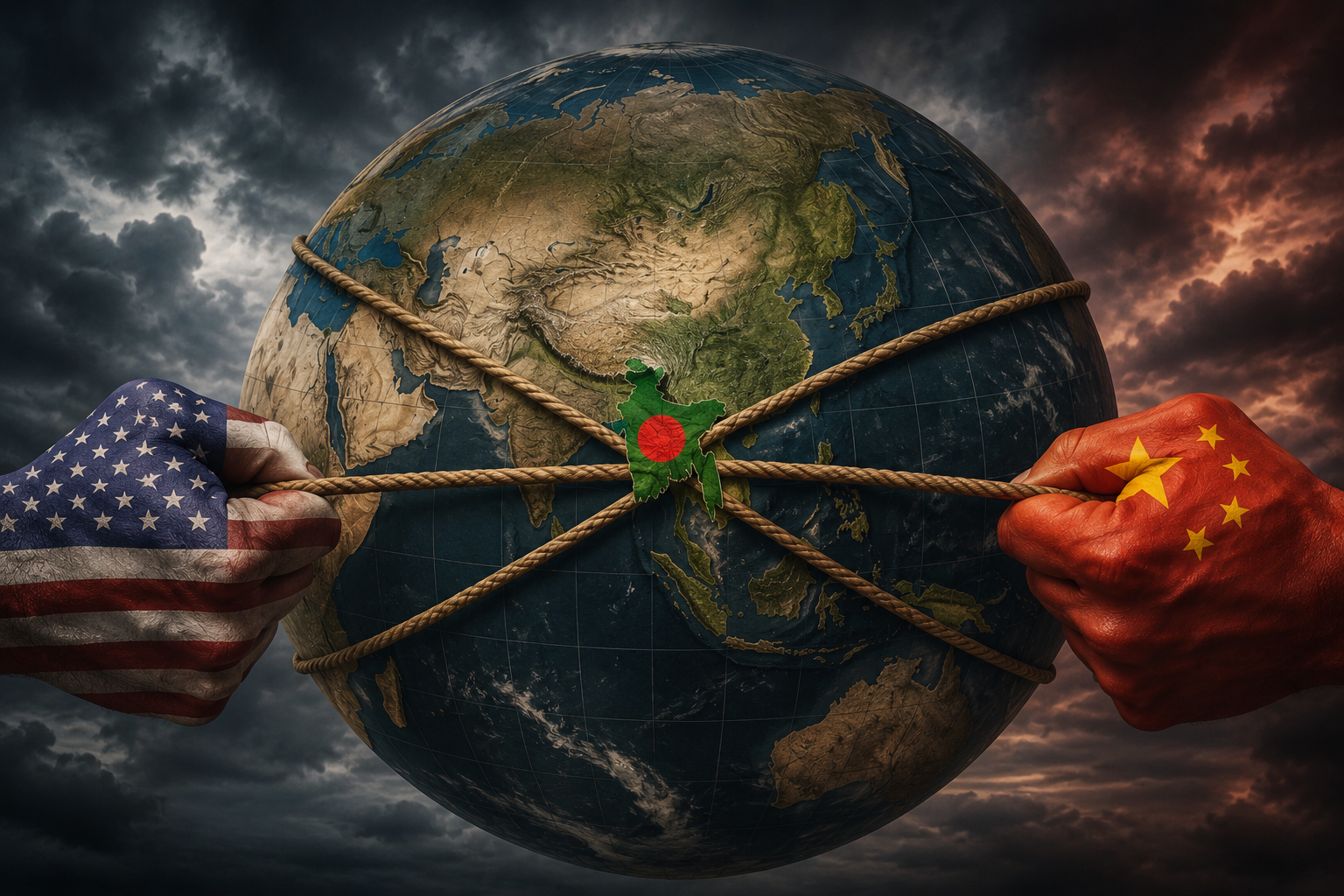
Bangladesh did not design the rules of the garment trade, set the terms of climate finance, draw the boundaries of the US-China rivalry that now bisects its supply chains, or fire the first missile over the Strait of Hormuz. Its exposure to all of these is the consequence of deep integration into a global order whose disruptions it can neither anticipate nor sustain, and whose direction it has no meaningful hand in shaping.
What we are watching unfold is not simply a crisis of the rules-based system. It is a moment in which the contingency of that system, its dependence on a particular and now shifting distribution of power, has become difficult to ignore. For the countries that built their futures on the assumption that the floor would hold, there is today no prescription that fits the situation. Regret is not a problem to be solved. It is an inherited condition. And for the countries that never had a hand in shaping the order that produced it, the regret arrives without even the dignity of having been party to the choice.
Ishmam Rayan Haq is a Research Assistant at the Bangladesh Institute of Development Studies.
Send your articles for Slow Reads to slowreads@thedailystar.net. Check out our submission guidelines for details.

Bangladesh’s gold paradox: From a shadow market to an export industry

Anu Muhammad speaks / Why Bangladesh’s energy crisis keeps coming back
The $5 billion opportunity Bangladesh is failing to see

How Bangladesh is failing its Qawmi graduates

Why is water-rich Bangladesh running short of water?

Bangladesh's education crisis: The future has already begun
The global injustice behind Bangladesh’s shipbreaking industry

How to make essential medicines affordable and accessible in Bangladesh
Can Bangladesh make its plastic waste policy work?