Chand Bibi and the forgotten history of Muslim women’s political resistance

Published in June 2026, Sarah Waheed’s Chand Bibi: The Lives and Legends of a Warrior Queen revisits the remarkable life and afterlives of one of the most powerful women of the sixteenth-century Deccan. Waheed, an assistant professor of history at the University of South Carolina and a historian of South Asia, explores empire, nationalism, colonialism, Islam, gender, and memory, with a particular focus on Muslim communities across the India-Pakistan divide. In this conversation with The Daily Star, she discusses Chand Bibi’s resistance to Mughal expansion, the political authority of Muslim women in the Deccan, and what recovering regional histories can reveal about South Asia’s contested past.
The Daily Star (TDS): What first sparked your interest in Chand Bibi, and what drew you to her story?
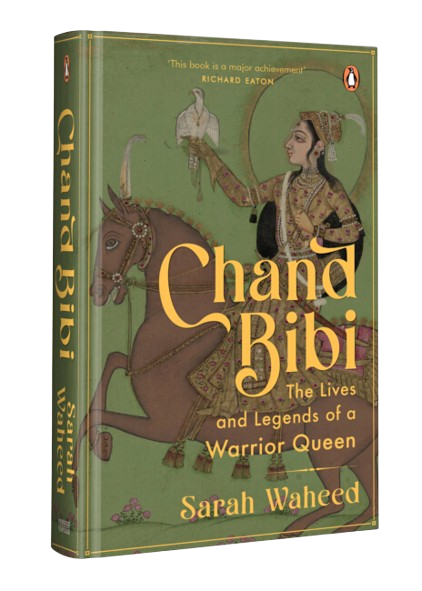
Sarah Waheed (SW): Chand Bibi first found me one June day seven years ago, when I had returned to my ancestral city of Hyderabad, India. I was walking through the old city streets of my childhood and stepped into a half-century-old bookshop. Quite by chance, I picked up an old Urdu play about Chand Bibi from the shelves. On the cover was a striking image of her riding a horse, with a falcon perched on her arm.
The more I read, the more I realised that Chand Bibi had been remembered in Persian histories, Urdu and Marathi plays, paintings, oral traditions, local legends, landscapes and women’s memories, and yet she remained marginal in the broader histories of South Asia.
What drew me back to her was precisely these layered contradictions. How could a woman be so vividly remembered in some places and yet remain so nearly absent from our modern popular and scholarly histories? I wanted to understand not only who Chand Bibi was, but also how she had survived.
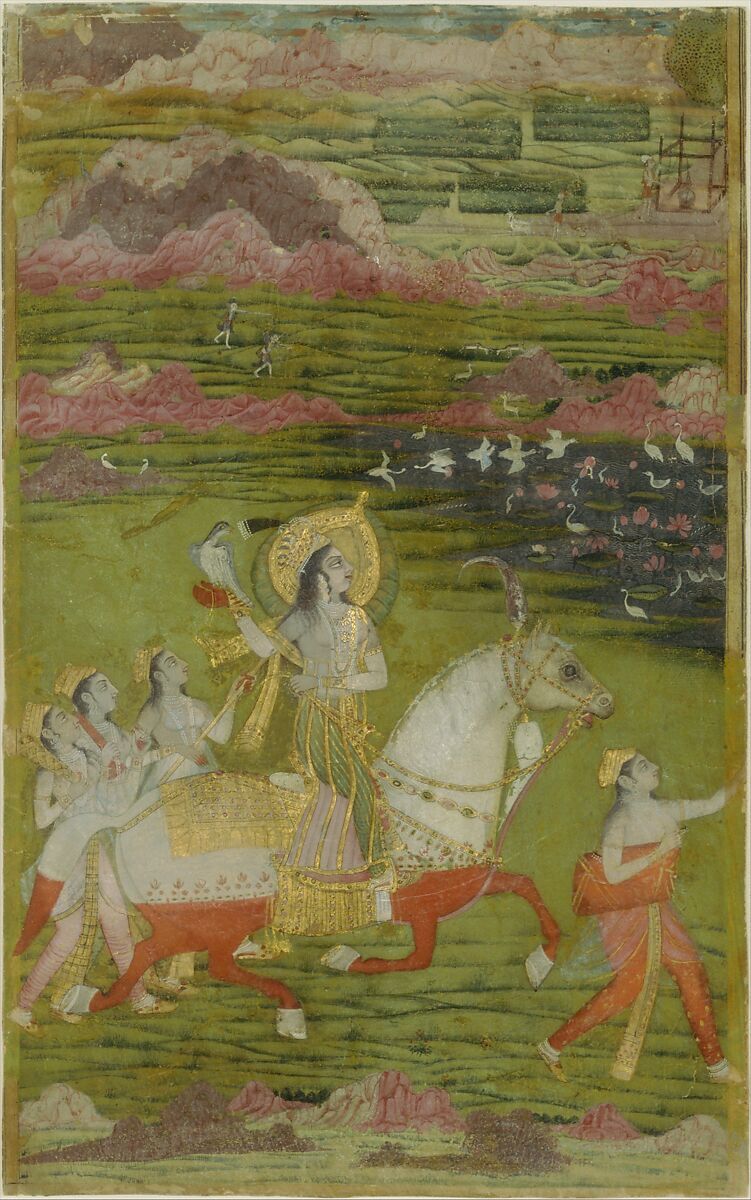
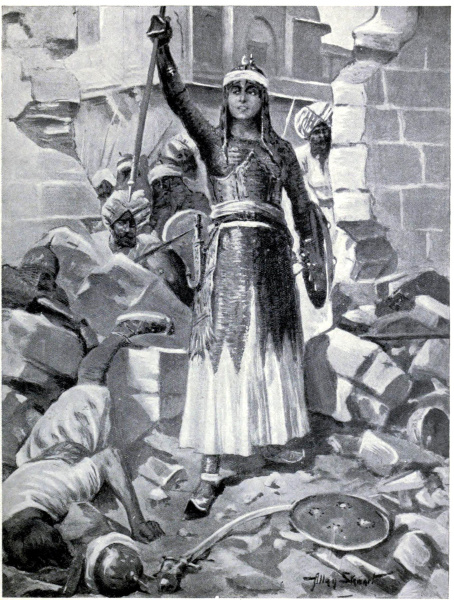
Art became one of my most important sources. In painting after painting, Chand Bibi appears on horseback with a predatory bird perched on her arm, hunting—the only woman to be so consistently portrayed this way in paintings of early modern South Asia. Falconry in the Persianate world was about cultivating the skills of an ideal ruler. The Persian word shaheen for ‘falcon’ is a derivative of shah, or ‘king’. Falconry was largely a male pursuit.
The paintings remembered something the written record kept hidden: that sovereignty could take the form of a powerful woman. The Chand Bibi falconer iconography spread far and wide across Hindustan in the eighteenth century, just as Mughal power was beginning to fracture, giving rise to multiple successor states. The paintings of Chand Bibi as a sovereign of the Deccan constituted a potent memory of anti-Mughal resistance and autonomy, asserted by regional successor states that commissioned these paintings at the very moment that Mughal power was on the wane.
TDS: Who was Chand Bibi? What kind of figure was she within the world of the Deccan Sultanates, and what did her regency at Ahmadnagar actually involve?
SW: Chand Bibi was one of the most extraordinary political figures of the early modern world. She was a politically savvy, intelligent, devout and highly educated Muslim ruler. She was known as ‘the Queen of the Deccan’, a woman whose authority stretched across the interconnected sultanates of not only Ahmadnagar and Bijapur, where she was queen-regent, but also Golconda. She briefly united the Deccan, roughly a fifth of the Indian subcontinent, against the Mughal Empire ruled by Akbar. Through kinship networks, diplomacy and military command, she moved across a vast political landscape. Chand Bibi successfully defied the Mughal imperial armies in 1595. She organised resistance, negotiated with imperial commanders, appealed to neighbouring Deccan rulers and helped hold together a fragile anti-Mughal front. She ruled amid multiple and competing political pressures: empires, trading ports, factional court politics and intra-Deccan warfare.
That is why I see her not only as the queen-regent of Ahmadnagar, but also as a sovereign figure of the Deccan itself. She was strategic, intellectually formidable and politically audacious—a military strategist, diplomat and patron of public works.
TDS: You describe drawing on archival research, oral histories, historical sites and institutions across Hyderabad and the Deccan while writing the book. Could you walk us through that process? What kind of detective work does it take to reconstruct a life that survives mostly in fragments and contradictions?
SW: I followed Chand Bibi wherever she led me. I travelled across several cities in the Deccan—Hyderabad, Gulbarga, Bijapur and Ahmadnagar—walking through forts, shrines, tombs, libraries and museums. I scoured at least a dozen archives, searching for traces of a woman who seemed to be everywhere and nowhere at once.
The work was archival, but also physical and imaginative. I followed her through Persian histories, Urdu plays, Deccani paintings, archaeological reports, oral traditions, local legends and the stories told by the communities who live around the monuments where she ruled and lived.
In Persian, there is a phrase I use in the book: sar-e-nakh, literally “the head of the thread”, but meaning a clue. I held on to one clue at a time and followed the thread through fragments and contradictions. What made the process so compelling was that the landscape itself became an archive. In Gulbarga, for instance, my search for Chand Bibi’s burial site led me to the dargah of the great saint of the Deccan, Khwaja Bande Nawaz Gesu Daraz, to an empty tomb and to people who still remembered her as Chand Sultana.
In Ahmadnagar, I encountered the ruins of the fort, the remains of palaces and the memory of the siege. In Hyderabad, I drew on family stories, Dakkhani memory and the histories of Muslim women that circulated outside formal archives.
The detective work was not simply about finding one definitive document that would solve everything. Chand Bibi’s life survives in fragments, contradictions and competing afterlives. So, I had to ask not only, “What happened?” but also, “Why was she remembered this way? Who preserved this narrative of her? What anxieties, desires or political claims does this account reveal?”
TDS: The book turns on a centuries-old unresolved question: how Chand Bibi died. Some accounts say she was killed by her own soldiers, others that she chose death over capture, and still others suggest that she escaped. What does the persistence of these competing accounts tell us about how power, memory and gender shape what gets recorded?
SW: The competing accounts of Chand Bibi’s death are at the heart of my book. I do not treat these accounts simply as “true” or “false”. Instead, I ask what each one reveals about the people who narrated them. The murder account shows the many betrayals that underscored the Deccan’s factional court politics. The suicide account reflects a local imagination in which a woman’s sexual honour is tied to death rather than survival. Both of these accounts tend to be narrated in elite and patriarchal modalities.
The escape story is especially fascinating because it departs from the other accounts. It emerged from oral traditions, local memory and communities outside official courtly archives; it was circulated by peasants for centuries. In the memory from below, Chand Bibi refuses defeat by finding a way out. Sceptics dismiss such tunnel escape narratives as tropes, and yet there were also written sources about it from the early seventeenth century. Does it become more believable once it is written down?
Of course, historians should not abandon evidence. But this does mean we must ask why some forms of memory are treated as serious history while others are dismissed as legend. Legends are not the opposite of history. They preserve grief, longing, resistance and political memory, especially for those non-elite peoples whose voices were not recorded in historical texts.
For me, the persistence of these three endings—murder, suicide and escape—shows that powerful women are often remembered in unstable ways. They are turned into martyrs, saints or symbols. What is harder for history to hold is a woman as sovereign: someone complicated, ambitious, strategic, intelligent, flawed and fully political.
TDS: Advance readers of the book have called it an act of recovering Muslim women’s political power at a moment when, as one endorsement puts it, “Muslim women rulers are pushed to the margins of history.” Beyond Chand Bibi herself, what does her story reveal about how Muslim women’s authority has been systematically written out of South Asian historical memory?
SW: Chand Bibi’s story reveals that Muslim women’s authority was not absent from South Asian history; rather, it was made difficult to see. It was not the veil that kept her hidden from political power, but rather historians who narrowed the terms of her visibility.
Her story challenges the Orientalist fantasy that Muslim women were confined to the harem and did not shape political life. This is incorrect. In the Deccan, Muslim women served as regents, patrons, advisers, military actors, builders, educators and political negotiators. The Deccan rulers lived mobile lives; their courts and capitals were on the move, and so were the women of this world. Chand Bibi’s harem was therefore not some walled-off space but was also quite mobile. What is more, Chand Bibi was not an anomaly. She belonged to a robust lineage of women who exercised power in the region.
In fact, the Deccan may have had more female rulers than any other region of South Asia. Both before and after Chand Bibi, Muslim women governed, commanded, advised, defended cities and shaped dynastic political power. There are figures like Agha Nargis Banu, who ruled the Bahmani Sultanate for over a decade in the fifteenth century and died at a military camp in Belgaum, where she was advising military commanders. Chand Bibi’s mother, Khunza Humayun, was also queen-regent of Ahmadnagar, involved in military campaigns as well as courtly rule. Hayat Bakshi Begum of the Qutb Shahi dynasty negotiated with Mughal emperor Aurangzeb, and Dilshad Agha of the Adil Shahi dynasty helped turn the tide of battle through her military involvement. These are but a few examples. Women were central to the formation and survival of Deccan political dynasties.
Chand Bibi thus emerged from a Deccan world in which women could and did exercise political, military, cultural and religious power. The problem is that later histories—colonial, nationalist and communal—so often failed to recognise their authority.
British imperial histories imagined Muslim women as secluded, passive and sexualised figures of the harem. Indian nationalist histories often inherited those categories, and Muslim women were pushed to the margins. Hindu nationalist histories cast Muslim power itself as foreign or threatening. Muslim nationalist histories, meanwhile, have often remembered kings, dynasties and empires, but not women’s sovereignty.
Chand Bibi’s story rebels against all of them.
TDS: Much of what general readers know of sixteenth-century India is filtered through a Mughal-centred narrative. How does situating Chand Bibi and the Deccan Sultanates at the centre of the story, rather than as a frontier the Mughals eventually change our understanding of South Asia’s political history in this period?
SW: When we place Chand Bibi and the Deccan at the centre, the sixteenth century looks very different. The Deccan Sultanates were not small states waiting to enter Mughal history. They commanded a vast south-central world, extending between the eastern and western coastlines of the subcontinent and deep into the southern peninsula. The Deccan was a region covering almost a quarter of India’s landmass, surrounded by major imperial powers: the Mughal Empire to the north, the Portuguese on the western coast and Vijayanagar to the south.
We also have to understand the scale here, for the Deccan Sultanates were among the great centres of the early modern world. The territories of Ahmadnagar, Bijapur, Golconda, Bidar and Berar stretched across a political world comparable in scale to large European realms, such as France.
The Deccan was cosmopolitan and connected to the Indian Ocean world, unlike the more land-based Mughal Empire. The courts of the Deccan were shaped by Persian, Dakkhani, Marathi, Telugu, Kannada, Arabic, Sanskritic, African, Arab, Turkic and local political cultures. African military elites, Persian émigrés, Maratha chieftains, Sufi lineages, temple networks, merchants, poets, soldiers and women of the court all shaped its political life. Ahmadnagar, Bijapur, Golconda, Bidar and Berar were not peripheral. They were vibrant centres of architecture, literature, music, military power, diplomacy and religious life.
Chand Bibi’s story forces us to shift the frame from conquest to resistance. In 1595, when Akbar’s armies advanced into Ahmadnagar, Chand Bibi did not simply defend a fort. She was a serious rival to Mughal sovereignty. She beat back the Mughal assault, forced the imperial army to negotiate and appealed to other Deccan rulers to unite against Mughal expansion. For a brief but important moment, she helped bring the Deccan Sultanates together in a shared anti-imperial cause under her banner. Again, the scale here needs emphasis. By 1600, the Deccan Sultanates’ broad regional bloc altogether encompassed roughly 700,000 square kilometres. These kingdoms were populous, wealthy and militarily formidable states embedded in Indian Ocean and Persianate networks.
Their wealth rested on agriculture, textile production, the horse trade, access to ports and maritime routes and, in parts of the eastern Deccan, the diamond mines that linked the region to global circuits of exchange. This is why the Mughals cared so much. Akbar devoted enormous resources to trying to take over Ahmadnagar. Among other things, Chand Bibi rivalled Mughal sovereignty by addressing herself as Sultan to the Portuguese Viceroy, and this posed a challenge to the Mughal imperial monopoly over diplomacy with the powerful Portuguese maritime and imperial forces.
Nearly a century later, the Mughal emperor Aurangzeb spent the final twenty-six years of his life in Deccan campaigns. Aurangzeb died in 1707 in Bhingar, near Ahmadnagar. The same landscape that nourished Chand Bibi’s imagination through women’s oral traditions thus became the place where male Mughal imperial ambition in the Deccan reached its exhausted end. These were contests for one of the richest, most populous and strategically important regions of the early modern world.
So, the story changes from “how the Mughals expanded southward” to “how the Deccan resisted, negotiated and imagined sovereignty on its own terms”. That shift matters because it allows us to see South Asian history not as a single imperial narrative but as a field of many competing political worlds.
TDS: There’s a broader current in South Asian historiography right now towards reclaiming regional and plural pasts against a single national narrative. Where does this book sit within that shift, and why does the Deccan in particular matter to how Bangladeshi and South Asian readers understand their own layered, contested histories?
SW: At a time when imperialist, hyper-nationalist and religiously narrow ideologies have captured so much of the collective South Asian imagination, there is a broader movement to recover regional histories. Most of the South Asian past was not determined by empires but rather by overlapping regional polities, which imagined political formations radically differently from what we see today in South Asia. These pasts do not fit into national, imperial or communal frames.
Chand Bibi was never sealed inside one nation, one religion or one language. She moved through a Deccan world shaped by Persian, Dakkhani, Marathi, Telugu, Kannada, Arabic, Islamic, Indic, Shi’a, Sunni, Sufi, African, Arab, Turkic and local traditions. Her life cannot be reduced to a Hindu-Muslim binary, a Mughal story or a modern national narrative. That is precisely why she matters.
The Deccan was a meeting ground of many different languages, peoples and political traditions. Muslim dynasties ruled there, but they did so alongside many communities, religious worlds and regional cultures. For Bangladeshi readers, I think this matters deeply. Bangladesh also carries layered histories shaped by Buddhist, Hindu, Muslim, Persianate, Bengali, colonial, nationalist, regional and transregional contexts. Like the Deccan, Bengal cannot be reduced to a single national or religious story. Recovering Chand Bibi and the Deccan allows us to think more capaciously about South Asia’s history as one made up of multiple and interconnected regions with entangled pasts.
The book asks readers to look beyond familiar narratives and invites them to ask what becomes visible when we begin from places and figures long treated as marginal. Chand Bibi’s story reminds us that South Asia’s past has always been multilingual, multi-regional, religiously layered and politically contested.
TDS: Given the present political climate around Muslim identity and women’s public authority in South Asia, how do you see Chand Bibi’s story speaking to the present, without collapsing the sixteenth century into a simple allegory for today?
SW: I am very careful not to turn Chand Bibi into a simple allegory for the present. The sixteenth century was not our world. Chand Bibi moved within dynastic, courtly, militarised, Persianate and Indic political cultures. Her world cannot be collapsed into modern democracy, nationalism, feminism or minority politics.
But the present does shape the questions historians ask of the past. I wrote this book at a time when the Hindu nationalist state wants to erase Muslims from the past as well as the present. Muslims in India are targeted, surveilled, violated and dispossessed of their homes, and we are hearing increasing calls for genocide against them from political leaders. In India, Muslim women in particular are often made into hyper-visible symbols of oppression, communal controversy, rescue, suspicion or hate, all while remaining invisible as historical actors. Even when they are highlighted, they are treated as exceptions.
Chand Bibi’s story reminds us that Muslim women in South Asia have not only endured history but have also made history. They have ruled, negotiated, defended, advised, built, taught, preserved memory and shaped political life.
We saw this at Shaheen Bagh in 2019–2020, which became the epicentre of the anti-CAA protests after the Indian state passed legislation that protesters argued discriminated against Muslims and threatened their citizenship rights. In response, ordinary Muslim women inaugurated a powerful display of solidarity at Shaheen Bagh and became powerful public actors, speaking in the language of citizenship, constitutional rights, memory and moral authority. Chand Bibi helps us see that Muslim women’s political resistance in South Asia has a much deeper history.
Her story complicates the way history is weaponised. Today, Mughal history is often debated, demonised and politicised in India. But what happens when we shift the frame from Mughal emperors to a Muslim woman in the Deccan who resisted Mughal expansion? Chand Bibi does not fit easily into any ideological narrative. She was Muslim but not Mughal. She was royal but anti-imperial.
That complexity is precisely why she matters now. She teaches us that the past is always more complicated than the modern political uses to which it is put. Her story does not give us a simple lesson for the present. Rather, it gives us a richer historical imagination. It asks us to remember Muslim women as fully complex people who have long exercised intelligence, sovereignty, courage and power.
TDS: After spending years with Chand Bibi, what are you working on now?
SW: In some ways, I am still walking with Chand Bibi. She has given me several gifts. She has opened up many more questions for me about Muslim women’s sovereignty, the Deccan, historical memory and the forms of knowledge that survive outside official archives.
I am especially interested in writing more about the Deccan as a region of layered collective memory, including its shrines, monuments, women’s stories, family archives, oral traditions and the afterlives of princely states such as Hyderabad. What do we do with stories preserved in families, songs, devotional contexts and local landscapes? How do we write rigorously without dismissing the forms of memory through which marginalised people have preserved knowledge of themselves? My next work will likely continue to explore these questions of Muslim women’s stories, Hyderabad, memory and the politics of writing histories that challenge the hegemony of nationalist historical erasure.
The interview was taken by Miftahul Jannat
Send your articles for Slow Reads to slowreads@thedailystar.net. Check out our submission guidelines for details.
Women’s voices in Nazrul’s Dhumketu
How Milad-un-Nabi shaped Muslim cultural life in colonial Bengal
What Rashomon teaches us about truth and human behaviour
Why Chittagong never became a maritime city
The many worlds of Ghulam Murshid
Operation Jackpot: How Bangladesh’s naval commandos struck at Pakistan’s lifeline in 1971
The Yellow Butterfly: How Sheba shaped my world growing up
What Bangladesh’s historic Test victory in Australia means for Bangladeshi-Australians
Remembering Sumit Sarkar, a historian who questioned orthodoxy