Between Bangladesh and Australia: Learning the rules of freedom

I regularly visit prisons as part of my work as a psychiatrist. Among the cases that have stayed with me are those of young men who came to Australia from traditional societies and subsequently found themselves in prison for sexual offences.
A few months ago, I saw a young man who had been jailed after sexually assaulting a teenage girl in a shopping centre. The case had attracted attention in both Australia and Bangladesh. The details were disturbing. The girl had been friendly towards him, but he appears to have interpreted that friendliness in a way that bore little relationship to what she intended. He crossed a line that should never have been crossed and ended up in prison.
There is no cultural explanation that makes such behaviour acceptable. The victim was not responsible for his misunderstanding, and unfamiliarity with Australian social norms cannot excuse sexual assault. But sitting with men like this has made me wonder about something larger than the individual cases. What happens when a young person moves almost overnight from a society characterised by considerable family supervision and social restriction into one in which personal freedom is assumed? Perhaps we don't talk enough about the possibility that freedom itself is something that has to be learned.
The ‘freedom gap’
This is becoming an increasingly relevant question for Bangladesh. Australia has become a major destination for Bangladeshi students. In 2025, more than 67,000 Bangladeshi students had studied in Australia at some point during the previous two decades, with more than 27,000 commencing or continuing their studies in 2025. In the first half of 2026, Bangladesh accounted for about 4 per cent of all international students in Australia, placing it among the country's five largest source countries.
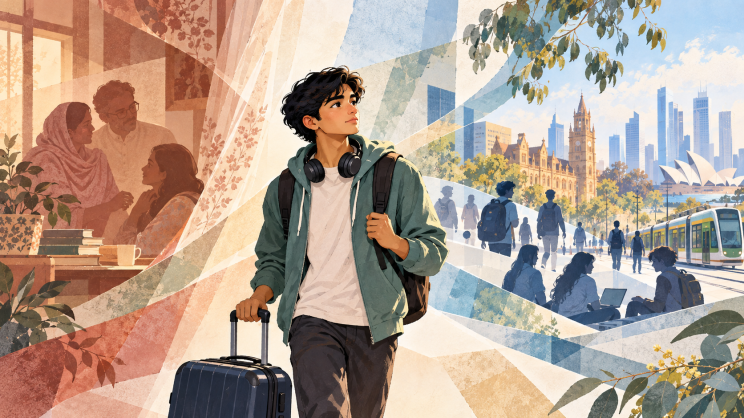
Behind those numbers are tens of thousands of young people making a profound psychological transition. A young Bangladeshi man might arrive in Australia at 19 or 20, having spent most of his life living with his parents. His family may have exercised considerable influence over his friendships, movements and relationships with women. Dating may have been discouraged or hidden. Sex may rarely have been discussed at home except in the context of marriage. Alcohol and drugs may have been prohibited. His parents may have made many of the important decisions in his life.
Then he arrives in Sydney. Suddenly, he has his own money, accommodation and a large degree of independence. He encounters alcohol, drugs, dating apps, nightclubs and a social environment in which young men and women mix freely. His parents are thousands of kilometres away.
At the same time, he may be working long hours to pay rent and tuition fees, studying under considerable pressure and worrying about the money his family has invested in his future. It is a strange combination: extraordinary freedom accompanied by extraordinary pressure.
I have come to think of this as the freedom gap.

Apprenticeship of adulthood
We tend to think of autonomy as something that arrives automatically when someone turns 18. In reality, most young people acquire it gradually. They have an apprenticeship in adulthood. A teenager gets a part-time job and learns what it means to earn money. He gets a driver's licence and gradually learns the consequences of taking risks behind the wheel. He goes to parties, discovers alcohol, makes friends with girls, experiences attraction and rejection, has relationships that don't work out and learns to negotiate boundaries. None of this is a formal curriculum. Much of it is learned through years of small experiences and occasional mistakes. Likewise, the very idea of autonomy is not always seen as desirable in highly collective societies.
Some young migrants arrive in Australia without having had the same opportunity to rehearse these things. They may be highly educated and academically accomplished, yet relatively inexperienced in the practical business of autonomy. They can be perfectly capable of passing an English-language examination while not understanding the social language of Australian relationships.
Understanding the sentence ‘she is being friendly’ is not the same as understanding what that friendliness means. A woman can be friendly without being sexually interested. She can enjoy talking to a man without wanting to kiss him. She can change her mind.

Research on international students from more conservative cultures in Sydney has found that some perceived Australia as substantially more sexually permissive than their home countries. Researchers found that the removal of close parental monitoring could contribute to a sense of sexual freedom and changes in behaviour. Importantly, the study was not about sexual offending; it was about how young people from different cultural backgrounds learn and interpret sexual norms.
This is perhaps the crucial distinction: information is not the same as experience. You can tell somebody what consent means in a lecture. It is harder to teach someone how to recognise the complicated social signals involved in attraction, rejection, embarrassment and uncertainty.
Navigating a shifting and unwritten social script
There is another complication. The sexual culture into which these young men arrive is not straightforward. Australia may be much more sexually permissive, but the rules governing relations between men and women have themselves become increasingly contested. The #MeToo movement, the growing emphasis on affirmative consent, arguments about pornography and hookup culture, and increasingly divergent attitudes between young men and women have made the old social script much less certain. Even young Australians who have grown up within this culture can struggle to navigate it. While sex is more visible, some evidence suggests that young people are dating and forming relationships less often, with researchers describing a possible ‘dating recession’. Australia has also seen a decline in marriage and a shift towards later couple formation.
For a young Bangladeshi man, then, the challenge is not simply one of moving from a sexually conservative culture to a sexually liberal one. He is moving from a society in which relations between unmarried men and women may be tightly structured by family, elders, religion and expectations around marriage into one in which individuals are expected to work out the rules for themselves. A young couple in Bangladesh may have their behaviour constrained by a remarkably clear set of social expectations; in Australia, two people meeting on a dating app may have to negotiate almost everything themselves. That is a much more demanding form of social freedom.
This is where Bangladesh's own culture becomes relevant. Sex remains a difficult subject in much of Bangladeshi society. Research involving young Bangladeshis has described premarital relationships and sex as heavily tabooed, with marriage remaining the socially legitimate context for sexual relationships. Other research examining middle-class Bangladeshi adolescents has found that silence around sexuality between parents and children is common.
This does not mean that young Bangladeshis are sexually naive. There is evidence of premarital sexual activity among young people, although reliable national data are limited, partly because sexuality remains a difficult subject to ask about. The point, rather, is that the social script is different. A young person may learn about sex through friends, the internet and pornography while receiving almost no guidance from parents about relationships, consent or sexual boundaries. That can create a peculiar mismatch between sexual knowledge and emotional maturity.
Religion can be part of this story, but it should not be exaggerated. Islam is not a single cultural experience, and there are enormous differences among Muslim families and individuals. Many religious young people navigate Australian society without difficulty. But for some young Muslims, as for some young people from other conservative religious cultures, sexuality may have been presented primarily as something that belongs within marriage. The young person may therefore have had little experience of the messy intermediate territory that Western adolescents commonly navigate: flirting, dating, rejection, casual relationships, changing one's mind and learning to understand another person's boundaries.
There is another important feature of the Bangladeshi experience: the extraordinary investment parents can make in their children's education overseas. Sending a son or daughter to Australia is rarely simply an individual decision. It may represent years of saving, borrowing and sacrifice. There may be expectations that the child will obtain a degree, secure a good job, eventually gain permanent residency and perhaps help the family financially.
For the student, this can create an enormous psychological burden. Migration research has described international students as living within what is sometimes effectively a transnational family project: their individual educational decisions are tied to the hopes, finances and future plans of families back home. The young person therefore arrives carrying two things simultaneously: freedom and obligation.

This can be particularly complicated for young men. In many South Asian families, sons may remain closely connected to their parents well into adulthood. Adulthood may be demonstrated through education, earning capacity, marriage and eventually becoming a provider, rather than by immediately establishing an independent life.
Recent research involving more than 11,000 young Bangladeshi men found that fatherhood and family responsibility remain strongly connected to ideas of masculinity and adulthood. Another study found that masculinity was closely associated with earning, providing for a family, marriage, sexuality and social status. Marriage itself could be viewed as a socially sanctioned way of managing sexual desire.
There is nothing inherently wrong with this family model. Indeed, there is much that Western societies could learn from its emphasis on family obligation and intergenerational responsibility. The difficulty comes when dependence and autonomy change at different speeds.
Academic brilliance vs social inexperience
A young man can be intellectually sophisticated but socially inexperienced. He can have spent years preparing for an engineering degree while having had almost no preparation for living independently.
This is why I think the phrase ‘mama's boy’, sometimes used dismissively about South Asian men, misses something important. Dependence on parents is not necessarily a sign of immaturity. It can reflect a perfectly legitimate cultural model of family life. The problem arises when a young man moves directly from a highly supervised family environment into an intensely individualistic society.
The consequences aren't necessarily sexual offending. They can be more mundane: reckless driving, excessive drinking, drug use, financial problems, unhealthy relationships or mental-health crises. But occasionally, the consequences can be catastrophic.
Learning to regulate oneself
That is why I think universities need to recognise that educating international students means more than helping them pass their exams. We are very good at teaching students how to enrol, where to find accommodation and how to navigate their courses. We should also teach them how to live.
That means talking openly about consent and sexual boundaries, explaining Australian expectations around alcohol and drugs, and discussing driving, money, gambling, relationships, loneliness and mental health. It should not be presented as ‘teaching migrants Australian values’. That would be patronising and counterproductive. It should be presented as an education in autonomy.
There is something else in this for parents in Bangladesh and other countries who are sending their children abroad. Perhaps preparing a child for overseas study should involve more than teaching them to study hard and saving enough money to send them away. They also need to learn how to make decisions without their parents: how to manage money, deal with alcohol, respond to sexual attraction, hear ‘no’, tolerate rejection, recognise danger and seek help when they are lonely.
And perhaps most importantly, they need to understand that freedom is not the same thing as getting to do whatever you want.
Freedom is the capacity to regulate yourself when nobody else is watching.
That is something most of us learn gradually, imperfectly, through the ordinary apprenticeship of growing up. For some young people arriving from Bangladesh, Pakistan, Indonesia and other relatively traditional societies, that apprenticeship has to happen after they have already left home.
It is not surprising that some young people find this sudden transition to independence difficult. The lesson is not that they were given too much freedom. It is that freedom sometimes arrives before they have had enough opportunity to learn how to use it.
Dr Tanveer Ahmed is a Sydney-based psychiatrist and author. He can be reached at drtahmed@gmail.com.
Send your articles for Slow Reads to slowreads@thedailystar.net. Check out our submission guidelines for details.

When loyalty decides what counts as facts: Welcome to the age of epistemic fragmentation

Revisiting the origins of Sufism: Competing narratives of authenticity and borrowing

International Translation Day 2026 / Beyond equivalence: Translation and the politics of being understood
Between Ghumparani masi-pisi and Baby Shark: Why Bengali lullabies still matter in the age of screens

Not love at first sight
How far can devotion take us? Radhe Jaggi’s BHAKTA explores the sacred

The moral hierarchy of pleasure: Who controls women’s bodies?
My grandmother’s world: Partition, Shia traditions and memories of Old Dhaka

The taste of childhood: Bengali food, family and memory