Between Ghumparani masi-pisi and Baby Shark: Why Bengali lullabies still matter in the age of screens

In my childhood, there was a particular hour of the day I waited for with quiet anticipation. It arrived when my mother had finally wrapped up her daily chores, washed the fatigue from her hands, and came to lie beside me and put me to bed. That meant only one thing: now she would tell me stories and recite poems until I fell asleep.
She remembered only a handful of verses by heart, but every time she hummed them, they captured my heart in an entirely new way. I was particularly enchanted by the tale of the chader buri, the old woman who lives on the moon, spinning thread on her chorka. As my mother sang, she would point towards the night sky and show me the moon. I would often ask her where the old woman was, as I could not see her, but she kept telling me she was up there somewhere. To my young mind, having some tangible presence was important to believe that someone truly lived there. So, I took the dark patches and shadows on the moon as proof that somebody really was up there, and that my mother was right. As she kept repeating the poem, I would lose myself wondering what the buri was doing and what her world looked like. Was she draped in white or shimmering silver? I would keep wondering until my mother’s voice gently trailed off as she fell asleep. Sometimes I let her rest; other times, reluctant to break the spell, I would gently shake her awake and plead for just one more poem.
As a young girl who dreaded the morning bell, waking up was an everyday tug-of-war. To coax me out of the warmth of the blanket, my mother would recite Kazi Nazrul Islam’s verse: “Bhor holo dor kholo khukumoni uthore” (Dawn has broken, open the door, wake up, little girl). What worked was not just the rhyme, but the way she made me believe that I was that very Khukumoni. On the mornings I rose willingly, she would happily dress me for class. On the days I resisted, she would tease me that I was not the Khukumoni of the poem after all, and my little mind would feel that mild sting, which made me resolve to do better next time.
Then there was the rhyme she sang whenever it was about to rain: “Aay Brishti jhepe, dhan dibo mepe, lebur pata koromcha, jaa brishti chole jaa.” As a child, I did not understand what dhan dibo mepe or lebur pata had to do with the rain, but hearing her voice rise against the pitter-patter of the showers made my heart leap with pure joy. Even now, whenever the skies darken and the rain splashes down, I lose myself in the strings of memories from my childhood, carried along by the rhythm of that very same rhyme my mother used to sing to me.
Songs as old as language itself
More than simple bedtime melodies, lullabies are an infant’s first conversation. They represent an ancient, intimate human ritual in which cadence, physical touch, and the timbre of a voice combine to teach a newborn safety, love, and the foundational music of human speech.
Lullabies have accompanied humanity for as long as recorded history can trace. The earliest known example was discovered in modern-day Iraq, etched with a reed stylus into a 4,000-year-old Sumerian-Babylonian cuneiform clay tablet. Yet those ancient verses were strikingly different from the gentle melodies we associate with motherhood today; they were stern, cautionary, and edged with menace. Mothers warned their weeping babies that their cries were disturbing the household gods and that, if they did not quiet down, a demon might seize them. Similar ominous warnings echoed through the cradles of ancient Greece and Rome. To modern ears, threatening a child with a monster sounds more terrifying than sleep-inducing, yet it sprang from a primal impulse: in a world cloaked in darkness and marked by infant vulnerability, a parent’s voice was an auditory boundary erected against the night.

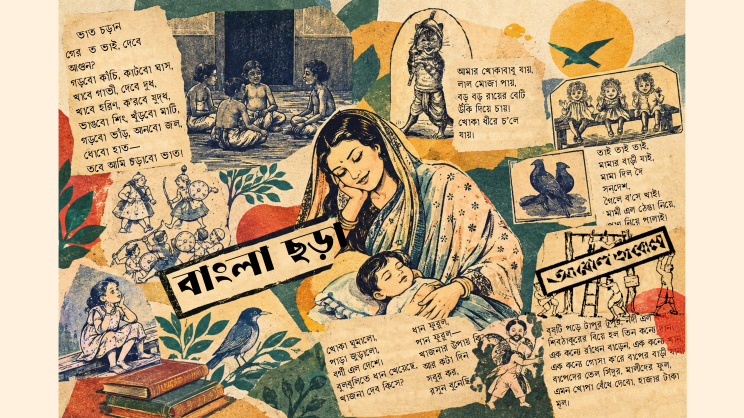
In Bengal, the lineage of lullabies is just as ancient. Scholars believe our chhara and cradle songs are at least a thousand years old, maturing alongside the Bengali language itself. Rabindranath Tagore viewed these folk verses as humanity’s earliest creative outpourings. For centuries, they existed purely in the air, passed down across courtyards without books and carried in the living memory of mothers, grandmothers, and elder sisters.
In these early Bengali songs, sleep was personified as an affectionate visitor. Mothers pleaded with Ghumparani masi-pisi (the maternal and paternal aunts of sleep) to step into their huts and gently bring sleep to their babies’ eyes. They looked up at the night sky and addressed the moon as Chad mama, pleading with him to bestow a loving mark, a tip, on the child’s forehead.
Yet Bengali lullabies were never insulated from historical reality; they absorbed the community's collective trauma. In his seminal study Bengali Folk Rhymes: An Introduction, folklorist Dr Syed Mohammad Shahed illustrates how these verses dynamically adapted to local lived experiences. During the mid-18th century, when the feared Maratha cavalry raiders, the Bargis, plundered the countryside of western Bengal, the terror seeped directly into bedtime verses: “Chhele ghumalo para juralo borgi elo deshe...” (The baby sleeps, the neighbourhood quiets down, the Bargis have arrived in our land...) The rhyme became an urgent plea for children to keep silent lest the marauders hear them. Remarkably, when the verse migrated to coastal regions like Chittagong, where horse-riding raiders never ventured, the local folk quietly swapped borgi for gorki, the devastating tidal surges that routinely wiped out their standing crops. The lullaby adapted to reflect the real-life vulnerabilities of the soil.
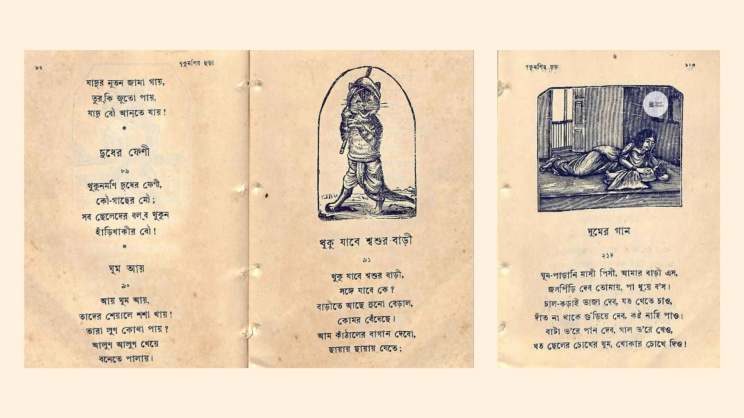
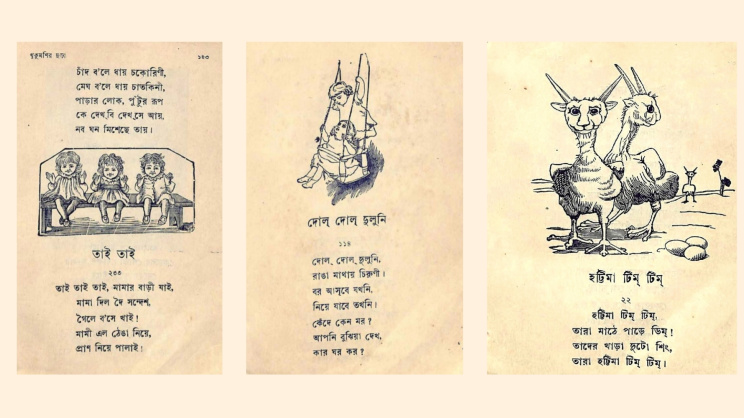
For generations, urban elites overlooked these rural verses as mere domestic trivia. That changed in the late 19th century, when Tagore began traversing rural Bengal, recording roughly a hundred folk rhymes and hailing them as pristine poetic treasures. His endeavour catalysed the efforts of others: in 1899, Yogindranath Sarkar published Khukumonir Chhara (Rhymes for the Little Child), the first printed compendium dedicated entirely to Bengali children’s verse. Following the 1947 Partition, as East Pakistan rose in defence of its mother tongue during the 1952 Language Movement, these oral traditions became symbols of cultural survival. By the 1960s, researchers from Dhaka’s Bangla Academy had fanned out into remote villages, documenting roughly 5,000 traditional rhymes. What began as quiet whispers in village huts had officially entered the national consciousness.

Lullabies, neuroscience, language, and the vagus nerve
What folk tradition preserved through intuition, modern science is now validating through neurobiology and linguistics. In an interdisciplinary study on early childhood development, researchers demonstrate that lullabies are far more than sleep-inducing tools; they function as multimodal developmental resources operating at the precise intersection of speech acquisition, emotional regulation, and neurological growth.

Long before an infant comprehends grammar, the human brain is attuned to the pitch, rhythm, and melodic contours of human speech. Lullabies naturally mirror the acoustic characteristics of infant-directed speech: elongated vowels, elevated pitch, and predictable repetition. Drawing upon Jerome Bruner’s concept of the Language Acquisition Support System (LASS), lullabies provide infants with early linguistic scaffolding. Through the regular, rhythmic cadence of traditional verses, a child learns auditory discrimination and phonological awareness long before they ever enter a formal classroom. In a sociocultural sense, as Lev Vygotsky framed early learning, singing creates an interactive social field: the baby responds to the mother’s song with gaze, micro-vocalisations, and subtle shifts in movement, turning a bedtime song into humanity’s foundational masterclass in communication.

Beyond speech, the melody of the lullaby operates as a form of biological medicine. Researchers highlight how the autonomic nervous system continuously scans the environment for cues of safety or threat. A caregiver’s soft, low-frequency hum and gentle rocking deliver direct auditory and somatic signals of safety. These cues stimulate the baby’s vagus nerve and activate the parasympathetic nervous system, the biological mechanism responsible for down-regulating heart rate, calming distress, lowering cortisol levels, and easing the child into rest.
Recent neuroimaging research underscores this profound connection: studies tracking infant neural responses show that infants’ brains demonstrate active, measurable neural tracking of live maternal singing. The predictable melodic architecture of lullabies not only synchronises neural firing patterns but is also directly associated with later vocabulary expansion.
Crucially, the researchers emphasise why artificial substitutes stumble: recorded music, algorithmic playlists, and AI-generated tunes lack the responsive feedback loop of a living caregiver. In live singing, a mother instinctively adjusts her tempo when she sees her baby’s eyes flutter; she softens her voice as the child’s breathing slows. A speaker can deliver sound, but only a human presence can establish this neurobiological circuit of safety.
The digital rupture
Yet, despite this intricate biological design, the vitality of these songs has begun to erode rapidly over time. I witnessed this generational break firsthand with my toddler niece.
Watching her grow, I was astonished by how effortlessly she embraced the digital landscape. At her age, I could barely recite the Bengali consonants in order; she, by contrast, could reel off the chronological classification of prehistoric dinosaurs with startling precision. We were delighted by the way she consumed knowledge, but beneath that awe lay an unspoken anxiety: she was absorbing a vast universe of information while remaining entirely untouched by the emotional texture of our upbringing.
When I tried reading her storybooks, her attention wandered. When we recited the rhymes of our childhood, she met them with mild indifference. She never asked for another stanza, nor did she imagine a village on the moon. Instead, she reached for a tablet, slid her tiny finger across the glass, and invited us to watch with her. She felt no curiosity towards “Aay aay chad mama,” but her entire body would light up the moment the hyper-vibrant, synthetic beats of “Baby Shark” filled the room.
Baby Shark and similar videos sweeping the internet often offer vibrant digital graphics and a relentless tempo, but they lack the soft, tender glow of a mother stepping onto a veranda, pointing up at the real night sky, and humming to the moon.
Co-regulation vs. visual capture
The loss of the oral lullaby is not merely a sentimental grievance; it has measurable consequences for the mental, emotional, and behavioural development of growing children. To understand what is lost when a screen replaces a singing caregiver, one must look closely at the mechanics of child psychology. According to Dr Md Azharul Islam, Associate Professor in the Department of Educational and Counselling Psychology, “When a parent or parental surrogate holds, rocks, and sings a traditional chhora to a child, they engage in a multisensory ‘co-regulation’ process. The child’s and carer’s physiology and psychology strive to achieve harmony together.”
This biological attunement, the synchronisation of heartbeats, the rise and fall of a parent's chest, the softening pitch of the voice, and skin-to-skin warmth, is how a baby's nervous system learns what safety feels like. An infant cannot regulate their own stress hormones; they borrow the calm of the adult holding them.
A screen, no matter how educational the application claims to be, is fundamentally incapable of this biological dialogue. As Dr Islam explains, “A screen offers visual capture, not co-regulation. It holds a child’s attention through passive sensory tracking, leaving the nervous system in an externally controlled state rather than teaching internal self-soothing. A screen can distract a child with bright pictures, but it cannot make them feel secure or teach them how to soothe themselves from the inside out.”
The stylistic contrast between traditional chharas and modern animated video rhymes further compounds the problem. Bengali folk rhymes are inherently slow, repetitive, and organic; they mirror the resting human pulse. Modern digital children’s content, by contrast, often relies on fast-paced scene cuts, rapid visual flashes, and relentless sensory stimulation designed to hold attention. This sensory onslaught can exact a developmental toll. “Fast-paced content often overloads young brains,” warns Dr Islam. “It leads children to expect constant excitement, which rarely aligns with real-life experiences. Hence, when a digital device is turned off, children may have tantrums, making it harder for them to sleep peacefully.”
When the tablet screen finally goes dark, the child can be left unsettled, their nervous system still stimulated, their brain craving another burst of excitement, and their emotional core deprived of the internal tools required to drift into rest.
When the living room grew quiet
It is easy to cast modern parents as indifferent, but this behavioural shift is rooted in profound structural transformations. We are living through sweeping urbanisation, industrialisation, and migration that have dismantled the quiet spaces where lullabies once thrived.
A primary driver is economic necessity, shaped by population pressure and diminishing rural land. Dr Md Saifur Rashid, Professor in the Department of Anthropology at Dhaka University, points to these structural cracks: “Due to a rising population, competition over our limited resources is growing. In our villages, changes are occurring in rural households: landlessness is rising, family size is pressing against diminishing land, pauperisation is taking place, and consequently migration is swelling. As a result, this economic change is altering our social structure as well.”
One of the most significant consequences of this economic pressure has been the decline of the single-income household. Whether in a rural union or a Dhaka high-rise, sustaining a family on one person’s wages has become increasingly difficult. “Even in villages now, a household cannot be sustained on a single income; the income of two people is getting combined,” Dr Rashid observes. “Women are working in villages, men are working, or engaging in income-generating activities where they earn direct cash. Because the cost of living for families has risen so steeply, a family simply cannot run on one person’s income alone. Consequently, the dual-income model has become a survival mandate.”
This economic pressure has also weakened the traditional support network of the extended family. In the joint households of our past, child-rearing was an ecosystem. If a mother was exhausted or busy at the hearth, a grandmother was waiting with an open lap; an aunt could recite a tale; an uncle could soothe a crying toddler.
Today, many of those extended networks have dissolved into isolated nuclear units. Urban parents return home from gruelling commutes and relentless workdays, physically, mentally, and emotionally depleted. With no relatives down the corridor to share the burden, parents find themselves running on depleted reserves of patience.
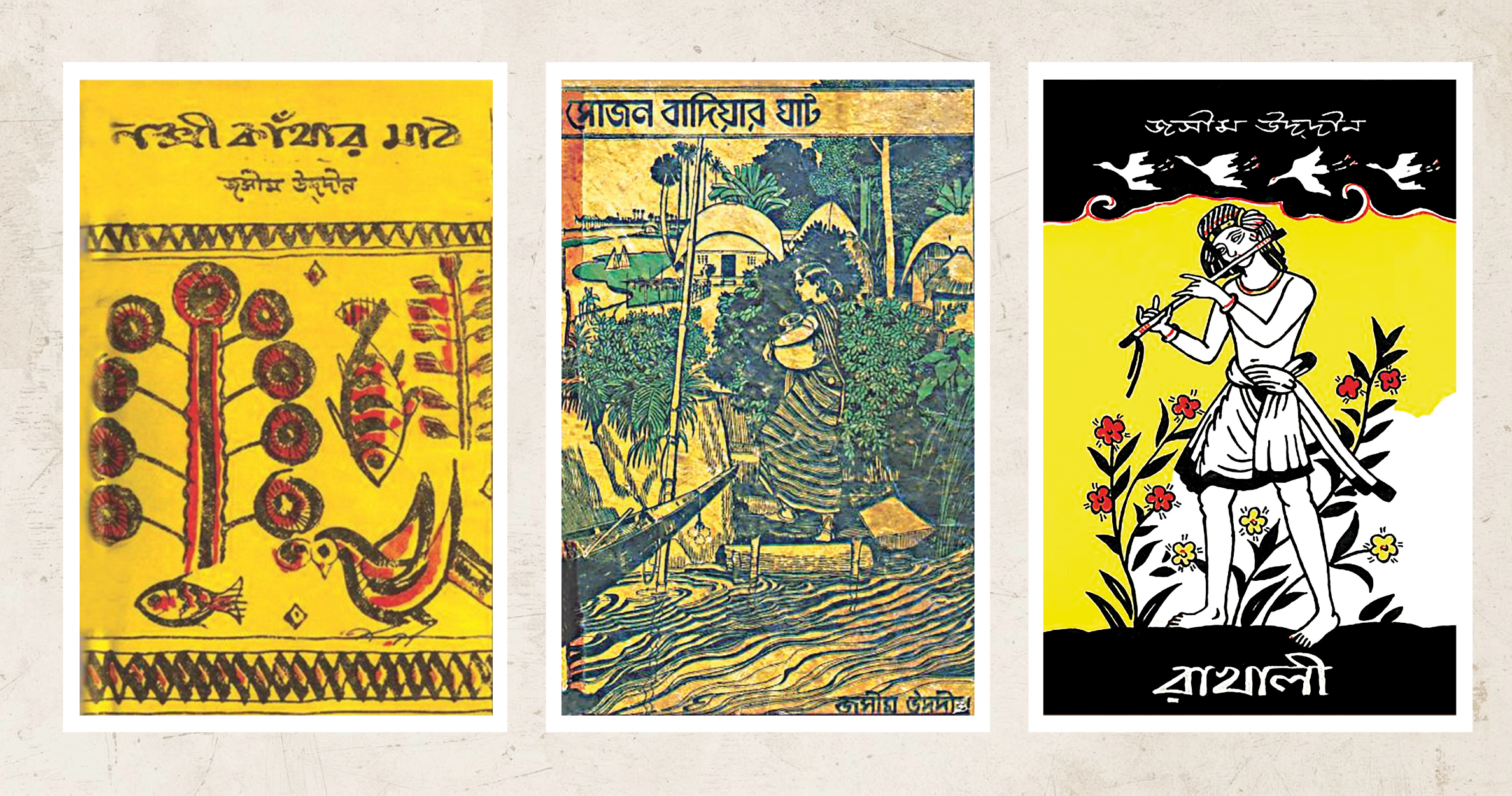
This cultural rupture resonates deeply with anthropologist Dr Rasheda Rawnak Khan, Associate Professor in the Department of Anthropology at the University of Dhaka. Reflecting on her own childhood, she recalls how her early love for her mother tongue did not begin in a classroom, but at home through her mother’s nightly stories. Her mother, a professor of Bangla, would regularly recount the classics of Bangla literature, from Kazi Nazrul Islam, Rabindranath Tagore, Michael Madhusudan Dutt, and Jasimuddin to Jibanananda Das.
Those stories did not just entertain; they planted seeds of cultural identity that stayed with her throughout adulthood. “Today, that very bridge is missing between parents and their children,” observes Dr Khan. “Parents return home from work utterly drained. Out of exhaustion, they find it easier to simply hand a digital screen to the child. In doing so, that vital, face-to-face interaction, where language, literature, and empathy are passed down naturally, is completely lost.”
In this vacuum of exhaustion, the digital screen ceases to be merely an entertainment device; it transforms into a digital pacifier. Handing a child a smartphone becomes a substitute born of fatigue. Just as slow, home-cooked meals are replaced by instant takeaway, and games in open playgrounds are traded for indoor confinement, the intimate labour of singing a lullaby is outsourced to an algorithm. We satisfy the child with pixels because we have run out of the time and peace required to sing.
The warmth no screen can give
Is the ancient music of childhood irrevocably lost to modern survival? Not necessarily. The solution for exhausted, working parents is not unrealistic guilt, but intentional, grounded presence.
When asked what minimum threshold of interaction is needed to preserve emotional security in homes dominated by screens, Dr Azharul Islam offers an encouraging, human perspective: “It is difficult to define a minimum threshold for physical interaction. More is always better. Parents should take at least some time to shift the child’s attention from the device to the sensation of a human. A 10-minute gentle hug or interaction can be enough for some children, while for others it may take a little longer. The chemistry behind every parent-child dyad is unique; only a mindful parent can identify it and therefore use it for the child’s betterment.”
Even ten minutes of undistracted physical contact, resting a tired head against a parent’s shoulder, receiving a slow back rub, or listening to a hummed verse of “Ghumparani masi-pisi” without a phone in sight, can help bridge that biological gap. It signals to the child’s overstimulated nervous system that the day’s stimulation is over and that the physical world is safe.

A lullaby was never merely about inducing sleep. It was about human presence. It was the vibration of a mother’s voice travelling through her chest and into her child’s ear; it was eye contact in the dim night light; it was the shared gaze into a dark sky that held both mystery and protection.
Algorithms can offer children sharp colours, catchy jingles, and taxonomies of prehistoric creatures. But they cannot look an infant in the eye. They cannot sense a toddler’s hesitation, soften their cadence to steady a shallow breath, or whisper that the old woman on the moon is still up there, watching over them as she spins her wheel into the night. In outsourcing the lullaby, we do not merely lose an old rhyme; we risk losing the very warmth that teaches our children how to feel safe and connected. Yet assigning blame solely to weary parents ignores the harsh realities of modern survival. A mother or father working twelve hours a day simply to keep pace with soaring living costs cannot be expected to single-handedly shoulder the preservation of a millennium-old oral tradition. If households can no longer function as the sole custodians of our folklore, a crucial question arises: where does institutional responsibility begin?
Anthropologist Dr Rashid argues that we are staring at a looming cultural catastrophe: the quiet erasure of our indigenous knowledge, oral rhymes, and lullabies. Halting this erosion, he insists, requires looking far beyond the domestic threshold. “We blame families, but we know the harsh reality,” says Dr Rashid. “Despite their deepest desires, parents today cannot easily take their children to open fields; they struggle to provide traditional, wholesome foods; and they often lack the time or energy to recite the rhymes, stories, and lullabies they grew up with. If families are overwhelmed, do our institutions bear no responsibility? Does our Ministry of Education have no role? Does our Ministry of Cultural Affairs have no obligation? And given our rapid technological development, shouldn’t our Ministry of Science and Technology actively participate in using technology to revitalise our eroding cultural heritage?”
Rather than waging an impossible war against technology, Dr Rashid advocates for an intentional transformation of what screens offer. Because televisions, tablets, and mobile phones have become permanent fixtures of childhood, the focus must shift from passive surrender to cultural revitalisation.
“This calls for a broad socio-cultural movement,” Dr Rashid emphasises. “A coordinated movement supported by our Ministries of Cultural Affairs, Education, and Science and Technology. Television and digital devices are ubiquitous, but how are we inspiring the next generation to engage with them meaningfully? If our public institutions and creative industries step forward to produce quality, engaging content based on our intangible cultural heritage, our folk rhymes, our stories, our musical traditions, then even when children look at screens under the pressures of modern life, they will not become alienated from their roots.”
Precedents for such cultural stewardship already exist in Bangladesh’s broadcast history. Formative programmes like Meena and Sisimpur proved that educational, culturally rooted media could captivate young audiences while instilling foundational values. More recently, dedicated platforms like Duronto Television, alongside revivalist efforts in traditional puppetry, or putul nach, have demonstrated how folklore and children’s rhymes can be brought into the 21st century without shedding their local soul.
For Dr Rashid, integrating traditional rhymes into school curricula, children’s theatre, television broadcasts, and curated digital spaces is not merely an aesthetic choice; it is a safeguard for the child’s inner development. “Our future generation should not become alienated from their culture,” he warns. “Through that alienation, children drift away from their own language; they lose touch with shared community values, and it inevitably takes a toll on their mental well-being and moral grounding. Preserving our intangible cultural heritage is not about living in the past; it is about ensuring our children do not lose the very social traditions that anchor who they are.”
Adrin Sarwar is a journalist at The Daily Star.
Send your articles for Slow Reads to slowreads@thedailystar.net. Check out our submission guidelines for details.
Not love at first sight
How far can devotion take us? Radhe Jaggi’s BHAKTA explores the sacred
The moral hierarchy of pleasure: Who controls women’s bodies?
Inherited Memories / My grandmother’s world: Partition, Shia traditions and memories of Old Dhaka

The taste of childhood: Bengali food, family and memory

Along the Kapotaksha, in search of Madhusudan’s river

Where did gold come from?

Do we understand the children we try to teach?