


How the system fails abused girls

A few days ago, in a lawyer’s chamber in the capital, a mother pleaded for something the law does not allow.
Her six-year-old daughter had allegedly been raped by her father, a CNG driver. After the child’s grandmother filed a case leading to his arrest, the family faced financial ruin.

“Please help me withdraw the case so I can get his bail,” Fahmida Akter, a lawyer at the Dhaka Medical College One-Stop Crisis Centre (OCC), recalled the mother pleading. “I have two small children to feed. Where do I go? He made a mistake, but he promised to run the family once he gets out.”
Told the case could not simply be withdrawn through an informal settlement, the mother left without seeking further legal aid.
In another case, the father of a 12-year-old survivor sought an out-of-court settlement despite his daughter having testified. Influential relatives of the accused had repeatedly pressured the family, the legal team said.
“Apa, suppose the man gets sentenced after two years,” Fahmida recalled him asking. “By that time, I won’t even be alive.”
The cases expose failures in Bangladesh’s child-protection system. Despite specialised laws, tribunals and reforms, protection can break down from disclosure and emergency care to investigation, prosecution and trial, particularly when abusers are family members or trusted adults.
Poverty, intimidation and inadequate witness protection, financial support and state intervention can make abandoning cases seem safer than seeking justice.
Legal analyst and researcher Fowzul Azim, a retired senior district judge, blamed failures throughout the law-enforcement process rather than inadequate laws.
Evidence may be lost, witnesses disappear, families face pressure and children remain unprotected before cases reach court, he said. Since judges must decide on available evidence, improving convictions requires stronger investigations, forensic examinations, prosecutions, witness protection and child-friendly trials, not merely harsher punishment.
When abusers are relatives, families cannot remain children’s sole protectors, he said. The state must provide alternative guardianship, legal representation, shelter and psychosocial support.
“Our goal should not simply be a speedy trial. It should be a speedy and accurate trial that minimises the child’s risk of re-traumatisation,” he said.
A poorly handled trial, even after years, is not judicial success, he added. Children must not be victimised again while seeking justice.
WHEN TRUST BECOMES A THREAT
A 2025 media-monitoring audit by child-rights organisation Shishurai Shob examined 308 reported child-rape cases. The accused were immediate neighbours in 40.58 percent, acquaintances in 21.43 percent, teachers or religious instructors in 14.61 percent, close relatives in 13.64 percent and strangers in just 9.74 percent.
The audit found 59.09 percent of reported sexual-abuse cases and 66.12 percent of 124 monitored child-murder cases occurred at home.
Roksana Sultana, executive director of Breaking the Silence, said abuse by relatives or guardians often remained hidden because of inadequate supervision, concerns over “social honour” and financial stability.
“Trusted adults often become perpetrators, while families remain silent,” allowing abuse to continue, often until it escalates, she said.
From Jan-Sept 2026, 14 OCCs and 67 district-level crisis cells received 2,087 child rape survivors aged 0–18. From Jan-Aug, 4,465 cases were filed under the Nari-O-Shishu Nirjatan Daman Act, including 1,715 child rapes.
Nahin Zaman Moury, manager of advocacy at Breaking the Silence, who has been working in child protection in Cox’s Bazar for nearly a decade, described similar barriers among low-income families.
 For all latest news, follow The Daily Star's Google News channel.
 A day labourer in Cox’s Bazar owed Tk 200,000 to his eldest daughter’s husband. When the son-in-law allegedly repeatedly sexually abused his younger sister-in-law, leaving her pregnant, he threatened immediate debt repayment and divorce if reported to police. The family remained silent.
In another case, a girl with a cognitive disability gave birth after repeated sexual abuse by her paternal uncle. His social standing and fears of retaliation prevented the family from reporting, Maury said.
EMERGENCY CALLS, WEAK RESPONSE
National Emergency Service 999 recorded reports of 176 child rapes, 107 attempted rapes, 127 domestic violence cases and 82 incidents of unusual sexual violence between January and September 2026.
In the past five years, the 1098 Child Helpline, under the Department of Social Services, logged 2.5 million calls -- 64,289 concerning violence against girls and 34,946 involving child-marriage prevention.
Chowdhury Md Mohaimen, manager at Bangladesh Child Helpline-1098, said that reporting child abuse remains severely constrained by restricted phone access for girls and widespread non-disclosure driven by social stigma.
Helpline records reflect this disparity, showing a higher volume of incoming calls from males (60pc) than females -- largely because adolescent girls rarely have personal access to mobile devices.
“Even when abuse is reported, intervention is hindered because our inter-agency coordination and referral mechanisms at the field level remain extremely weak,” he said.
Although the Children Act 2013 mandates upazila-level Child Welfare Boards chaired by the UNO to handle local child protection, coordination among local administration, police, and social welfare officers remains largely unmonitored and fragmented, he noted, adding that there is no centralised state database to systematically track case resolutions across districts.
Furthermore, the Department of Social Services operates under acute field-level capacity constraints, employing approximately only one social worker for every 103,000 children in Bangladesh, making continuous case management and monitoring across upazilas exceptionally difficult, he added.
STRAINED SUPPORT SERVICES
Bangladesh’s 14 One-Stop Crisis Centres (OCCs) at public medical college hospitals received 1,580 rape survivors aged 0-18 between January and September 2026, while its 67 district-level One-Stop Crisis Cells received 507.
Despite this steady influx of young survivors seeking care, the vast majority never enter the formal justice process. Of the 66,711 women and children supported across these centres up to July 2024, official records show that formal cases were filed in only 20,914 instances. OCC staff attribute this massive reporting gap to pervasive threats, intense family pressure, the absence of witnesses, and forced out-of-court settlements.
Compounding these operational hurdles, 373 personnel across OCCs, crisis cells, and the national DNA profiling laboratory -- including legal officers, psychological counsellors, and forensic technicians -- had gone unpaid since January 2026 amid administrative delays in transitioning to outsourced recruitment models.
DMCH OCC lawyer Fahmida Akter, observed that families frequently conceal abuse perpetrated within the home by close relatives, such as father, uncles or stepfathers, seeking only emergency medical treatment without registering a police case.
Furthermore, reporting delays combined with early family intervention severely compromise forensic proof.
“When families bathe the child or wash their clothes before arriving at the hospital, vital biological and DNA evidence is destroyed,” Akter explained.
“While doctors may still identify physical trauma during medical examinations, the lack of matching DNA makes proving guilt beyond reasonable doubt exceptionally difficult in court.”
SAFEGUARDS ON PAPER
Police Headquarters recorded 4,465 cases under the Nari O Shishu Nirjatan Daman Ain between January and August 2026, including 1,715 child-rape cases.
Highlighting major operational hurdles in child abuse investigations, Kamarum Munira, assistant inspector general (Media and Public Relations) at Police Headquarters, noted that delayed reporting often leads to evidence destruction when victims shower or wash clothes, while out-of-court compromises and a lack of neutral witnesses leave trials over-reliant on compromised forensic reports.
To address this, police operate Child Help Desks across 661 stations, instructing officers to gather verified forensic evidence, document statements meticulously, and protect threatened witnesses.
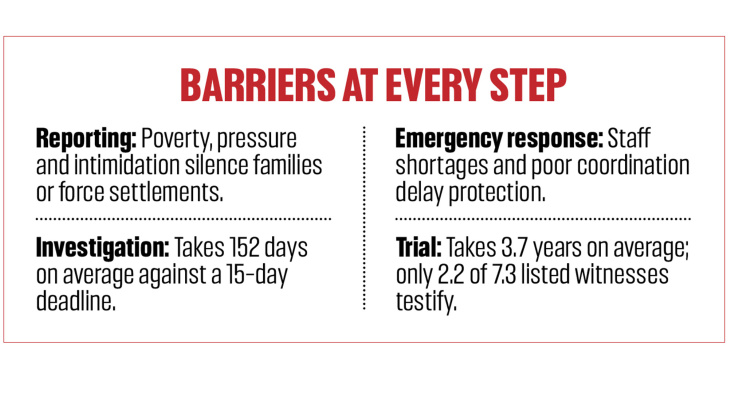
Yet a stark gap remains: a 2026 joint Supreme Court–BRAC study found investigations averaged 152.2 days -- far exceeding the 15-day limit -- with only 2.2 of 7.3 listed witnesses actually testifying.
JUSTICE DELAYED
The study examined 4,040 disposed cases across 32 districts. Of these, 1,193, or 29.55 percent, involved victims under 18, including girls as young as two.
Despite a 90-day statutory deadline for rape trials under the amended law, cases averaged 1,370 days, about 3.7 years, and 22 hearings.
Only 3 percent ended in convictions, against 70.2 percent acquittals and 13.4 percent compromises. Fifteen districts recorded no convictions among cases examined.
After charge-sheet submission, charge framing took another 346 days on average, followed by 963 days from charge framing to judgment.
“A judge cannot become a prosecutor,” said Fowzul Azim, stressing that courts cannot build prosecution cases when investigators fail to collect evidence or prosecutors fail to produce key witnesses.
Investigation quality is therefore critical to convictions. But judicial neutrality should not mean passivity, he said.
Azim urged proactive case management, stricter limits on unnecessary adjournments, scheduled appearances of material witnesses and digital tracking of investigation deadlines, charge-sheet submissions, witness attendance, forensic reports and adjournment reasons to identify delays, alongside objective assessments of prosecutors.
THE MISSING LAYER
Child protection must extend beyond policing and criminal justice, said Laila Khondkar, convener of Shishurai Shob.
Citing international frameworks, she noted that specified professionals in Australia face mandatory obligations to report suspected abuse, while local authorities in England are legally required to make enquiries if a child faces significant harm.
Such systems, she explained, extend protection to risk assessments, case management, social-work interventions, and coordinated health and psychosocial services.
Pointing out that Bangladesh lacks an integrated protection system despite existing provisions under the Children Act 2013, Khondkar urged clearer reporting and referral mechanisms, specialised social workers, and inter-agency coordination among police, social welfare, health, education, and justice bodies.
A family’s decision to compromise, she stressed, cannot absolve the state of its responsibility to protect the child.
Comments