


What if your next wedding was cashless?
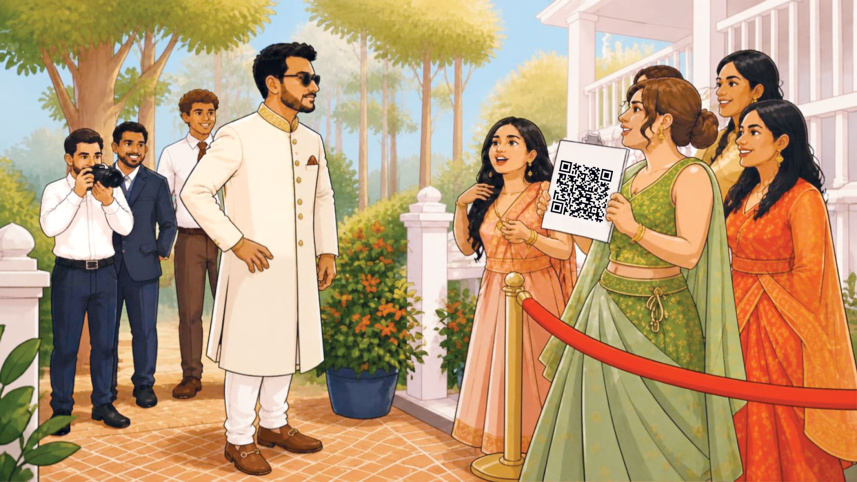
At a Bangladeshi wedding, you do not usually need to be told to bring a gift. You do that even if you are told the opposite.
For many guests, they prefer not to add yet another blender or a dinner set to the pile of gifts for the evening. Your thoughtfulness comes in an envelope with some cash which lets the couple decide for themselves what they will need in their brand-new life.

Now imagine arriving to the wedding without the envelope.
Not because you forgot the gift, but because you haven’t paid with cash in a while. Instead, you take out your phone.
There is a QR code at the reception. You scan it, enter the amount and send the newlyweds their gift digitally. On the plus side, there is no risk of the envelope going “missing” either.
This may sound unusual, but it has already happened elsewhere.
In 2017, at a wedding in Beijing, a bridesmaid reportedly wore an Alipay QR code around her neck at the reception table. It was meant for guests who had forgotten their traditional red envelopes and wanted to send their wedding gifts digitally. Some older members of the family reportedly objected, and the bride’s mother-in-law asked the bridesmaid to remove it.
A few years later, a couple in Vietnam took the idea further. At their 2022 wedding in Bac Ninh, the bride and groom placed a QR code at the venue so guests could transfer their monetary gifts instead of handing over envelopes. The story attracted attention online as an example of a wedding adapting to digital payments.
The tradition had not disappeared in either case. Only the way the money changed hands had.
Now imagine that becoming part of a Bangladeshi wedding.
Inside, the bride’s friends stop you for “gate dhora”. They demand money before letting you pass. You bargain. They insist.
But then you hit them with the classic: “We can’t pay that! We don’t have that much cash with us”
Out comes the QR code from the bride’s side. As you concede defeat, you realise that modern problems require modern solutions.
Later, you tip the waiter digitally. You pay the driver without looking for change. A vendor needs a final payment. Another QR code appears.
The wedding still looks and feels familiar. Only the cash is disappearing.
And the technology needed for this is no longer particularly exotic.
In Bangladesh, Bangla QR is designed to allow customers to make payments through participating banks and mobile financial services using a common QR system. For a wedding, where dozens of guests may need to make relatively small payments to different people, that interoperability could make digital transactions more practical.
“One of the biggest advantages of Bangla QR is its interoperability,” said Tareq Refat Ullah Khan, managing director and CEO of BRAC Bank PLC.
The same ecosystem involves both banks and mobile financial service providers such as bKash, as the country expands digital payment acceptance across merchants.
There is another potential advantage for wedding payments: a digital trail.
 For all latest news, follow The Daily Star's Google News channel.
 “Every digital transaction creates a verifiable financial record,” Rashid said.
For newlyweds, that could mean no pile of envelopes to open, sort and record after the guests have gone home. For small vendors, regular digital transactions can also create a financial footprint that may help them access formal financial services.
But a cashless wedding would not automatically mean a cashless society.
Cash remains deeply familiar, particularly to older relatives. Not every guest uses digital payments, and not every vendor may accept them. Internet connectivity, payment errors and security concerns also remain practical issues.
So the future may not be a wedding where cash disappears completely. It may simply become optional.
The uncle who prefers an envelope can still bring one. The friend who has not carried cash in years can scan a code.
The “gate dhora” can stay. The bargaining will be there. The celebrations will be unchanged.
Only the colourful banknotes will remain a thing of the past.
Comments