


Are we working our way to a cardiac health crisis?

Most people expect their workday to end at 6pm. Nabiha is often still at her desk past 7pm.
A journalist by profession, her official hours are 10am to 6pm. But her work frequently stretches well into the evening. Supervisors review assignments, ask the team to stay back, or schedule the next day’s tasks after office hours end. Staying late has become routine for Nabiha and so has taking work home, losing personal time, and going to bed mentally exhausted. Then one day, during a particularly stressful moment at work, she felt a sharp pain in her chest.

Her experience is far from unique. For many, the workday does not end when they leave the office. Work follows them home through their phones, occupies their evenings, and eats into time meant for sleep, meals, and recovery.
This raises a question: is the way we work unhealthy?
The concern goes beyond feeling tired after a long day. Extended working hours, prolonged sitting, irregular meals, and sustained stress combine to take a heavy toll on cardiovascular health.
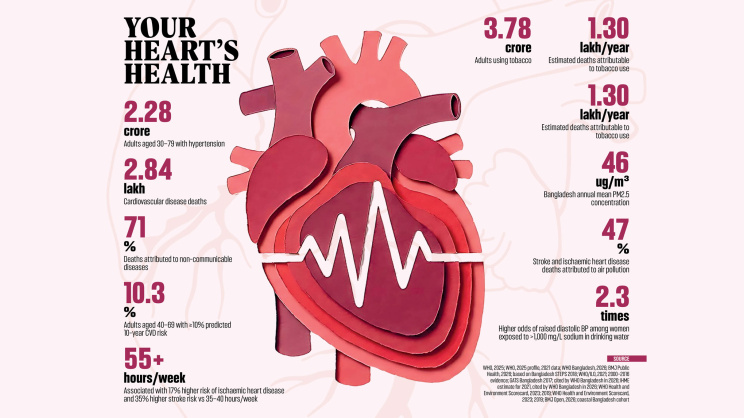
A joint analysis by the World Health Organization and the International Labour Organization found that people working 55 hours or more per week faced a 17% higher risk of ischaemic heart disease and a 35% higher risk of stroke compared to those working 35 to 40 hours. The study estimated that long working hours were associated with 745,000 deaths globally from stroke and ischaemic heart disease in 2016.
Yet hours alone do not tell the whole story.
Prof. Dr. Mohsin Ahmed, head of Cardiology and chief consultant at United Medical College Hospital, said that longer hours do not equate to better output.
“If you make a person work more and more, it does not mean their output will be better,” he said, explaining that excessive work degrades mental and physical health, ultimately reducing productivity.
The damage also builds gradually. When long hours and constant pressure become routine, maintaining regular sleep, eating, and exercise schedules becomes nearly impossible.
“When you do not have a fixed time to sleep, wake up, or eat, everything becomes disorganised,” Dr. Mohsin said, noting that prolonged occupational stress contributes to major cardiovascular risk factors like hypertension, diabetes, and high cholesterol.
The sedentary nature of office jobs adds another layer of risk. A study of office executives in Dhaka, published in the European Journal of Public Health, revealed that 56% were physically inactive, spending an average of 10.9 hours a day in sedentary activities, around two-thirds of which occurred during office hours.
For many employees, however, the working day is difficult to switch off from mentally.
A message from a supervisor, an unfinished task, or a request for the next morning keeps work present long after leaving the office. Being constantly available gradually becomes an unwritten job requirement.
Md Rafi Nizamee, Unit Head of Alliance & Partnership at a private commercial bank, sees this as part of a broader corporate problem.
“I think we need to learn where to draw the line in our professional rat race. Too often, our work culture rewards appearing busy and mindless hustling over working smart,” he said. “We need to collectively challenge these norms and redefine what healthy and sustainable success at work really means.”
Workplace pressure is rarely an explicit command. Staying late is viewed as commitment. Answering messages at night becomes a sign of professionalism. Taking a break feels uncomfortable when everyone else is still working.
When that pressure becomes routine, the consequences extend far beyond fatigue.
“Stress is directly related to hypertension, diabetes, cholesterol, heart attacks, and strokes,” Dr. Mohsin said.
According to him, addressing the issue requires more than telling employees to manage their own stress or exercise more; employers must fundamentally reconsider how teams function.
 For all latest news, follow The Daily Star's Google News channel.
 In his 25-staff department, Mohsin fosters a sense of ownership to transform how employees approach their responsibilities.
“If my junior feels he is part of the team, he is the influence of the team,” he said. “If I can build teamwork where responsibilities are shared, help them understand their role in our development, and appreciate them, the work gets done automatically.”
He also highlighted the importance of listening to employees, understanding their struggles, delegating responsibility, and offering motivation.
“Team building is most important,” he said. “If you build a strong team and a healthy atmosphere, listen to employees, delegate responsibility, and motivate them, you create a far more effective working environment.”
He pointed to psychological counselling as another essential resource for employees dealing with sustained stress, noting that such support remains limited in Bangladesh.
Ultimately, the goal is not simply to ask employees to cope better with an unhealthy culture. When long hours, constant pressure, and after-hours availability become the baseline, employers share the responsibility to change those expectations.
Work itself is not the problem. But when professional commitment requires sacrificing sleep, recovery and personal life, the way we structure work demands closer scrutiny.
Comments