


Islamic credit cards: what you need to know
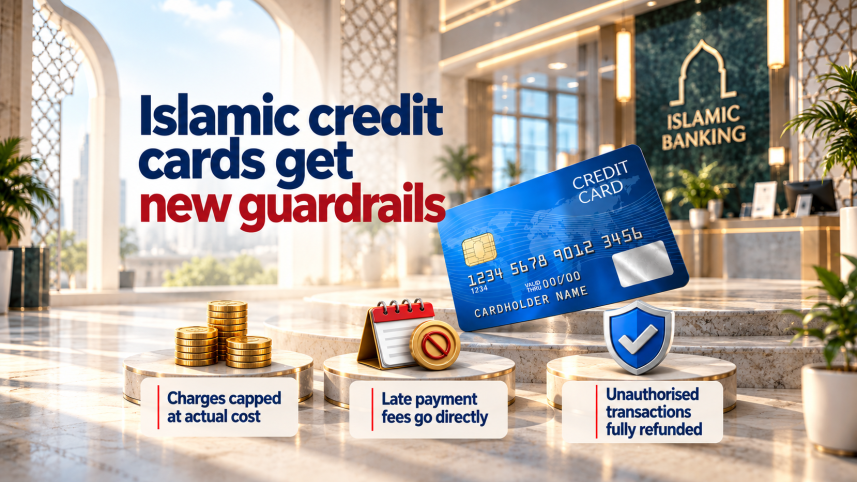
Bangladesh Bank (BB) issued its first full guidelines on Islamic credit cards on September 29, barring banks from earning more when customers' debts grow or when they pay late.
Who can issue the cards?

Any scheduled bank offering Islamic banking services may issue taka cards. Foreign-currency and dual-currency cards require Authorised Dealer status, meaning the bank must be licensed to deal in foreign exchange.
How does the card work?
Every credit purchase, cash advance or delayed payment is treated as "Qard Hasan", an interest-free loan. Banks can charge nothing for the money lent, only fixed fees, or "ujrah", for specific services. The cards cannot be funded from "Mudarabah" deposits, which customers place to earn a profit share.
What can banks charge?
Banks can charge lending-linked fees, such as issuance, renewal, account maintenance and cash advance fees, but these cannot exceed the "Actual Direct Cost" of the service. Banks "should not expect" any margin.
Any charge that changes with the outstanding balance, credit limit or length of delay is banned. Banks cannot pass the merchant discount, the commission shops pay on card sales, on to cardholders. Any excess must be refunded at year-end or given to charity.
If a card costs Tk 800 a year, the bank can charge at most Tk 800 as a fixed fee, not 2 percent of the credit limit. A cash advance fee must also be flat, not a percentage of the amount withdrawn.
What happens on late payment?
Cardholders must pledge upfront to donate a fixed sum to charity if they miss a due payment date. The bank cannot keep the sum, and it cannot increase with the length of the delay. If the amount is Tk 500, a customer paying two days late and one paying two months late must both donate Tk 500.
How are customers protected?
Applicants get a five-business-day cooling-off period. Banks must give 30 days' notice before changing any charges or terms.
Banks shall be liable for all transactions not authorised by credit cardholders after the bank has been served with notice that a card has been lost or stolen. Such unauthorised transactions shall be reimbursed within seven working days, according to the guideline.
Cash withdrawals are capped at 50 percent of the credit limit, and banks must set limits conservatively to prevent over-borrowing.
What spending is blocked?
Cards cannot be used for goods or services forbidden by Shariah. Banks must block such transactions at the point of sale using the Merchant Category Code, which identifies a shop's type of business. Blocked categories include alcohol, gambling, tobacco and crypto trading.
Banks must carry out annual Shariah audits and file a consolidated return with BB within two months of the financial year-end. Non-compliant income must go to charity. BB said it may amend the rules and issue further clarifications.
 For all latest news, follow The Daily Star's Google News channel.
Comments