


Syed Saymun Haque Nayim on reimagining denim fabric
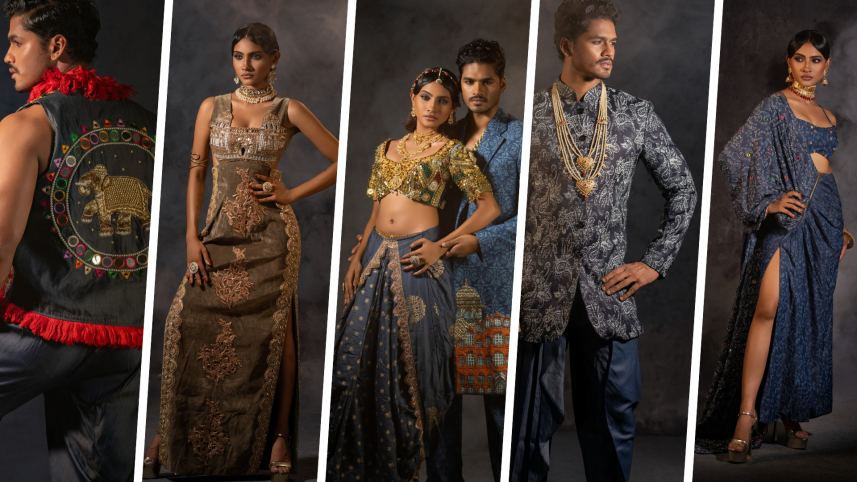
Denim is usually associated with structure and durability, and familiar garments such as jeans, jackets, and shirts. A saree, on the other hand, depends on movement. Its fabric must fold, fall and respond naturally to the body. Bringing the two together required Syed Saymun Haque Nayim to reconsider not only the silhouette, but also the type of fabric he used.
The fashion design student at BGMEA University of Fashion & Technology is currently exploring denim through The Royal Fade, a collection that combines contemporary silhouettes with visual references from Rajasthan. At the centre of the project is a denim saree made with Tencel denim, chosen for its lighter weight, comfort and ability to drape more fluidly than conventional denim.

“I wanted to take the various denim fabrics available and modernise them a bit,” Nayim shares. “We usually see standard items being made, like regular denim pants, denim shirts and other fits such as barrel, cargo and baggy.”
Rather than repeating those established forms, he wanted to discover whether denim could take on a more ceremonial and culturally layered identity.
“I wanted to bring this into a different silhouette to make it more interesting,” he explains, “something no one in Bangladesh has done with denim yet.”
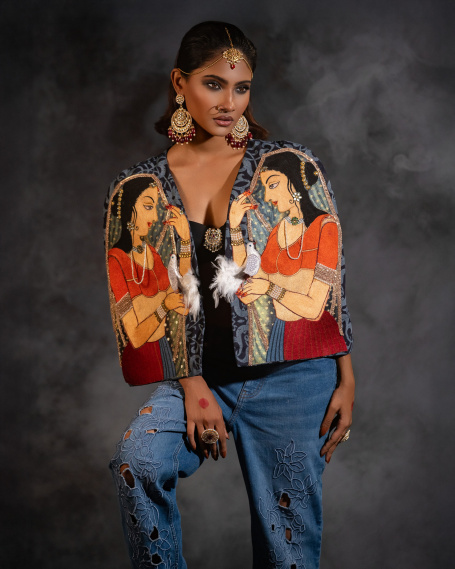
Taking denim into unfamiliar territory
The denim saree was not simply a traditional garment recreated in a heavier fabric. Nayim conducted both local and international trend research and then studied the market to identify a material that would support the saree’s movement.
“I had to do market research for the specific fabric and materials I needed for the saree,” he says. “I used Tencel denim, which is very suitable because it drapes well, can be worn as a saree, and is a lightweight, comfortable fabric.”
His process demonstrates the balance required between innovation and wearability. An experimental silhouette may look convincing on paper, but it only succeeds as clothing when the material responds properly to the body.
The saree became part of The Royal Fade, inspired by Rajasthan’s architecture, vibrant colours, traditional prints and elaborate embellishment traditions.
“I used heavy embellishments because I was inspired by the architecture of Rajasthan, their vibrant colours, and embellishment techniques like mirror work and Zardosi,” Nayim says. “My prints were also taken from Rajasthani prints.”
The collection brings together references such as Bandhani, Leheriya, ghagras, turbans and ornate surface decoration alongside contemporary denim forms. Denim introduces associations of youth, practicality and rebellion, while the Rajasthani elements bring grandeur, colour and craftsmanship.
“That was the purpose behind choosing denim, to give it a different look,” he says. “Instead of following the usual path everyone takes, I wanted to include my own unique touch and create a collection.”
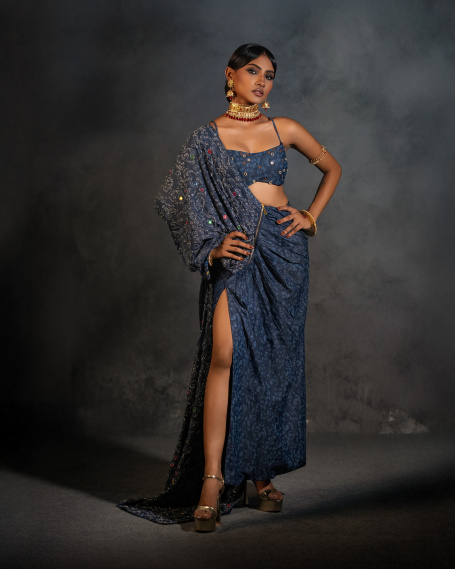
Where technology meets the hand
Nayim’s current practice also reflects the expanding role of technology in fashion design. He uses Adobe Illustrator to digitise inspiration, prepare silhouettes and experiment with motif placement.
He explains that a designer inspired by a tree might traditionally begin by sketching it with a pencil, developing the image into a motif and then applying it to a garment.
“But now is the generation of AI, so we are adapting to AI very well,” he clarifies. “I can take my inspiration and digitise it.”
He has also explored NewArc, an AI-supported fashion tool used to generate preliminary ideas through written prompts.
“We can get an idea by writing a prompt there,” Nayim explains. “Then there is patternmaking. What we used to do by hand, we can now do through computer-based methods. It is very accurate, and the measurements come out perfectly.”
Yet, he does not believe technology can replace every stage of fashion.
 For all latest news, follow The Daily Star's Google News channel.
 “There are some things that have been done traditionally from the beginning which technology cannot replace,” he explains, pointing to traditional handicrafts and embellishment techniques. “You cannot get the same finish with machinery.”
Draping, in particular, still requires direct engagement with fabric.
“Draping obviously has to be done by yourself,” he asserts. “In pattern software, draping does not come out as beautifully as it does manually.”
For Nayim, technology is therefore not a substitute for craftsmanship. It is a tool that can support speed, accuracy and visualisation, while handwork continues to provide texture, character and finish.
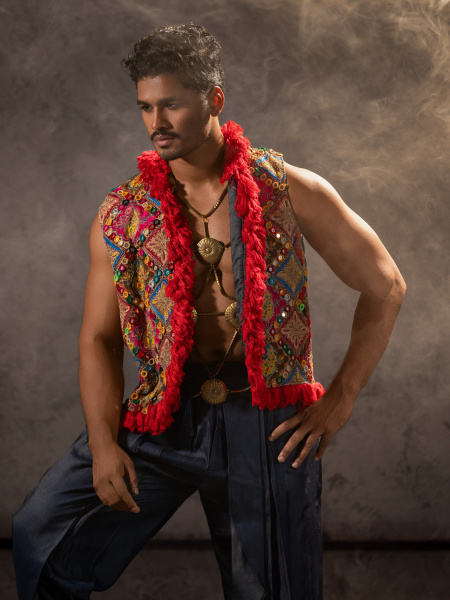
From childhood art to House of Inaya
Nayim’s interest in design began in class five, when he won first place in a district-level art competition organised by Lifebuoy in Madaripur.
“My father influenced me a lot,” he recalls. “He said that since I am good at art, I should study fashion designing or fine arts.”
His mother, sister and wider family also encouraged him. Acclaimed Bangladeshi designer Lipi Khandaker belongs to his family, and seeing her work on television helped him imagine fashion as a profession. Later, the work of Sabyasachi Mukherjee, Gaurav Gupta, and Manish Malhotra expanded his creative references.
Nayim now plans to develop his work under the brand name House of Inaya. At present, he mainly uses the platform to share his projects rather than operate commercially.
“I have not started working commercially in that way yet,” he remarks. “But hopefully, I will very soon.”
His denim saree offers an early indication of that future. It asks denim to move differently, carry cultural ornamentation and enter a silhouette rarely associated with it. Through The Royal Fade, Nayim is building a practice grounded in research, technical learning and a willingness to take familiar materials somewhere unexpected.
Jackets, sherwanis and relevant stories
Nayim’s exploration of Rajasthan extends beyond the denim saree into jackets, sherwanis and coordinated separates, with each garment translating a different aspect of the region’s visual heritage.
The embroidered jacket combines patchwork, Shisha mirror work, paisley and floral embroidery, while red fringes create movement and a contemporary edge. Its defining feature is the large elephant motif placed across the back.
“Historically, elephants were associated with Rajput kings and royal processions,” Nayim explains. “They were used during royal ceremonies, festivals and palace celebrations, making them one of Rajasthan’s strongest cultural symbols.”
He chose the back because it offered “the largest uninterrupted surface,” allowing the elephant to become the garment’s central statement.
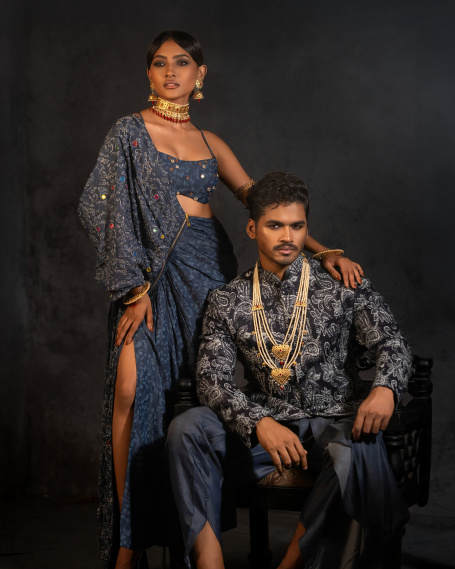
The sherwani takes inspiration from Ajrakh, known for its intricate geometric and floral patterns. Nayim recreated the surface through laser printing rather than traditional block printing, describing the result as a blend of “traditional craftsmanship with modern technology.” Embroidery inspired by Hawa Mahal and Amber Fort appears near the lower front, while the deep blue palette references Jodhpur, the Blue City. Layered gold jewellery further strengthens the royal character of the look.
The dhoti skirt and blouse ensemble offers a softer, more fluid interpretation. The skirt draws from traditional Indian draping and Rajasthani block-print traditions, while the blouse uses oxidised metal ornamentation, beads, sequins and stones to evoke the elaborate jewellery worn by Rajasthani women.
“I wanted the blouse itself to appear like a piece of jewellery,” Nayim says.
Together, the pieces show how one cultural source can take multiple forms. The jacket carries symbolism, the sherwani becomes a canvas for architecture, and the skirt and blouse reinterpret textile and jewellery traditions through contemporary silhouettes.
Styling & fashion direction: Sonia Yeasmin Isha
Model: Shakira Israat Riyaa and Zahid Emon
Wardrobe: House of Inaya
Makeover: Sumon Rahat
Hair: Sheuly
Studio: Studio Crane Dhaka
Light Gaffer: Selim Ahmed and Md Shakil
Comments