


From Dhaka to Paris: Samia Rashid Hai's journey in colours
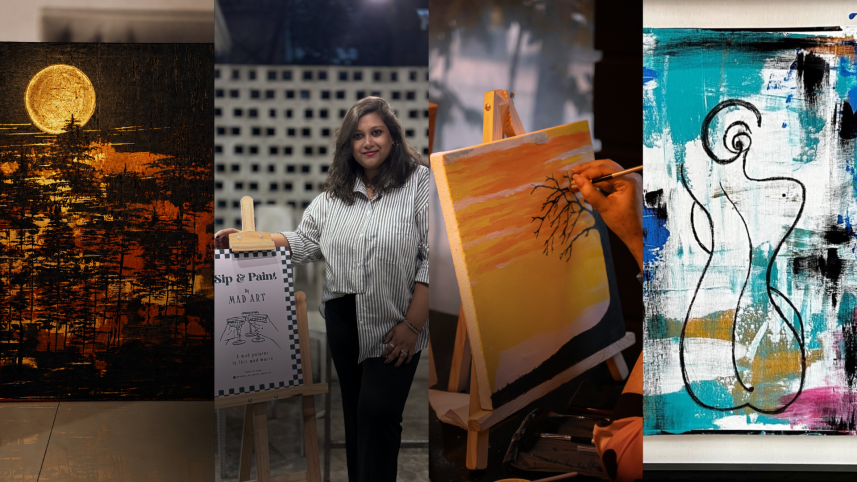
Samia Rashid Hai begins the conversation with an admission rarely associated with artists whose work has crossed continents. “I’m a bit nervous,” she says.
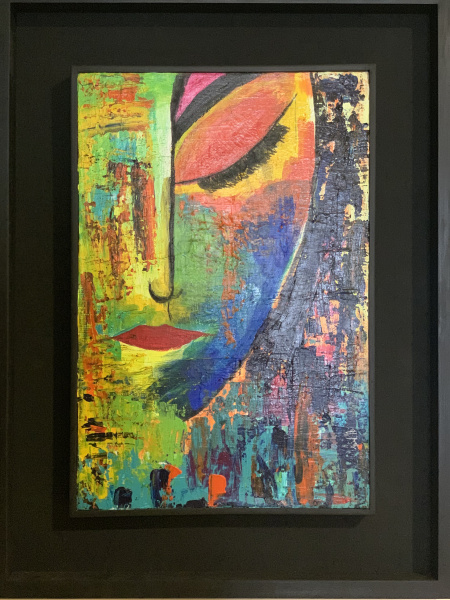
The nervousness feels almost unexpected beside the confidence of her paintings. On canvas, Hai’s language is unapologetically bold. Red presses against black, vivid colours collide, and textured surfaces seem to hold several emotions at once. Yet, this contrast between vulnerability and visual force lies at the centre of her practice.

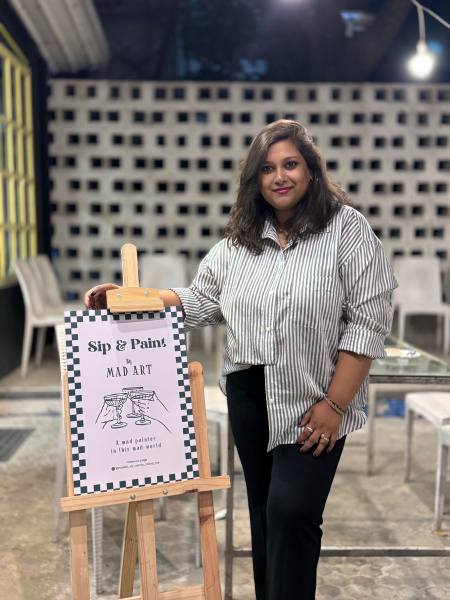
For Samia Rashid Hai, Painting is not simply an act of making images. It is a way of processing grief, anxiety, memory and the emotional noise of everyday life. Working under the name Madart by Samia Rashid Hai, she has built an international presence largely through social media.
A painting beneath the Louvre
One of Hai’s proudest moments came when two of her paintings were exhibited at Le Carrousel du Louvre, the prominent underground exhibition and commercial complex adjoining the famous Parisian Museum, through Artio Gallery in October 2022.
For Hai, however, the emotional significance of the moment extends beyond boundaries — a painting created in Dhaka, during one of the most difficult periods of her life, had entered an international exhibition space in Paris.
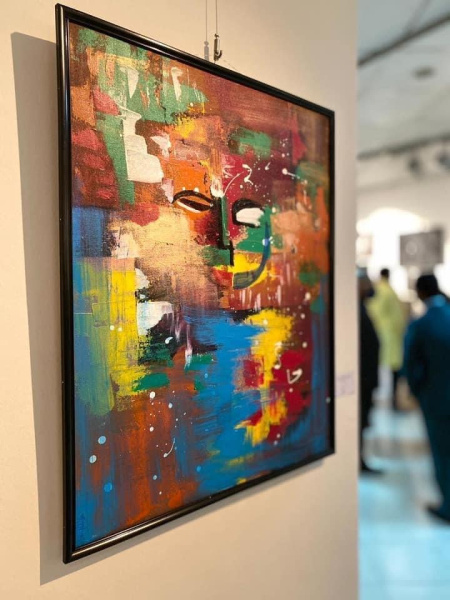
Hai painted the work after the death of her mother-in-law, while recovering from COVID-19 and major skull surgery. The physical and emotional exhaustion of that period entered the canvas.
“Whatever I’m feeling, I put it on the canvas,” she shares. “My paintings are basically my love letters to the world.”
This explains the visual intensity of her work. Her contrasts are not decorative choices added for effect. They reflect the emotional conditions in which each painting was made. Some feelings appear as dense layers; others emerge through forceful marks or sudden areas of colour. Viewers may not always recognise a fixed story, but Hai does not consider that a failure.
“That’s what abstract art is all about,” she elaborates. “You portray whatever you see and whatever you feel.”
Remembering 1971
Another significant milestone came through Art Anthology III: Madrid Edition, published in October 2021 by Vision Libros and Guto Ajayu Culture. The international volume presents 147 artists from 63 countries and is listed in the National Library of Spain.
Hai was represented by her painting Ekattor, a work responding to the violence of Bangladesh’s 1971 Liberation War. Through blood-like splatters and suggestions of bodies being dragged away, the painting approaches history through emotional fragments rather than a literal reconstruction.
“Even when I’m gone, I’ll have something in Madrid that will be there forever,” she reflects.
The statement reveals something essential about her understanding of art. A painting may begin as an intensely private response, but once exhibited or published, it becomes part of a wider cultural record.
Ekattor carries Hai’s personal interpretation of history beyond Bangladesh, introducing an international readership to a national wound through abstraction.
Freedom through materials
Samia Rashid Hai works primarily with acrylic and oil paint, using brushes for finer details and palette knives when she wants greater physical and expressive freedom.
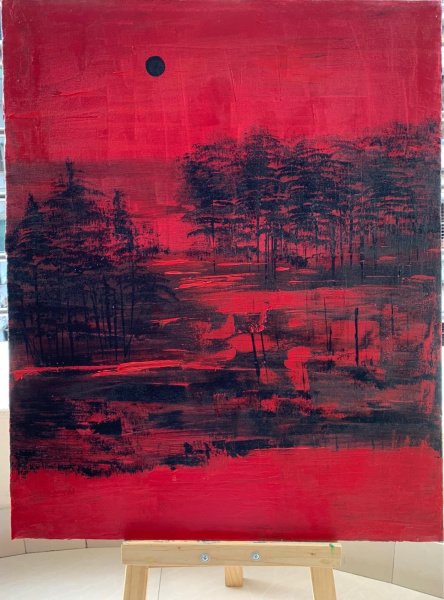
Her painting Bulbbul, inspired by the Hindi-language film of the same name, marked an early turning point. The film’s final sequence, dominated by fire, red and black, stayed with her. She translated that atmosphere into a painting created almost entirely with acrylic paint and palette knives. Bulbbul and another of her works were selected for her first group exhibition at Bangladesh Shilpakala Academy.
 For all latest news, follow The Daily Star's Google News channel.
 The palette knife allows her to push, scrape and layer paint without the restraint of careful brushwork. It suits an artist interested in sensation before explanation. Even when her works begin with a recognisable source, they rarely remain straightforward representations.
Making the canvas a listener
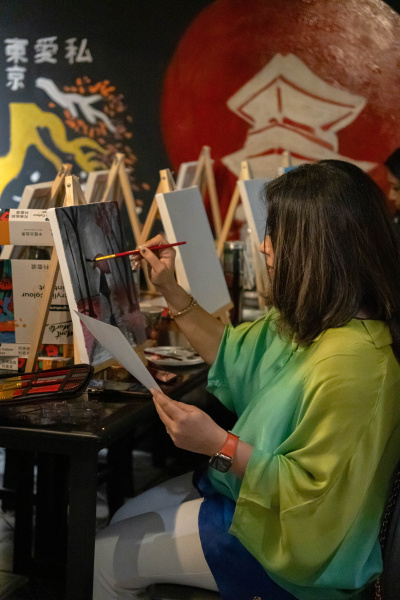
During the COVID-19 pandemic, painting became Hai’s refuge from severe anxiety and panic attacks. From that experience emerged Sip and Paint, her participatory art initiative in Dhaka.
After nearly a year of research, she organised her first private session for the birthday of friend Umaila Akhter. Further events followed at Amisheé, 138 East, Dhaka Flow, Gojo Ramen, and Tokyo Express, as well as sessions for Foodpanda and Glenrich International School.
Participants arrive alone, with friends, spouses, or parents. Some use the sessions as dates. Others paint quietly for several hours. Eventually, Hai says, even a busy restaurant can fall into near silence.
“Make the canvas your therapist,” she tells participants, using the phrase metaphorically to describe painting as an emotional outlet rather than professional mental-health treatment.
For Hai, their expressions at the end matter as much as the finished paintings. Her next Sip and Paint event is scheduled for 21 August at Fika in Banani, offering another opportunity for participants to step away from everyday noise and spend a few hours with colour and canvas.
Together, these experiences show how painting can move between deeply personal expression and public engagement. Hai’s work may begin with her own memories and emotions, but through exhibitions, publications and Sip and Paint sessions, it opens a space where others can encounter art in equally personal ways.
Photo: Courtesy
Comments