


Why do modern films look artificial?
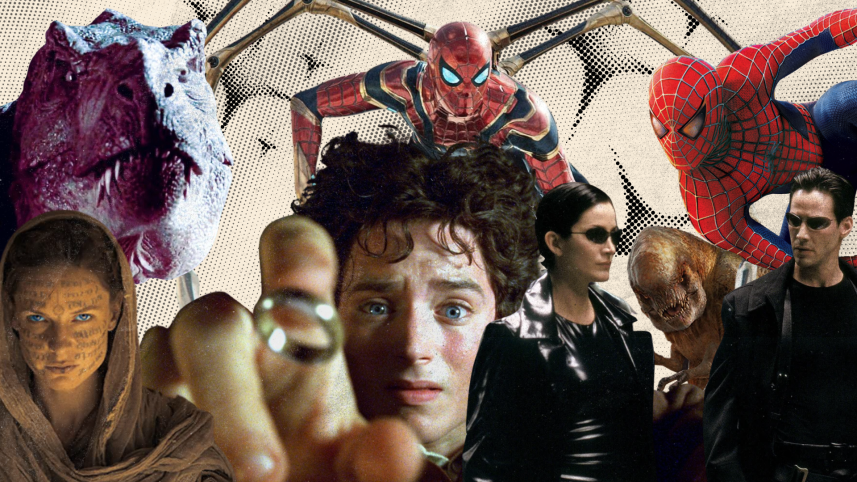
My last term break was mostly spent rotting in bed and streaming film after film on Netflix with little to no breaks in between. Surely my overstimulated brain couldn't maintain focus for long, and often I stared blankly at the screen with little attention to the plot. And then, it hit me: all these productions look very similar to each other. They all have the same sharp, sterile, and quite unnatural look with more or less varied plots. To me, movies weren't always like this before. They had their own individual character.
If you are not yet sure what I am talking about, just compare the visuals of the first Spider-Man film, Spider-Man (2002), with Spider-Man: No Way Home (2021). It is the same character, but notice how the first movie spellbinds us and gives us goosebumps like it's happening in our reality. Do you really feel that watching the 2021 iteration? One factor could be the nostalgia behind the films, but I cannot seem to brush it off simply as that. The latest releases did not hit the same spot as the initial Spider-Man films.


But why didn’t it hit the spot?
In the last few decades, the technologies used in filmmaking have advanced at an exponential rate, but this has somehow made new releases look inferior. We may talk about how Wicked (2024) comes across as duller than the studio film of 1939, The Wizard of Oz. It is also the case in The Hobbit trilogy; everything is so clean, crisp, and cartoony, whereas the original movie, The Lord of the Rings trilogy, makes us forget that it's a fictional world. To this day, The Lost World: Jurassic Park (1997) makes our bones go cold with a realistic portrayal of what dinosaurs would look like in our world. Now, the latest release of this franchise, Jurassic World Rebirth (2025), seems like a video game. Undoubtedly, these recent movies are more visually stunning than ever. Unfortunately, they lack what makes people connect with them.
One of the missing elements in digital films is texture, which is a quality that signal realism. That’s why movies shot on film cameras look so sensory and authentic, something that digital cameras are not able to capture all the time. Ever since the invention of the digital camera, camera companies have tried their best to eliminate texture to achieve the pristine outcome. It seems like digital cameras have overreached in hyperrealism. But the issue doesn’t come down to digital cameras failing to capture reality. Cameras are merely the devices that are used to shoot movies with; most of the aesthetics are determined by intentional technical choices. We notice this in Dune (2021). Though it is a sci-fi film shot on digital, it appears tactile and realistic due to its thoughtful lighting and composition.
The former, in particular, is a key element that helps the audience distinguish between reality and artificiality. Because human vision is accustomed to seeing a balance of light and shadow, forced contrast can make an image appear artificial. Respecting the natural pattern of light and shade, we get amazing movies like Batman (2022), The Conjuring (2013), The Social Network (2010), Marriage Story (2019), Prisoners (2013), Sinners (2025) and more. All of them were filmed using digital cameras, and none of them fails to deliver the rawness of the plot. Alternatively, The Matrix (1999), while shot on a film camera, perfectly mimics the crisp, edgy look of digital cameras with its colour grading and lighting. This again tells us that it’s all about the intentionality behind the technicalities that defines the final look.
As such, the film industry’s growing inclination to use grey, neutral, flat lighting has meant that we have lost something vital: the personality behind the films, rendering them artificial. But for cinema to really make an impact for an overstimulated generation, we need that authenticity back. We need more films that can pull us in, slow us down, make us feel, and keep us awake at night with thoughts we can't shake away.
Ramisha Arzumand is a daydreaming procrastinator. Remind her to get back to work at ramishaarzumand@gmail.com.
 For all latest news, follow The Daily Star's Google News channel.
Comments