


Housing a changing Bangladesh
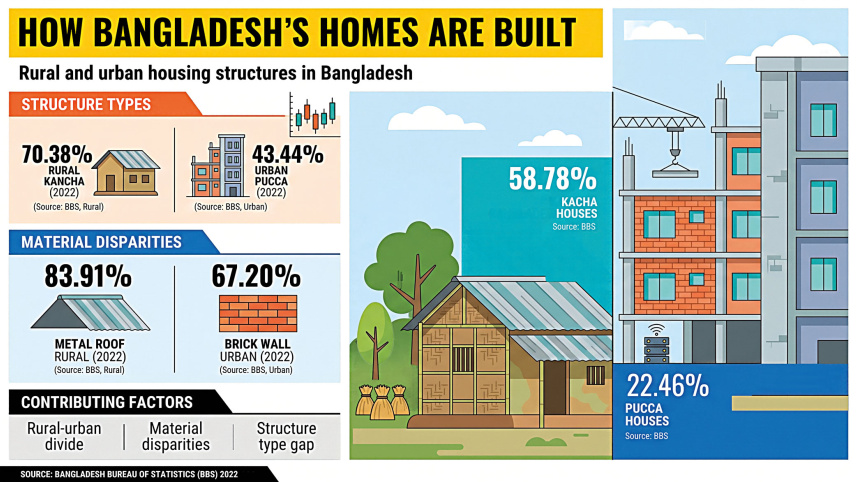
After food and water, a person needs a safe shelter to survive. Ancient humans called caves and hollowed-out trees their home, then came huts and houses made of brick and stone. Today, massive structures of concrete and reinforced steel provide much of humanity with a place to call home. Fittingly, October 5 this year marks both World Habitat Day and World Architecture Day, observed by the International Union of Architects under the theme “Housing is a Human Right. Build It.” The two occasions share a common concern: how we design and build places that can safely and adequately house the people who live in them.
The United Nations General Assembly observes the first Monday of October as World Habitat Day. The first time this day was celebrated was in 1986, in Nairobi, Kenya. That year, the central theme was “Shelter is My Right”. Forty years later, this year’s theme is “Adequate Housing for All”, with the global observance taking place in Muscat, Oman.

The challenge of urbanisation
Urbanisation is one of the defining demographic shifts of our time. Bangladesh is still a predominantly rural country, but that scenario is changing steadily. In the last decade, from 2015 to 2025, the share of the population living in rural areas dropped from around 70.5 percent to 66.7 percent, according to World Bank data based on the United Nations Population Division’s World Urbanisation Prospects.
The long-term direction points towards an increasingly urban Bangladesh. UN projections put the urban share of the population at 59.3 percent by 2050. Recent changes in the economy may have slowed that movement somewhat. Bangladesh Bureau of Statistics data for 2023 showed rural-to-urban migration falling compared with the previous year, while movement from cities back to villages increased. Whether that is a temporary response to the high cost of urban living or a longer-term shift remains to be seen. The broader challenge, however, remains the same: millions more people will need adequate places to live in the decades ahead.
Providing those homes is no easy task. Unplanned urban sprawl is already a major problem in Bangladesh, compounded by high population density, limited land, a tropical monsoon climate and floodplain geomorphology. As cities become denser and expand outwards and upwards, simply building more floors and more apartments cannot be the only answer.
More than four walls
Adequate housing is more than just having a roof over one’s head. A home needs to be safe, affordable and liveable. It needs access to water, sanitation, electricity, transport, schools, workplaces and other basic services. A house that a family cannot afford to maintain, or one that leaves its occupants exposed to heat, flooding, fire or structural hazards, cannot truly fulfil that purpose.
This makes planning as important as construction. New neighbourhoods need roads, drainage, open spaces and services alongside housing. Existing buildings need maintenance, and additions or alterations need to respect the limits of the original structure. As our cities grow vertically, structural safety, fire protection and responsible use of materials become increasingly important. Many of the decisions that determine how safe a building will be need to be made from the earliest stages of planning. Condition of the ground dictates the structural design of the building. Quality of steel, concrete, bricks, blocks and electrical systems used determine how safe it is.
Bangladesh also has to build for its environment. Heavy rainfall, flooding, extreme heat, cyclones and the risk of earthquakes place very different demands on buildings. This is where modern engineering can work alongside lessons already present in local architecture: shade, ventilation, courtyards, raised structures, suitable materials and designs that respond to sun, rain and airflow rather than fighting them at every turn.
Building sustainably
Housing millions more people will also require an enormous amount of material and energy. Cement, steel, bricks, ceramics and glass all carry environmental costs before they reach a construction site. Sustainable housing therefore cannot be separated from the way these materials are manufactured.
More efficient production, recycling industrial water, recovering waste heat, reusing by-products and reducing material waste can make the construction supply chain less resource-intensive. At the building level, passive cooling, natural ventilation, rainwater management, durable materials and energy-efficient systems can reduce the resources a home consumes throughout its life.
None of these ideas alone can solve the housing challenge. There is no single material, technology or architectural style that can provide adequate housing for everyone. Bangladesh will need high-rise apartments and rural homes, affordable developments and private projects, new construction and the careful improvement of buildings that already exist.
We can always build more homes. But building better homes and to make those homes accessible to the people who need them is the main challenge. A safe shelter may be one of humanity’s oldest needs, but providing one for everyone remains one of the defining challenges of the modern city.
 For all latest news, follow The Daily Star's Google News channel.
Comments