


Rooftop solar is turning property owners into power sellers
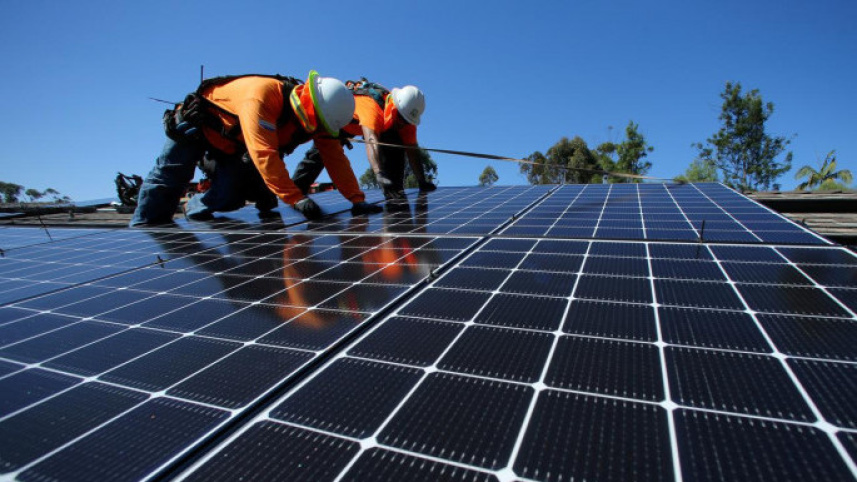
For the owner of a house, an apartment block, a factory floor or a shopping complex, the roof overhead has quietly turned into a revenue-generating asset. Under a gazette notification issued by the Ministry of Power, Energy and Mineral Resources on 1 September, 2026, any property owner who installs a net-metered rooftop solar system and exports surplus power to the grid now qualifies for a guaranteed purchase tariff of Tk10.50 per unit, a rate that beats what the same owner would otherwise pay for grid electricity.
For some property owners, installing solar is no longer optional. A Power Division circular from December 2025 made net-metered rooftop solar mandatory, for a minimum 20-year operational life, on new connections for any building with at least 1,000 square feet of usable roof space. Three-phase industrial or commercial consumers applying for loads of 10kW or more must additionally install solar capacity equal to at least 20% of that load. For smaller residential connections and buildings below that threshold, the scheme remains voluntary but, given the tariff on offer, increasingly attractive.

A guaranteed Tk10.50 per-unit tariff, mandatory solar rules for larger buildings and a simplified net-metering process mean owners of homes, apartment blocks, factories and commercial premises now have a direct financial stake in their own rooftops
The tariff itself is built to reward owners. Officials benchmarked the maximum production cost of rooftop solar paired with battery storage at Tk8.00 per unit, based on recent market tenders, then added a 20% profit margin and an 11.25% premium to arrive at the Tk10.50 purchase rate. That guaranteed feed-in price surpasses the current average retail grid electricity rate of Tk10.40 per unit set by the Bangladesh Energy Regulatory Commission. Owners who bring their own installation costs in below the Tk8.00 benchmark keep the difference as an additional dividend on top of the tariff.
The window to lock in that rate has a deadline attached. Property owners who install net-metered systems by 28 February, 2027, qualify for the guaranteed Tk10.50 rate for three consecutive years, running until 28 February, 2030. Systems installed after that cut-off will not be eligible for the special tariff. Payment is designed to reach owners directly and without friction: distribution utilities maintain grid export records and, at the end of each quarterly settlement period, credit 90% of net exported electricity to the consumer's bank account, mobile financial services (MFS) account or by cheque, retaining the remaining 10% as a distribution maintenance charge. Cash payments are strictly prohibited. All equipment installed must meet technical standards set by SREDA and the Bangladesh Standards and Testing Institution.
This tariff sits inside a wider regulatory overhaul that has removed several barriers that previously kept ordinary property owners out of the market. The Net Metering Guideline – 2025, issued by SREDA and the Power Division to replace the 2018 rules, raised the net-metered capacity ceiling from 70% to 100% of a consumer's sanctioned electrical load and, for the first time, opened eligibility to single-phase connections, the type used by most individual households, alongside every consumer category from residential to extra-high-voltage industrial. Applications are now filed through a single national portal, nem.powerdivision.gov.bd, with SMS and email tracking, and prepayment and smart meters are explicitly supported under a dedicated annex.
Owners also have a choice in how they fund a system. The guideline formalises two routes: a CAPEX model, where the property owner pays for the system outright and keeps the full tariff income, and an OPEX model, where a third-party investor installs and owns the system under a tripartite agreement with the owner and the utility, selling the power to the owner below the standard retail tariff, a route that lets owners go solar with little or no upfront capital.
The numbers behind that choice look favourable. A case study published in the International Journal of Computer Applications in 2026 evaluated a 3.09 MW rooftop solar system installed at Daffodil International University (DIU) in Ashulia, Savar, a large institutional property comparable in scale to a commercial complex. Consisting of 4,290 Trina Solar 720W modules, the system is projected to generate 3.615 GWh of clean electricity annually. Over its lifespan, the study found a levelised cost of electricity (LCOE) of $0.0186 per kWh, equivalent to approximately Tk2.29 per unit at current exchange rates, and a return on investment of 277.17%, underlining the case for institutional and commercial property owners in particular.
The incentives are arriving as Bangladesh's energy import bill turns increasingly volatile, giving property owners' decisions added weight at a national level. The power sector remains heavily reliant on natural gas, which fuels approximately 50% of national electricity generation, and recent conflict involving the United States, Israel and Iran has disrupted maritime shipping through the Strait of Hormuz. State energy giant QatarEnergy has repeatedly extended a force majeure notice on long-term LNG deliveries to Bangladesh, pushing state buyer Petrobangla onto the volatile spot market, where prices have climbed to nearly $30 per million British thermal units (MMBtu), almost triple pre-war levels. In September 2026, the Cabinet Committee on Government Purchase approved spot cargoes from Vitol Asia at $29.795 per MMBtu and TotalEnergies at $28.95 per MMBtu. At roughly Tk123 to the dollar, a single standard cargo now costs around Tk1,200 crore. Speaking in Parliament during the third session of the 13th Parliament in September 2026, Prime Minister Tarique Rahman reiterated that Bangladesh targets generating at least 20% of its electricity from renewable sources by 2030 and 30% by 2040, a target that depends heavily on rooftops in private hands.
Net-metered rooftop solar still accounts for only a fraction of the national grid, though it is growing quickly: SREDA's own tracked figures put installed capacity at roughly 300–420 MWp over the course of 2026, according to independent reviews of the regulator's data, with deployment concentrated among commercial and industrial property owners. Bangladesh's garment sector alone offers further headroom. A Centre for Policy Dialogue study this year put the readymade garment industry's rooftop solar potential at up to 1,768 MWp.
One practical consideration for owners weighing a system: solar output peaks at midday, while Bangladesh's grid experiences its heaviest demand in the evening, with generation hitting a record peak of 17.2 GW at 9pm on 20 May, 2026. Energy experts emphasise that rooftop solar works best paired with battery storage, the same combination the government's Tk8.00 cost benchmark assumes, or with Virtual Power Plant (VPP) aggregation schemes such as SOLshare's Rickshaw VPP initiative, which aims to use Bangladesh's more than five million electric three-wheelers as mobile battery storage. For property owners, the message is straightforward: with a guaranteed tariff, an expanded 100% load limit and mandates now reaching buildings of ordinary size, the rooftop has become an asset worth putting to work.
 For all latest news, follow The Daily Star's Google News channel.
Comments