


Making work feel at home
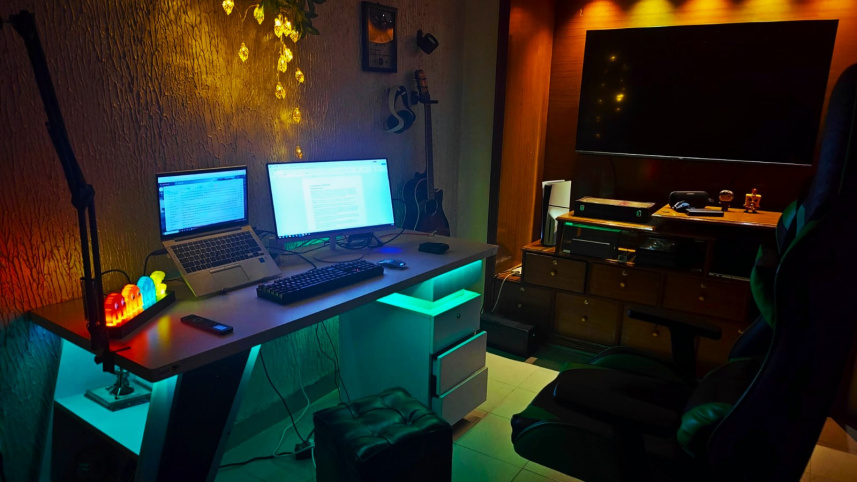
For many people, the workday now begins at home, often at a desk squeezed into a bedroom, a living-room corner or whatever space is available. As remote work and flexible schedules become part of everyday life, the challenge is not simply finding a place to work, but creating one that feels functional without making the rest of the home feel like an office.
This becomes particularly important in compact urban homes, where every square foot already has a purpose. Yet a productive workspace does not require a separate room or an elaborate makeover. With thoughtful choices in furniture, lighting, storage and personal touches, even the smallest corner can become a place that works for you.

For those accustomed to an office environment, working from home can also change the rhythm of the day. Colleagues are no longer nearby, conversations do not happen spontaneously, and tea breaks no longer arrive with a casual invitation from across the room. For Tashfia Noor, Talent Acquisition and Operations Team Lead at College Mastermind USA, that contrast is sharper because much of her work follows US hours. Late at night in Bangladesh, her pet cat is often her only company, while soft piano, mellow tunes or jazz play in the background.
Her routine is a reminder that a home workstation should suit not only the space available, but also the way a person actually works.
Start by considering the kind of work the space needs to support. A simple laptop setup may fit neatly on a smaller desk, while paperwork or multiple screens will naturally require more room. Md Anamul Haque, founder and chief interior designer of Interior-Concepts & Design Limited and a director of the Interior Designers Association of Bangladesh, recommends planning the workstation around the nature of the work. In a small flat, customised furniture can also make better use of an awkward corner, particularly when storage, sockets and charging points must fit into limited space.
The chair deserves as much thought as the desk. Choose one that remains comfortable during long working hours and is suited to the desk height. The screen, keyboard and mouse should have their own designated positions instead of being rearranged every day. For laptop users, even a stand and an external keyboard can make a modest desk more adaptable.
Then come the less glamorous details that quietly determine whether a desk feels calm or chaotic. Chargers, earphones and cables have a habit of spreading. Cable clips, sleeves, trays and small organisers can keep them contained. File holders can keep papers upright, while a floating shelf makes use of wall space when floor space is scarce. Hooks or carefully placed double-sided tape can help secure lightweight accessories.
The aim is not a showroom-perfect desk. In fact, trying to fill every centimetre with décor can make a small workstation feel even smaller. Leaving part of the surface empty creates visual breathing room and can make the objects you do keep there feel more intentional.
Once the practical structure is settled, the corner can acquire personality. Lighting is one of the simplest ways to transform its mood. Instead of asking one ceiling light to do everything, think in layers: general light for the room, a focused task light for the desk and softer ambient light for warmth. Haque also emphasises balancing these sources while considering available daylight and screen placement.
Colour can be introduced more subtly. Warm off-whites, muted greens, dusty blues and earthy neutrals can form a restrained background, with stronger colours appearing through smaller details. If repainting is part of the plan, water-based or lower-VOC options may be considered where suitable, while remembering that an “eco-friendly” label alone should not be treated as a guarantee of every possible benefit.
Afifa Shahid, a junior executive at a freelancing company, allowed her study table to evolve naturally into a workstation while balancing employment with her studies. “I did not want to overdo the setup. I kept the things I genuinely need within easy reach,” she says.
Her laptop, work diary and earbuds remain the essentials, while colourful stationery and yellow accents bring personality to the space. Yellow, she says, feels “fresh, bright and uplifting”, while warm yellow lights give the corner the cosy atmosphere she prefers.
It is an easy approach to adopt without copying someone else’s aesthetic. Pick a small visual language and repeat it. Perhaps it is one colour, a wood texture, a ceramic pen holder, attractive stationery or a favourite print. A desk calendar, to-do pad, hourglass or tactile object can lend character. One or two real plants can introduce a living texture without turning the desk into a miniature garden.
Greenery need not remain on the desk either. Tashfia has created a small balcony garden and steps outside for a few minutes when she wants to leave the screen behind. In a dense urban neighbourhood, even a narrow balcony or a chair beside a pleasant window can offer that valuable change of scene.
And this is where the familiar office tea break can be reinvented.
At the office, someone asks, “Tea?” and a few colleagues leave their desks together. At home, a break can easily turn into washing a cup, folding clothes or attending to another household chore. A tiny tea or coffee corner can make the pause feel deliberate again. A favourite mug, a small tray, a few preferred teas or coffees and perhaps a jar of nuts are enough. If there is a balcony or window nearby, take the cup there and leave the workstation behind for a few minutes.
A framed photograph, a small artwork, a textured mat or a subtle fragrance can add warmth and personality to the workspace. For those who enjoy scented candles or diffusers, these can become part of the atmosphere as well. Such touches are entirely optional; the idea is to choose objects that fit naturally into your routine rather than filling the desk simply for the sake of decoration.
Interestingly, both Afifa and Tashfia independently mentioned keeping a water bottle beside their desks. It is an ordinary detail, but perhaps that is precisely why it matters. The most useful elements of a workstation are often the ones that quietly become part of everyday life.
A home office does not have to imitate a corporate cubicle, a Pinterest board or an Instagram reel. Professional advice, ergonomic principles and design inspiration can offer direction, but the final arrangement still belongs to the person who returns to it every day.
In a small space, thoughtful editing can matter more than spending lavishly. Keep what serves the work, add what gives the corner warmth, and leave enough of yourself in it that sitting down feels natural. The best workstation is one that makes room for work without asking home to disappear.
 For all latest news, follow The Daily Star's Google News channel.
Comments